
A Study on Factors Influencing the Intention to Adopt New Media Platform Services Technology
© Author(s), 2026.
Licensed under CC-BY-NC-ND 4.0.
Abstract
This study examines the factors influencing public librarians’ adoption intention and adoption behavior toward New Media Platform Services. Using the UTAUT framework, the study analyzes the effects of performance expectancy, effort expectancy, social influence, and facilitating conditions, while also testing the mediating role of adoption intention and the moderating effects of age and New Media understanding. The findings show that performance expectancy, social influence, and facilitating conditions positively influence adoption intention, whereas effort expectancy has a negative effect on adoption behavior. The study suggests differentiated librarian training, institutional support, and future research on AI-assisted archiving, collaboration models, and user engagement.
Keywords:
New Media Platform Services, Adoption Behavior, Performance Expectancy, Effort Expectancy, Moderating Effects, Librarian Perception, Structural Equation Modeling (SEM)1. Introduction
The rapid advancement of digital technologies has profoundly reshaped the production, distribution, and preservation of information. New Media Platform Services, including social media, the metaverse, and extended reality (XR), have significantly transformed daily life and are redefining how cultural, historical, and social records are created and preserved. These platforms generate materials that serve as invaluable cultural assets and public resources, highlighting the urgent need for comprehensive strategies to ensure their effective collection, preservation, and accessibility.
In this study, New Media Platform Services are operationally defined as public-library services that collect, manage, preserve, and provide access to user-generated or platform-mediated digital materials produced through social media, video-sharing platforms, immersive media, and metaverse-based environments. Respondents were instructed to evaluate New Media Platform Services in relation to library work, including digital content collection, preservation, service provision, and user engagement, rather than in terms of general personal platform use. These platforms are defined by their adaptability to technological advancements, emphasis on user-generated content, and ability to support real-time, multidirectional communication. Social media platforms, such as Facebook, Instagram, and Twitter, provide spaces for social interaction, information exchange, and collaborative content creation. Video-sharing platforms like YouTube and TikTok enable users to distribute and engage with multimedia content while fostering active user participation. Furthermore, live-streaming and immersive platforms, such as Twitch, Zoom, and XR environments, integrate virtual and physical spaces, offering real-time interaction and heightened engagement.
Despite their growing significance, New Media materials face the risk of obsolescence due to their transient nature and dependence on rapidly evolving technologies. Factors such as shifting platform policies, service discontinuation, and technical limitations often result in the disappearance or inaccessibility of critical digital materials. These challenges are distinct and cannot be effectively addressed using traditional methodologies designed for static web-based or documentary content.
Platform-based New Media materials differ from conventional digital resources because they are dynamic, interactive, frequently modified, and dependent on commercial or external platform infrastructures. Their preservation requires decisions regarding capture timing, metadata description, copyright and privacy management, technical migration, and long-term accessibility. Therefore, public libraries need service models that integrate digital archiving, platform governance, rights management, and user-oriented access. This preservation-oriented context provides an important basis for examining librarians’ adoption of New Media Platform Services. Content generated on these platforms—such as social media posts, immersive digital artifacts, and interactive media—exhibits dynamic and complex properties that necessitate innovative and adaptable strategies. Traditional approaches often fail to address the legal, technical, and collaborative dimensions essential for managing these assets effectively.
Therefore, there is an urgent need for systematic research to develop robust legal frameworks, advanced technological tools, and collaborative models with relevant institutions to ensure the sustainability of New Media materials as vital public resources.
This study contributes to the literature by extending UTAUT to the public-library context, where librarians are not merely technology users but professional intermediaries responsible for selecting, preserving, curating, and providing access to platform-based digital materials. Unlike prior UTAUT studies that mainly examined general technology acceptance or service use, this study links technology adoption to the institutional responsibilities of public libraries, including digital preservation, copyright-sensitive collection, metadata management, and user-oriented service provision. By offering a clear definition and contextual examples of New Media Platform Services, it also contributes to a deeper understanding of their implications for public libraries, positioning these institutions as both repositories and facilitators of digital cultural heritage in the modern information landscape.
2. Theoretical Background
2.1 Previous Research
The transformation of library media and the reconfiguration of library spaces have been extensively studied. Research by Ko (1996) and Kim et al. (2003) highlights the shift from traditional print-based media to digital media, which has reshaped the spatial configuration and roles of libraries. These studies emphasize the importance of restructuring public library spaces in a user-centered manner to enhance information accessibility. Expanding the role of libraries requires them to function not only as information providers but also as cultural and social hubs for community engagement and youth settlement. By integrating digital media with physical spaces, libraries can serve as critical platforms for fostering social participation and interaction, particularly among younger generations.
Regarding the definition and characteristics of New Media, studies by Baek (2013), Kim (2017), and Lee (2020) suggest that New Media, unlike traditional media, are characterized by interactivity and immediacy. This has fundamentally changed how libraries mediate information and knowledge. Specifically, New Media—such as the internet, social networking services (SNS), and digital TV— necessitate the evolution of libraries from one-way information providers to interactive communication platforms that foster user engagement.
The adoption of new technologies remains a critical issue in the context of technological advancement, prompting the development of theories to explain how users perceive, adopt, and utilize technology (Lee, 2021). The Unified Theory of Acceptance and Use of Technology (UTAUT) is a widely used framework for analyzing technology adoption. Developed by Venkatesh et al. (2003) as an extension of the Technology Acceptance Model (TAM), UTAUT addresses TAM’s limitations, such as its inability to account for external variables and causal relationships. TAM, initially developed by Davis (1989) and grounded in the Reasoned Action Theory (RAT) by Fishbein and Ajzen (1975), aimed to explain individual media selection and usage behavior. However, TAM's narrow focus necessitated more integrative models (Lee, Y., 2021).
Venkatesh et al. (2003) addressed these shortcomings by incorporating concepts from eight theoretical frameworks, including RAT, the Theory of Planned Behavior, Innovation Diffusion Theory, and Social Cognitive Theory. This synthesis resulted in the UTAUT model, as further elaborated by Koo (2015) and Shim (2018). Drawing on key concepts from RAT—belief, attitude, and behavior—UTAUT describes a path where beliefs influence attitudes, which shape behavioral intentions and ultimately lead to technology acceptance (Yu, J. H., et al., 2010).
Taken together, previous studies suggest that technology adoption in libraries is shaped not only by perceived usefulness and ease of use but also by organizational support, peer influence, and professional understanding of emerging media. Accordingly, this study formulates hypotheses linking performance expectancy, effort expectancy, social influence, and facilitating conditions to adoption intention and adoption behavior, while also examining whether age and New Media understanding moderate these relationships. They form the foundation for exploring how libraries can adapt to integrate New Media platform services and function as cultural and social hubs.
However, existing research has primarily focused on library space design, infrastructure improvements, user satisfaction, and the broader social and cultural roles of libraries. Relatively little attention has been paid to the collection and service of materials generated by New Media Platform Services. This gap underscores the urgent need for research on effective methods for collecting, preserving, and providing services tailored to the unique characteristics of materials generated by New Media Platform Services.
This study seeks to address this gap by exploring the factors that influence librarians, as service providers, in the collection, preservation, and use of materials generated on New Media Platform Services. Additionally, it aims to propose practical directions for the collection, preservation, and utilization of New Media platform materials in libraries.
Based on these research gaps, this study connects previous discussions on digital technologies, New Media services, and technology adoption to the development of the research hypotheses. Prior studies on UTAUT suggest that performance expectancy, effort expectancy, social influence, and facilitating conditions are key determinants of technology adoption intention and behavior. In the context of public libraries, these factors are particularly relevant because librarians’ adoption of New Media Platform Services is closely related to digital content management, preservation work, user-service innovation, and institutional support. Therefore, this study applies the UTAUT framework to examine how these factors influence librarians’ adoption intention and adoption behavior toward New Media Platform Services.
2.2 Unified Theory of Acceptance and Use of Technology (UTAUT)
The Unified Theory of Acceptance and Use of Technology (UTAUT) builds upon the Technology Acceptance Model (TAM), which was initially proposed by Davis (1989) and grounded in the Theory of Reasoned Action (TRA). TAM has been widely acknowledged for explaining user acceptance of technologies and services (Choo, R., Ryu, M., 2023). However, the initial Technology Acceptance Model (TAM), despite its contributions, was criticized for limited consideration of external variables beyond perceived usefulness and ease of use, as well as its low causal validity between these variables (Kwon, O., 2010; Jeon, S., et al., 2011).
To address these limitations, Venkatesh et al. (2003) expanded TAM by integrating 33 core variables from various theories and models, including the Theory of Reasoned Action (TRA), Theory of Planned Behavior (TPB), Innovation Diffusion Theory (IDT), and Social Cognitive Theory (SCT), among others. This resulted in the Unified Theory of Acceptance and Use of Technology (UTAUT), which identified four key factors influencing technology acceptance: Performance Expectancy, Effort Expectancy, Social Influence, and Facilitating Conditions. Additionally, UTAUT introduced four moderating variables—Gender, Age, Experience, and Voluntariness of Use—to account for individual differences, enhancing its explanatory power compared to TAM (Lee, H., 2021; Zou, R., Ryu, M., 2023).
Although UTAUT2 later extended the original model by adding hedonic motivation, price value, and habit, this study retained the original UTAUT structure because the research context is an organizational and professional public-library environment rather than a consumer market. In this context, performance expectancy, effort expectancy, social influence, and facilitating conditions remain theoretically appropriate for explaining librarians’ professional adoption of New Media Platform Services. The model has been widely applied in fields such as education, healthcare, and library services, demonstrating its robustness in predicting user acceptance and use behaviors across various contexts (Ko, J., Eom, G., 2022; Feng, S., Ryu, M., 2023).
The influence of performance expectancy on technology adoption intention has been consistently validated in numerous studies. According to Venkatesh (2012), performance expectancy is a critical factor within the Unified Theory of Acceptance and Use of Technology (UTAUT) that significantly impacts behavioral intention. This indicates that the expectation of improved performance through technology use acts as a primary motivator for adoption intention, a finding supported across various contexts.
For instance, Al-Qeisi et al. (2014) demonstrated that performance expectancy positively influences the relationship between website design quality perception and internet banking usage, highlighting how users’ expectations of a technology's performance enhance their likelihood of adoption. Similarly, Son et al. (2014) found performance expectancy to significantly affect the usage intention of wearable devices. Zuiderwijk et al. (2015) further confirmed the positive impact of performance expectancy on usage intention in the adoption of open data technologies, using a modified UTAUT model.
Jeon and Choi (2017) identified performance expectancy as a key explanatory variable in the adoption of mobile delivery app services. Similarly, Diño and Guzman (2015) emphasized the importance of performance expectancy in driving the adoption of smart telemedicine services among elderly individuals in the Philippines, while Jeon and Choi (2017) identified it as a key explanatory variable in the adoption of mobile delivery app services. Similarly, Diño and Guzman (2015) emphasized the importance of performance expectancy in driving the adoption of smart telemedicine services among elderly individuals in the Philippines. Hoque and Sorwar (2017) corroborated this finding, showing that performance expectancy significantly influences mHealth adoption intentions.
More recent studies have reinforced these conclusions. Wang et al. (2021) highlighted the importance of performance expectancy in remote education technology adoption among community social workers, while Yoon and Kim (2021) demonstrated that perceived usefulness, as a dimension of performance expectancy, positively influenced elderly care workers’ intention to adopt assistive robots.
Overall, performance expectancy consistently emerges as a key determinant of technology adoption intention across a wide range of technologies and services. This underscores that users’ expectations of performance improvement through technology usage are a critical driver of their intention to adopt.
The relationship between effort expectancy and technology adoption intention is grounded in the idea that potential users are more likely to adopt technology when they perceive it as easy to understand and use (Venkatesh et al., 2003). Numerous studies have identified effort expectancy as a crucial factor influencing technology adoption intention.
Zhou et al. (2010), in their analysis of mobile banking adoption in China, found that effort expectancy was the strongest predictor of adoption intention. This highlights the significance of ease of use in mobile environments, which differ from traditional PC-based internet experiences. Similarly, Awwad and Al-Majali (2015) demonstrated that effort expectancy significantly influenced university students’ intention to adopt library services, while Tsourela and Roumeliotis (2015) emphasized its importance in explaining technology-based service usage and adoption.
Gaitán, Peral Peral, and Jerónimo (2015) confirmed that effort expectancy significantly impacted elderly users’ adoption of internet banking, aligning with findings from Chen et al. (2014), who analyzed age-friendly technology adoption among elderly individuals in Hong Kong. Their study revealed that effort expectancy played a pivotal role in shaping adoption intention. Similarly, Van Houwelingen et al. (2018) found effort expectancy to be a key factor for elderly individuals in the Netherlands adopting remote medical consultations.
In studies focused on health and care technologies, Xun et al. (2020) showed that effort expectancy influenced the adoption of elderly health monitoring systems among social workers in Hong Kong. Wang et al. (2021) also identified effort expectancy as a significant driver of community social workers’ adoption of remote education technologies. Yoon and Kim (2021) revealed that perceived ease of use influenced care professionals’ intention to use robots in elderly care institutions, while Chiang-Kuo Tu and Hong Liu (2021) found effort expectancy to be the most critical factor in the adoption of age-friendly technologies among elderly residents in Guangzhou.
These findings consistently underscore that the expectation of ease of use—effort expectancy—is a key determinant of technology adoption intention, particularly in contexts involving elderly users or environments requiring technological adaptation. This highlights the importance of strategic approaches that prioritize ease of use to facilitate technology adoption and enhance user engagement.
Social influence has been widely recognized as a critical factor in explaining the adoption and usage intention of new technologies and information systems (Venkatesh, 2012). Numerous studies have consistently demonstrated the positive impact of social influence on users’ adoption intentions. For instance, Park and Ahn (2012) found that social influence significantly influenced the adoption of mobile credit card services among university students and working professionals, emphasizing the importance of expanding the initial user base to enhance social influence. Similarly, Martins et al. (2014) confirmed that social influence positively affects usage intention and behavior in the context of internet banking, while Lai and Lai (2014) identified its role in driving the adoption of mobile commerce.
In health-related contexts, Diño and Guzman (2015) identified social influence as a key factor in the adoption of smart telemedicine services among elderly individuals in the Philippines. Hoque and Sorwar (2017) similarly reported its significant impact on the adoption of mHealth services. Liu et al. (2017) further highlighted the positive influence of social factors on the adoption of GPS-based services for dementia patients and their caregivers.
In studies on ICT-based services, Koo (2020) confirmed that social influence plays a crucial role in the usage intention of home monitoring and ICT-based home nursing services. Wang et al. (2021) also found social influence to be a critical determinant in the adoption of remote education technologies by community social workers.
These findings underscore the vital role of social influence in shaping technology adoption intention by fostering positive perceptions and encouraging behavioral change. Factors such as building an initial user base, promoting social acceptance, and disseminating information within communities are pivotal for leveraging social influence to enhance technology adoption.
Research examining the influence of gender and age on the relationship between performance expectancy and technology adoption intention has yielded varied results. According to Lee (2023), men exhibit a stronger tendency toward technology adoption compared to women, with performance expectancy having a statistically significant impact on adoption intention in the context of digital information access. Notably, women demonstrated a more pronounced variation in adoption intention based on differences in performance expectancy.
In terms of age, Lee and Han (2019) identified significant differences in how performance expectancy influences adoption intention across age groups. Studies by Kim and Jeon (2018) and Venkatesh et al. (2003) found that younger individuals, particularly those in their twenties, are more likely to adopt technology when performance expectancy is high, compared to older individuals in their fifties. This suggests that performance expectancy has a greater impact on adoption intention in younger populations. However, contrasting findings were reported by Lee Jeong-Min, Jeong Hyun-Min, and Ko Eun-Ji (2018), who observed no statistically significant relationship between performance expectancy and adoption intention based on age.
These findings indicate that gender and age act as important moderating variables in the relationship between performance expectancy and technology adoption intention. While results may vary across studies, performance expectancy generally tends to have a stronger influence on younger and male populations, highlighting the importance of demographic considerations when analyzing technology adoption behavior.
Research on the influence of gender and age on the relationship between effort expectancy and technology adoption intention has produced mixed results. Kim Ki-Bong and Jeon In-Oh (2018) verified that age and experience significantly affect the relationship between effort expectancy and adoption intention. Similarly, Venkatesh et al. (2003) reported that age and experience act as moderating factors, highlighting their importance in understanding technology adoption behavior. These studies collectively suggest that older individuals or those with less experience may be more influenced by the perceived ease of use of a technology when forming adoption intentions.
Conversely, the study by Lee Jeong-Min, Jeong Hyun-Min, and Ko Eun-Ji (2018) found no statistically significant differences in the effect of effort expectancy on adoption intention based on gender or age. This suggests that in some contexts, effort expectancy may have a uniform impact across demographic groups, or its influence may be limited under certain conditions.
These findings indicate that the role of effort expectancy in technology adoption intention varies depending on gender, age, and the specific context of each study. While demographic factors such as age and gender may moderate this relationship, these effects are not always consistent, underscoring the need for context-specific analysis to understand how effort expectancy influences adoption behaviors.
The relationship between social influence and technology adoption intention varies across gender and age groups. Lee Ho-Gi and Han Mun-Seong (2019) examined the moderating effects of gender, age, experience, and voluntariness of use on this relationship. They found that individuals in their 50s exhibited a unique trend where increased social influence corresponded with a decrease in adoption intention, confirming the significance of age-related differences. Furthermore, their study revealed that women were more affected by social influence than men, while older individuals with less experience were more strongly influenced by social factors.
Gender differences in technology adoption intention have been extensively explored in previous research. Studies by Rosen and Weil (1995), Durndell and Thomson (1997), Whitley (1997), and Brosnan (1998) indicate that women are more likely to experience anxiety and fear of technology use, which can lead to lower adoption rates. Conversely, men tend to have higher levels of confidence and awareness regarding technology adoption (Durndell & Thomson, 1997; Whitley, 1997). For certain technologies, such as mobile chat services, men have been found to be more strongly influenced by social factors in their adoption intentions (Nysveen et al., 2005).
These findings emphasize that social influence affects technology adoption intention differently depending on gender and age, underscoring the need to consider these variables in technology adoption research. Such insights highlight the importance of developing tailored strategies that address the unique needs and perceptions of different demographic groups when introducing new technologies or systems.
Synthesizing previous studies reveals that factors such as self-efficacy, personal innovativeness, performance expectancy, effort expectancy, and social influence play critical roles in shaping the adoption intention of age-friendly technologies. In the context of technological innovation, these factors vary significantly across gender and age, a pattern validated by numerous studies. The Unified Theory of Acceptance and Use of Technology (UTAUT) has been extensively employed as a key framework to explain technology adoption across diverse research fields.
Building on these prior findings, this study focuses on examining the adoption intention of public library librarians toward new media platform service technologies. Specifically, this study examines how performance expectancy, effort expectancy, social influence, and facilitating conditions influence adoption intention and adoption behavior, and how these relationships vary according to age and New Media understanding. Additionally, the study investigates the moderating effects of gender and age on the relationships between performance expectancy, effort expectancy, social influence, and adoption intention. These insights are expected to provide a more nuanced understanding of adoption behavior and serve as foundational data for developing tailored strategies to promote technology adoption effectively.
New Media understanding differs from general digital literacy, prior technology experience, and self-efficacy. Digital literacy refers to the general ability to access, evaluate, and use digital information, while prior technology experience refers to accumulated exposure to specific technologies. Self-efficacy concerns an individual’s confidence in performing technology-related tasks. In contrast, New Media understanding in this study refers to librarians’ domain-specific comprehension of the characteristics, service potential, preservation risks, copyright issues, and user-interaction mechanisms of platform-based digital materials. Unlike traditional technologies, new media requires users not only to adopt the technology but also to develop a deep understanding of its functions and usage. This study explores the moderating effect of new media understanding on adoption intention, emphasizing its role in facilitating easier adoption and effective use of technology.
Previous research has extensively analyzed the impact of key variables in the Technology Acceptance Model (TAM) and the Unified Theory of Acceptance and Use of Technology (UTAUT) on adoption intention and usage behavior. However, limited attention has been given to how users’ understanding of specific technologies and their utilization methods affects adoption intention. The present study addresses this gap by investigating the significance of new media understanding as a moderating variable in the adoption process.
In the context of public libraries, the adoption and utilization of New Media Platform Services extend beyond the mere introduction of technology. Effective operation and meaningful interaction with users hinge on the depth of understanding of new media. Greater understanding increases users’ recognition of the technology’s usefulness (performance expectancy) and ease of use (effort expectancy). It may also influence the relationship between social influence and technology adoption intention. , either strengthening or weakening this dynamic. For instance, Kim, Chung, and Hans (2023) highlighted funding and cost as barriers to implementing AI applications, while Wang, Liu, and Zhang (2021) emphasized the importance of understanding librarians’ perspectives in adopting IoT services. These findings underscore the multifaceted nature of technology adoption in libraries.
Thus, this study positions new media understanding as a moderating variable, aiming to examine its influence on adoption intention and usage behavior. By analyzing this relationship, the study seeks to identify critical factors to consider when introducing and managing new media technologies in public libraries. It also aims to determine whether strategies to enhance new media understanding—such as educational programs or initiatives to improve user awareness—can strengthen adoption intention and ensure the successful implementation of technology.
3. Research Method
3.1 Research Procedure
Figure 1 visually presents the research procedure and content in a step-by-step manner. This study aims to explore the factors affecting the adoption behavior of New Media Platform Services in public libraries and analyze the structural relationships. The research is divided into six main stages.
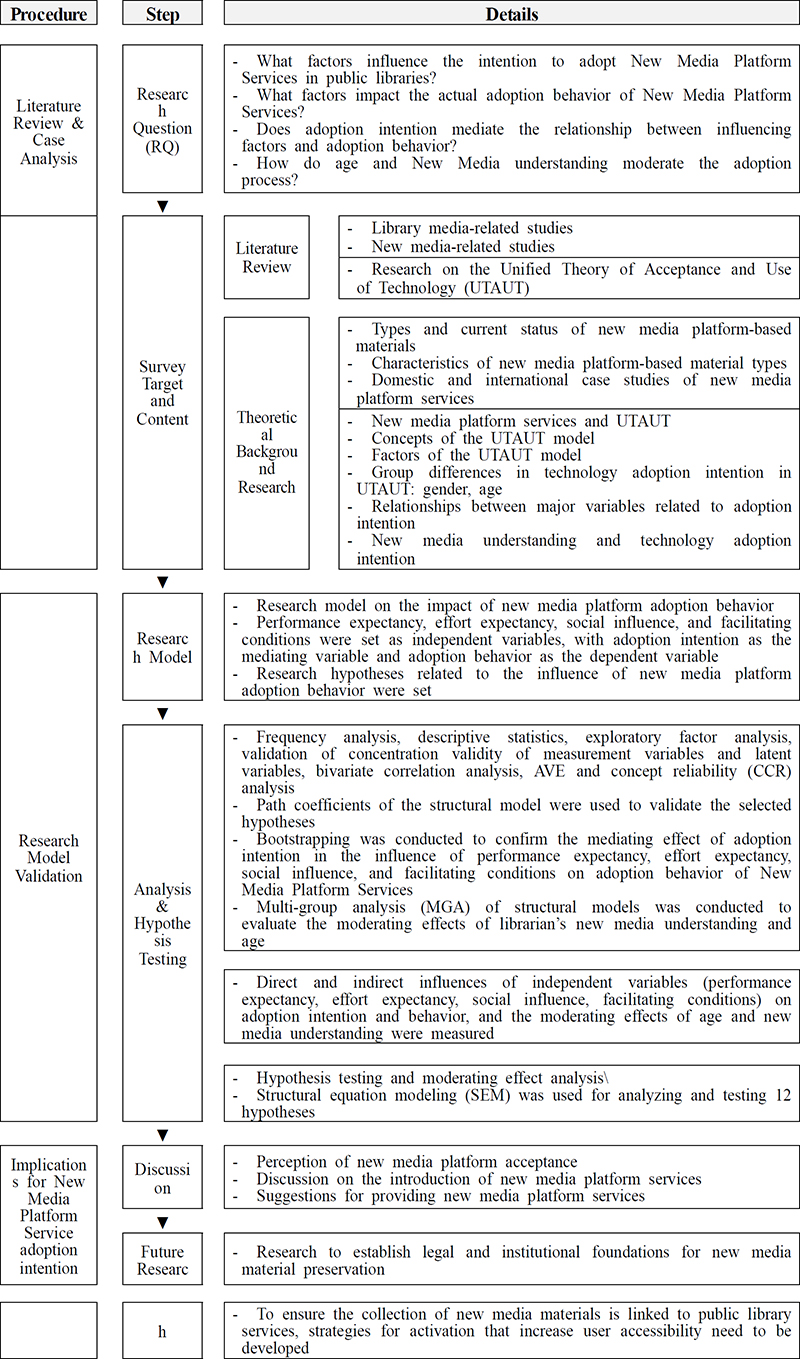
Research Procedure and Content
First, the Problem Identification stage involves setting the basic direction for understanding the structural relationships between variables and the influence of factors on the adoption behavior of public library librarians regarding New Media Platform Services. This includes examining the effects of performance expectancy, effort expectancy, social influence, and facilitating conditions in the adoption and use of New Media Platform Services, as well as the moderating effects of new media understanding and age.
Second, the Literature Review and Conceptualization stage focuses on comprehensively reviewing relevant previous studies to establish the theoretical background. The main research is based on the Unified Theory of Acceptance and Use of Technology (UTAUT), and the review includes literature on the status of data collection, utilization, and preservation of New Media Platform Services. Additionally, similar studies and specific cases of new media usage in public libraries were investigated to strengthen the theoretical foundation.
Third, the Research Model Setting stage is where the research model and hypotheses are established based on the literature review and theoretical background investigation. The hypotheses primarily deal with the direct and indirect effects of independent variables such as performance expectancy, effort expectancy, social influence, and facilitating conditions on the dependent variables of adoption intention and adoption behavior, including the moderating effects of age and new media understanding.
Fourth, the Analysis and Hypothesis Testing stage involves applying various statistical analysis techniques to data collected through surveys. The primary analytical methods include frequency analysis, descriptive statistics, exploratory factor analysis, construct validity, and bivariate correlation analysis. Reliability verification, correlation analysis, and structural equation modeling (SEM) are conducted. To test the moderating effects, multi-group analysis is applied.
Fifth, the Discussion stage provides empirical evidence on the adoption and utilization of New Media Platform Services in public libraries and draws policy implications.
Finally, discussions are made on legal and institutional foundations for the preservation of new media data and strategies for effective service provision through public library data collection and utilization methods.
3.2 Survey Content and Survey Structure
Table 1 presents the survey structure used in this study, systematically outlining the design of each item in alignment with the research objectives. The survey investigates librarians’ perceptions and behaviors regarding the adoption, utilization, and preservation of New Media Platform Services in public libraries. Each item is designed to address key aspects required to achieve the research goals.

Survey Structure
Basic respondent information was collected to identify demographic characteristics and ensure the reliability and validity of the survey. Perception items related to New Media Platform Services measure how librarians perceive the definition and functions of New Media Platform Services, forming the basis for analyzing differences in perception.
The section on data collection and preservation evaluates the importance of these tasks and explores the factors and conditions librarians consider when managing new media materials. The current utilization section examines how libraries are presently using New Media Platform Services, reflecting the growing importance of digital materials in library operations.
The future utilization and preservation plans section investigates librarians’ perceptions of strategies and policy directions for effectively using and preserving New Media Platform Services, offering insights for practical implementation. The section on adoption intention analyzes the influence of performance expectancy, effort expectancy, social influence, and facilitating conditions on the intention to adopt New Media Platform Services, grounded in the Unified Theory of Acceptance and Use of Technology (UTAUT).
Lastly, the "Other Comments" section invites respondents to provide detailed, open-ended feedback on the utilization and preservation of New Media Platform Services, enriching the study’s qualitative analysis.
The development of the survey items followed a systematic process to ensure alignment with the research objectives and goals. First, a thorough review of relevant literature was conducted to define the research objectives and construct the survey items. Studies related to the Unified Theory of Acceptance and Use of Technology (UTAUT) were referenced, focusing on key factors such as performance expectancy, effort expectancy, social influence, and facilitating conditions. This literature review helped enhance the validity of the research by grounding the survey items in established frameworks tested for reliability and validity.
Second, survey items were designed to reflect the practical work of librarians in public libraries, particularly their adoption and utilization of New Media Platform Services. These items incorporated aspects of the workflow in public libraries and critical elements related to the preservation and utilization of digital data, ensuring their relevance to the respondents' professional experiences.
Third, a pilot test was conducted to assess the clarity and consistency of the survey items. The pilot involved a small group of librarians, whose feedback was used to evaluate the appropriateness and effectiveness of the questions. This process helped identify and revise unclear or ambiguous items, resulting in a more refined and precise final survey.
Finally, to enhance the survey's reliability and validity, all items were structured using a Likert scale. This approach allowed the quantification of respondents’ perceptions and attitudes while ensuring that the questions enabled clear and consistent responses.
3.3 Research Subjects and Data Collection
The purpose of this study is to investigate the perceptions of public library librarians regarding the use and preservation of New Media Platform Services, to understand the current status of New Media Platform Services in public libraries, and to establish future directions for their collection, preservation, and utilization. Additionally, the study seeks to identify the factors influencing the adoption of New Media Platform Services by public libraries. To achieve this, a survey was conducted targeting public library librarians, focusing on the current status of new media platform operations, their perceptions, and adoption behavior.
To enhance methodological rigor, procedural controls were applied to reduce common method bias. The questionnaire assured anonymity, used neutral wording, and separated key constructs across different sections. In addition, Harman’s single-factor test was conducted as a diagnostic check. Possible non-response bias was also assessed by comparing early and late respondents on major demographic variables and key constructs, and no substantial differences were identified. These procedures suggest that common method bias and non-response bias were unlikely to seriously distort the interpretation of the results.
A pilot test was conducted to ensure the validity of the survey instrument. The pilot test was carried out from August 1 to August 5, 2024, with 10 librarians participating. The collected data were analyzed to confirm the reliability and validity of the measurement tool, and the reliability coefficient exceeded the required threshold, allowing the main survey to proceed. The main survey was conducted from September 19 to September 30, 2024. The survey was distributed to public librarians through an online survey platform. A total of 255 responses were returned, and 232 valid responses were used for the final analysis after excluding incomplete or missing responses. Possible non-response bias was assessed by comparing early and late respondents on major demographic characteristics and key variables. No substantial differences were identified, suggesting that non-response bias was unlikely to seriously affect the interpretation of the results. Of the 1,271 public libraries contacted, 437 agreed to participate, 255 responses were returned, and 232 valid responses were used for analysis. The effective response rate was therefore 18.3% based on all contacted libraries and 53.1% based on libraries that agreed to participate. To assess possible non-response bias, early and late respondents were compared on major demographic variables and key constructs. No substantial differences were identified, suggesting that non-response bias is unlikely to seriously affect the interpretation of the results. The survey links were sent to librarians from these institutions, and 255 surveys were returned. After excluding incomplete responses and missing data, 232 valid surveys were analyzed.
The demographic characteristics of the respondents showed that the highest number of librarians were from Seoul, with 33 participants (14.2%), followed by 31 (13.4%) from Gyeonggi-do, 22 (9.5%) from Jeollanam-do, and 20 (8.6%) each from Gyeongsangbuk-do and Gyeongsangnam-do. In terms of age, the largest group of respondents was in their 30s, comprising 111 librarians (47.8%), followed by 64 in their 40s (27.6%) and 57 in their 20s (24.6%). Regarding gender, 167 respondents were female and 85 were male. Based on the valid sample of 232 respondents, the proportions were 72.0% and 36.6%, respectively. With respect to library experience, 112 respondents (46.3%) worked for 1-5 years, which was the largest proportion, followed by 26 respondents (10.7%) with 6-10 years of experience, and 26 respondents (11.2%) with either 11-15 years or more than 16 years of experience. Regarding their current duties, the largest group of respondents worked in cultural programs (16.4%), followed by reading and lending services (12.9%), acquisitions (11%), and reading room management (8.8%).
This study adhered to ethical standards and obtained approval from [Insert Institution Name]. Participants were informed about the study's objectives and provided with detailed consent forms before participation. The research complied with international standards for human subject research, including data privacy and confidentiality guidelines outlined in the Declaration of Helsinki. These measures ensured that the study was conducted ethically and in accordance with institutional and national regulations.
To improve methodological transparency, this study clarified the sampling procedure and valid-response process. The survey was distributed to public librarians through an online survey platform, and incomplete or missing responses were excluded from the final analysis. Possible non-response bias was assessed by comparing early and late respondents on major demographic characteristics and key variables. No substantial differences were identified, suggesting that non-response bias was unlikely to seriously affect the interpretation of the results.
3.4 Sample Size Adequacy
To ensure an adequate sample size for this study, a sample size calculator based on structural equation modeling (SEM) was utilized. According to Kline (2015), a minimum sample size of 200 is required for reliable results when analyzing models with multiple latent variables. Additionally, the commonly accepted ratio of 5–10 respondents per parameter estimate, as suggested by Bentler and Chou (1987), was applied.
Given the study's research model, which included 12 hypotheses and multiple variables, a minimum of 220 participants was determined to be necessary. The final sample size of 232 valid responses exceeds this threshold, ensuring the robustness of the analysis and the validity of the findings. Furthermore, the effective sample size aligns with statistical power recommendations (power = 0.80, alpha = 0.05) for detecting medium to large effect sizes, as outlined by Cohen (1992).
This validation confirms that the collected data is sufficient to ensure the reliability and generalizability of the study’s results.
3.5 Research Model and Research Hypotheses
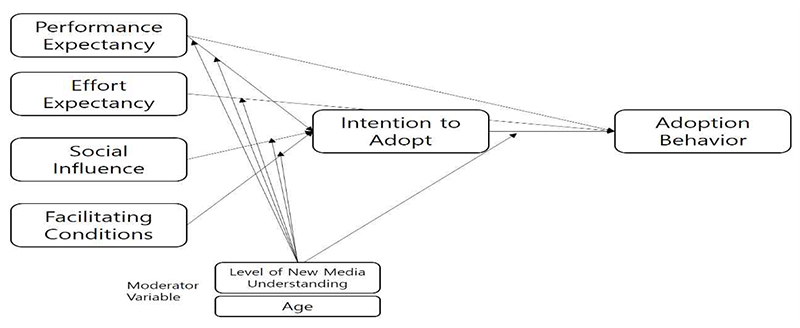
The primary objective of this study is to identify the factors influencing the adoption behavior of New Media Platform Services in public libraries and analyze the structural relationships between variables. To achieve this, the study designates performance expectancy, effort expectancy, social influence, and facilitating conditions as independent variables. adoption intention serves as the mediating variable, while adoption behavior is the dependent variable. Additionally, the moderating effects of new media understanding and age are examined. The research model is depicted in <Fig. 2>.
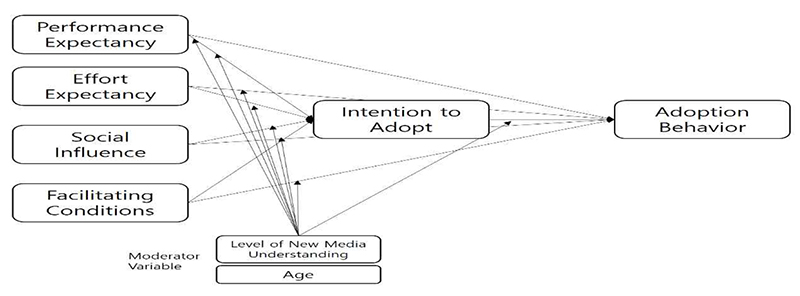
Research Model
The research hypotheses (H) established to explore the factors influencing adoption behavior and analyze the structural relationships between variables are as follows:
Research Hypothesis
3.6 Measurement Tools
The survey instrument for this study was structured into two main sections: one focusing on the perception of New Media Platform Services and the other on the adoption behavior of New Media Platform Services. The measurement tools for performance expectancy, effort expectancy, social influence, facilitating conditions, behavioral intention, and adoption behavior were developed based on operational definitions from prior research. These tools were modified to align with the objectives of this study and were informed by both domestic and international studies.
The survey included five demographic questions regarding library staff. Perception-related items were divided into the following categories: 5 items on the perception of New Media Platform Services, 10 items on the preservation of New Media Platform Services, 3 items on platform operation, 6 items on the status of new media platform ownership and usage, 2 items on challenges in platform operation, 19 items on platform collection, 3 items on considerations when collecting platforms, 3 items on strategies for platform service activation, and 4 items on improvements to platform policies.
Regarding the adoption behavior of New Media Platform Services, as summarized in Table 3, the survey included 4 items each for performance expectancy, effort expectancy, social influence, facilitating conditions, behavioral intention, and adoption behavior.
Operational Definitions of Variables in the Unified Technology Acceptance Model for New Media Platform Adoption
All measurement items related to adoption behavior were rated using a 5-point Likert scale, where 1 = strongly disagree and 5 = strongly agree. Statistical analysis of the survey data was conducted with a significance level of p < 0.05, ensuring the robustness and reliability of the findings.
4. Analysis of the Intention to Adopt New Media Platform Services
4.1 Exploratory Factor Analysis and Reliability Analysis
The exploratory factor analysis was conducted on the independent variables in the research model: performance expectancy, effort expectancy, social influence, and facilitating conditions. The eigenvalues ranged from 2.209 to 3.135, all exceeding the threshold value of 1.0, indicating a clear classification of the factors. The total cumulative variance explained was 75.135%, and all factor loadings were greater than 0.4, confirming the convergent validity among the measurement variables within each factor. The Kaiser-Meyer-Olkin (KMO) measure of sampling adequacy was 0.876, and Bartlett’s test of sphericity was significant (χ² = 2094.022, df = 91, p = 0.000), verifying the suitability of the data for factor analysis.
Performance expectancy consisted of four items, with an eigenvalue of 3.135, accounting for 22.390% of the variance. For effort expectancy, two items were removed because they showed substantial conceptual and empirical overlap with performance expectancy. After these deletions, effort expectancy consisted of two items, with an eigenvalue of 2.410, accounting for 17.214% of the variance. The two retained items represented the core meaning of effort expectancy, namely perceived ease of learning and use. Social influence consisted of four items, with an eigenvalue of 2.209, explaining 15.781% of the variance. Facilitating conditions consisted of four items, with an eigenvalue of 2.765, accounting for 19.747% of the variance. These results confirm the validity of the factors within the study. The reliability analysis showed that the Cronbach’s Alpha values for all four factors were above 0.6, indicating that the measurement tools used for these variables were reliable.
The exploratory factor analysis for the mediating variable, intention to adopt, and the dependent variable, adoption behavior, resulted in the extraction of two distinct factors. The eigenvalues were 3.692 and 2.823, both exceeding the threshold value of 1.0, indicating clear factor classification. The total cumulative variance explained was 81.440%, with all factor loadings greater than 0.4, confirming convergent validity among the measurement variables within each factor. The Kaiser-Meyer-Olkin (KMO) measure of sampling adequacy was 0.924, and Bartlett’s test of sphericity was significant (χ² = 1661.938, df = 28, p = 0.000), further validating the suitability of the data for factor analysis.
The exploratory factor analysis for intention to adopt consisted of four related items, with an eigenvalue of 3.692, explaining 46.151% of the variance, confirming its validity as a distinct factor. Similarly, the exploratory factor analysis for adoption behavior consisted of four related items, with an eigenvalue of 2.823, accounting for 35.290% of the variance, confirming its selection as a distinct factor.
The reliability analysis further demonstrated that the Cronbach’s Alpha values for both factors exceeded 0.6, indicating that the measurement tools used for the mediating and dependent variables were reliable.
To confirm that common method bias (CMB) did not significantly affect the study results, Harman’s single-factor test was performed. The unrotated factor analysis revealed that the largest single factor accounted for 34.2% of the total variance, which is well below the 50% threshold commonly used to indicate significant common method bias (Podsakoff et al., 2003). These results indicate that common method bias is not a major concern in this study.
4.2 Confirmatory Factor Analysis
Confirmatory factor analysis was conducted to assess the validity of the measurement model. The measurement model included six latent variables: performance expectancy, effort expectancy, social influence, facilitating conditions, adoption intention, and adoption behavior. Each latent variable was measured using its corresponding observed indicators.
The final measurement model consisted of four items for performance expectancy, two items for effort expectancy, four items for social influence, four items for facilitating conditions, three items for adoption intention, and four items for adoption behavior. For adoption intention, the third item was removed because its squared multiple correlation (SMC) value fell below the acceptable threshold.
The standardized factor loadings of the retained items ranged from 0.61 to 0.97 and were statistically significant, indicating that the observed variables adequately represented their corresponding latent variables. These results support the convergent validity of the measurement model and provide a basis for subsequent structural equation modeling.
The measurement model and the structural model were evaluated separately. Confirmatory factor analysis was conducted to assess the validity of the measurement model, including the relationships between latent variables and their observed indicators. Subsequently, structural equation modeling was performed to test the hypothesized relationships among performance expectancy, effort expectancy, social influence, facilitating conditions, adoption intention, and adoption behavior. The model-fit indices for each model are reported separately to ensure transparency and consistency in the interpretation of the results.
The structural equation model (SEM) employed in this study was designed to examine the relationships between the independent variables—performance expectancy, effort expectancy, social influence, and facilitating conditions—and the dependent variables, intention to adopt and adoption behavior. The model also evaluated the mediating effect of intention to adopt on adoption behavior. Furthermore, the SEM incorporated multiple indicators for each independent variable, enabling effective estimation of the latent variables and providing a comprehensive analysis of the relationships within the framework.
The structural equation model illustrates the relationships between the latent variables—performance expectancy, effort expectancy, social influence, facilitating conditions, intention to adopt, and adoption behavior—and their corresponding measurement indicators. Each latent variable is assessed using multiple indicators. For instance, performance expectancy is measured by four indicators (performance expectancy 1, performance expectancy 2, performance expectancy 3, and performance expectancy 4). Similarly, effort expectancy, social influence, facilitating conditions, intention to adopt, and adoption behavior are each measured by multiple indicators. The relationship between the latent variables and their respective indicators is represented by path coefficients, which range from 0.61 to 0.97. All path coefficients were statistically significant, indicating that the measurement variables effectively represent their corresponding latent variables.
The path coefficients between latent variables were analyzed to evaluate the direct effects of performance expectancy, effort expectancy, social influence, and facilitating conditions on intention to adopt, as well as the direct effect of intention to adopt on adoption behavior. The path coefficients ranged from 0.43 to 0.67, indicating statistically significant relationships. Among these, the path coefficient for the effect of intention to adopt behavior was the highest at 0.69, demonstrating that intention to adopt has a very strong influence on adoption behavior. This finding highlights the critical role of intention to adopt as a mediator, effectively translating the influence of other factors into actual adoption behavior.
The structural model fit for this study was evaluated using various fit indices. The Chi-square test yielded χ²(df = 174, n = 232) = 518.501, p = .000, with a Chi-square to degrees of freedom ratio of 2.980, indicating a good model fit. The fit indices were as follows: Goodness of Fit Index (GFI) = 0.826, Comparative Fit Index (CFI) = 0.909, Normed Fit Index (NFI) = 0.870, Tucker-Lewis Index (TLI) = 0.890, and Root Mean Square Error of Approximation (RMSEA) = 0.093. Most indices were within acceptable ranges, confirming a good overall model fit. Notably, CFI and TLI exceeded 0.90, reflecting a strong fit. RMSEA, while slightly higher than 0.08, remained below 0.10, suggesting an acceptable fit. Although GFI and NFI were slightly below optimal thresholds, they still indicated a reasonable fit.
Overall, the fit indices demonstrate that the structural model proposed in this study is appropriate for testing the research hypotheses. The model adequately explains the relationships between the intention to adopt and the adoption behavior of New Media Platform Services, supporting its validity.
4.3 Discriminant Validity
The discriminant validity of the measurement tools used in this study—performance expectancy, effort expectancy, social influence, facilitating conditions, intention to adopt, and adoption behavior—was evaluated using Average Variance Extracted (AVE) and the correlation coefficients between the constructs. According to Fornell and Larcker (1981), discriminant validity is established if the squared correlation coefficient between constructs does not exceed the AVE.
The AVE was calculated based on the formula proposed by Fornell and Larcker (1981), with an AVE value of 0.5 or higher indicating convergent validity. This implies that at least half of the variance in the items is explained by the construct. Composite Reliability (CR) was also assessed, with a threshold of 0.7 or higher indicating good convergent validity (Anderson and Gerbing, 1986).
The correlation analysis results, summarized in Table 4, revealed significant relationships among the constructs. Performance expectancy exhibited the highest positive correlation with effort expectancy at .625 (p < .01) and with adoption behavior at .622 (p < .01). Effort expectancy showed significant positive correlations with social influence at .570 (p < .01), facilitating conditions at .454 (p < .01), and intention to adopt at .384 (p < .01). Social influence demonstrated significant positive correlations with intention to adopt at .629 (p < .01), adoption behavior at .533 (p < .01), and facilitating conditions at .591 (p < .01). Facilitating conditions showed a positive correlation of .576 (p < .01) with intention to adopt and .822 (p < .01) with adoption behavior.
Correlations Among Key Variables and Evidence of Discriminant Validity
The analysis of AVE and composite reliability confirmed that the thresholds were met for all constructs. Performance expectancy had an AVE of .753 and a CR of .924; effort expectancy had an AVE of .905 and a CR of .950; social influence had an AVE of .658 and a CR of .883; facilitating conditions had an AVE of .661 and a CR of .886; intention to adopt had an AVE of .810 and a CR of .928; and The revised table reports values that meet the logical and statistical requirements for convergent validity, and the explanatory text has been revised accordingly. These results indicate that the constructs demonstrated both sufficient convergent validity and discriminant validity.
4.4 Hypothesis Testing of the Structural Model (Direct Effects)
After confirming the validity of the measurement model, structural equation modeling was conducted to test the hypothesized relationships among performance expectancy, effort expectancy, social influence, facilitating conditions, adoption intention, and adoption behavior. The structural model fit indices were as follows: χ²(df = 174, n = 232) = 518.501, p < .001, χ²/df = 2.980, GFI = .826, CFI = .909, NFI = .870, TLI = .890, and RMSEA = .093. Although GFI and NFI were slightly below the commonly recommended threshold and RMSEA was somewhat high, the overall fit indices were considered acceptable for testing the hypothesized structural relationships.
An analysis of the direct effects on intention to use revealed that performance expectancy had a statistically significant positive effect on intention to use (𝛽 = 0.267, p < 0.01). Similarly, social influence exhibited a significant positive effect (𝛽 = 0.384, p < 0.001), as did facilitating conditions (𝛽 = 0.333, p < 0.001). These findings indicate that higher levels of performance expectancy, social influence, and facilitating conditions contribute to an increased intention to use New Media Platform Services. Among these factors, facilitating conditions had the strongest influence on intention to use.
As a result, hypothesis 1 (performance expectancy affects intention to use New Media Platform Services), hypothesis 3 (social influence affects intention to use New Media Platform Services), and hypothesis 4 (facilitating conditions affect intention to use New Media Platform Services) were supported. However, hypothesis 2 (effort expectancy affects intention to use New Media Platform Services) was rejected.
Regarding adoption behavior, performance expectancy demonstrated a significant positive effect (β = 0.294, p < 0.001), while effort expectancy showed a significant negative effect (β = −0.161, p < 0.01). The negative effect of effort expectancy on adoption behavior may indicate that librarians who are highly aware of the effort required to operate New Media Platform Services also recognize the additional workload, role ambiguity, copyright responsibility, and technical maintenance burden involved. Thus, ease of use alone may not translate into actual adoption when the technology introduces new professional responsibilities. This finding suggests that public libraries should address not only usability but also workload allocation, institutional support, and role clarification. Adoption intention exhibited a significant positive effect on adoption behavior (β = 0.753, p < 0.001), indicating that stronger adoption intention leads to higher adoption behavior.
Based on these findings, hypothesis 5 (performance expectancy affects use behavior of New Media Platform Services), hypothesis 6 (effort expectancy affects use behavior of New Media Platform Services), and hypothesis 9 (intention to use affects use behavior of New Media Platform Services) were supported. However, hypothesis 7 (social influence affects use behavior of New Media Platform Services) and hypothesis 8 (facilitating conditions affect use behavior of New Media Platform Services) were rejected.
Direct Effect Analysis Using Path Coefficients
4.5 Indirect Effects
In this study, intention to accept New Media Platform Services was selected as a mediating variable. To evaluate the indirect effects of intention to accept, bootstrapping (500 iterations, 𝑝 < .05) was conducted. The analysis revealed that the indirect effect of performance expectancy on adoption behavior, mediated by adoption intention, was significant, with a 95% confidence interval (CI) of (.029 ~ .420), which does not include zero. Similarly, the indirect effect of social influence on adoption behavior, mediated by adoption intention, was significant, with a 95% CI of (.110 ~ .540). Additionally, the indirect effect of facilitating conditions on adoption behavior, mediated by adoption intention, was significant, with a 95% CI of (.077 ~ .401). These findings confirm the presence of significant indirect effects, as detailed in <Table 6>.
Indirect Effects Analysis Results
The effect decomposition table, which outlines the direct, indirect, and total effects within the research model, is presented in <Table 7>.
Decomposition of Direct, Indirect, and Total Effects
In summary, performance expectancy, social influence, and facilitating conditions demonstrated significant indirect effects on adoption behavior through adoption intention. However, no significant indirect effect was observed for effort expectancy. Based on these results, hypothesis 10 was partially supported.
4.6 Moderating Effect
This study examined age as one of two moderating variables (the other being librarians' understanding of new media). The moderating effect was analyzed using Multi-Group Analysis (MGA) within the structural model to assess differences in influence among age groups. Age was categorized into three groups: 20s (57 participants, 24.6%), 30s (111 participants, 47.8%), and 40s and older (64 participants, 27.6%).
The results of the analysis showed significant moderating effects by age, with df = 16, CMIN = 30.560, 𝑝 = .015 (𝑝 < .05), and NFI Delta-1 = .007. For the 20s group, facilitating conditions significantly influenced adoption intention, and acceptance intention had a strong positive effect on adoption behavior. In the 30s group, performance expectancy and social influence significantly influenced acceptance intention, while performance expectancy positively and effort expectancy negatively influenced adoption behavior. In the 40s and older group, effort expectancy, social influence, and facilitating conditions significantly affected acceptance intention, with effort expectancy showing a negative effect.
In all age groups, acceptance intention positively influenced adoption behavior, with the strongest effect observed in the 20s group. This indicates that younger participants, particularly those in their 20s, are more adept at adopting new technologies and integrating them into their work. In contrast, participants in their 30s and 40s and older demonstrated lower confidence in the ease of learning and using New Media Platform Services. Social influence had a stronger impact on acceptance intention in the 30s and 40s groups, whereas it did not significantly affect the 20s group. The 30s group also exhibited higher performance expectancy, influencing both acceptance intention and behavior, suggesting that expectations of technological outcomes play a stronger role for this group.
Based on these findings, hypothesis 11 was supported.
Moderating Effect by Age
The moderating effect based on librarians' level of understanding of new media was examined in this study. Participants were categorized into three groups: high (56 participants, 24.1%), medium (131 participants, 56.5%), and low (45 participants, 19.4%). When these groups were applied to the research model, the results indicated df = 16, CMIN = 33.820, 𝑝 = .006 (𝑝 < .01), and NFI Delta-1 = .007. These findings confirm a statistically significant moderating effect based on the level of new media understanding.
Research Model Verification Results (Standardized Coefficients)
The group with the lowest level of new media understanding showed a significant positive effect on acceptance intention. Similarly, the group with medium new media understanding also demonstrated a significant positive effect on acceptance intention. All groups exhibited a significant positive impact of facilitating conditions on acceptance intention, with the medium understanding group showing the highest influence.
For adoption behavior, only the group with the highest level of new media understanding showed significant results. Performance expectancy positively influenced adoption behavior, while effort expectancy and facilitating conditions negatively influenced adoption behavior. These findings suggest that higher levels of new media understanding lead to greater acceptance of New Media Platform Services. However, as experience and understanding increase, the need for strong technical support and ease of learning (effort expectancy) becomes less critical. Based on these results, hypothesis 12 was supported
4.7 Hypothesis Testing Results and Model Validation Results
The results of the hypothesis testing conducted in this study are summarized in <Table 10>. The analysis identified performance expectancy, social influence, and facilitating conditions as significant factors influencing acceptance intention. For adoption behavior, significant factors included performance expectancy, effort expectancy, and acceptance intention. The indirect effect analysis further confirmed that performance expectancy, social influence, and facilitating conditions had significant indirect effects on adoption behavior through acceptance intention, whereas effort expectancy did not demonstrate a significant indirect effect. Additionally, the analysis of moderating effects revealed statistically significant influences based on age and new media understanding, confirming their role as moderating variables in the relationships examined.
Hypothesis Testing Results Table
This study examined the factors influencing the adoption behavior of New Media Platform Services in public libraries using the Unified Theory of Acceptance and Use of Technology (UTAUT). It also explored differences in librarians' perceptions of the utilization and preservation of New Media Platform Services. To verify the 12 hypotheses established, structural equation modeling (SEM) was employed for analysis.
The goodness-of-fit of the structural equation model was assessed using the following indices: chi-square statistic (χ²), degrees of freedom (df), Comparative Fit Index (CFI), Incremental Fit Index (IFI), Root Mean Square Error of Approximation (RMSEA), and Standardized Root Mean Square Residual (SRMR). A CFI or IFI value above 0.90 indicates a good model fit, while a RMSEA value below 0.08 is considered acceptable.
The model fit analysis yielded the following results: χ² = 362.147, df = 218, CFI = 0.917, IFI = 0.920, RMSEA = 0.067, and SRMR = 0.045. These values indicate that the model is generally well-fitted and has explanatory power in analyzing the adoption behavior of New Media Platform Services.
Figure 3 presents the results of hypothesis verification for the structural model, encompassing direct effects, indirect effects, and moderating effects, as applied to the research model.
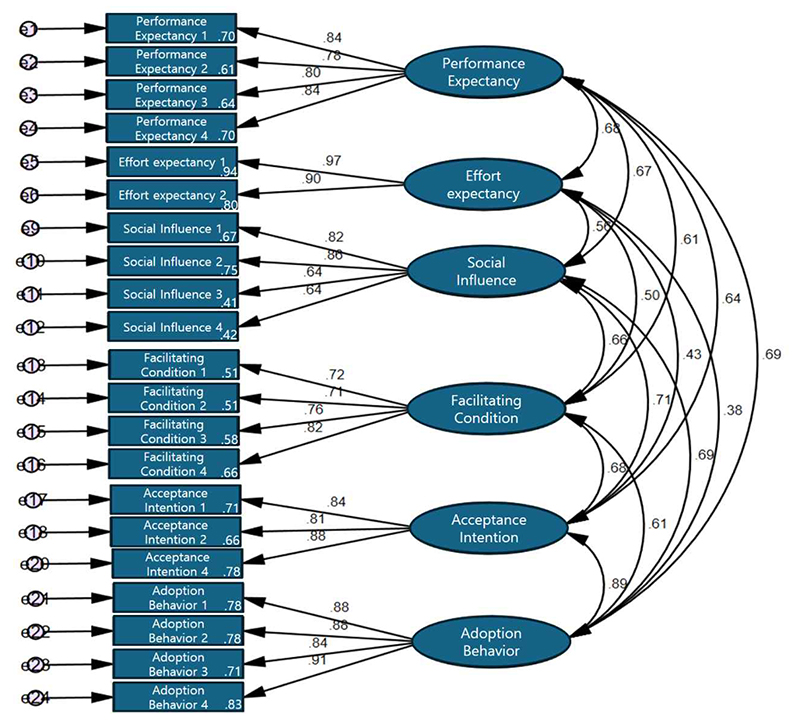
Confirmatory Factor Analysis Results (Standardized Estimates
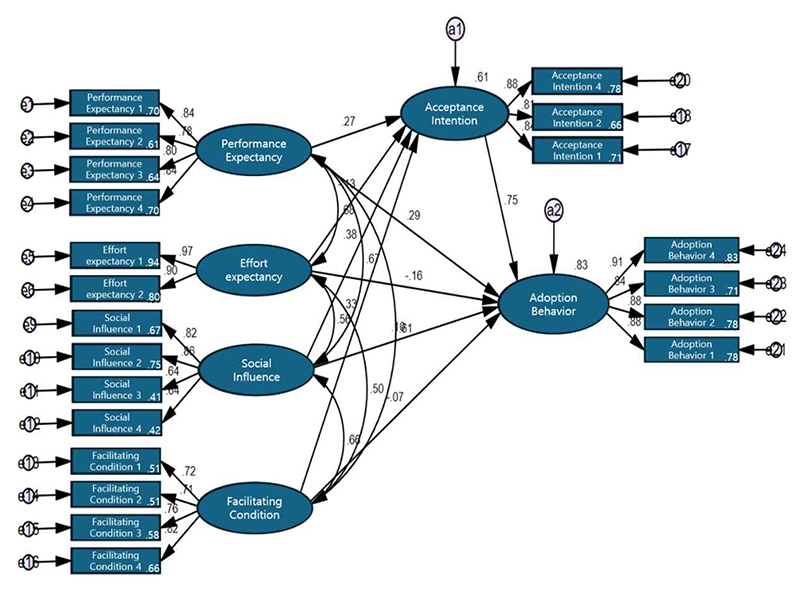
Research Model Verification Results (Standardized Coefficients)
Research Model Reflecting Hypothesis Testing
This chapter analyzes the impact of various factors on the acceptance of New Media Platform Services and identifies the key drivers influencing users' acceptance intention and adoption behavior.
First, the analysis of technical statistics and normality confirmed that the measurement tools used in the study were statistically appropriate. Mean and standard deviation values revealed that performance expectancy had the highest mean score of 3.36, indicating high expectations for performance when utilizing New Media Platform Services. Both skewness and kurtosis values were within acceptable limits, confirming the normality of the data.
Second, the exploratory factor analysis demonstrated clear distinctions among the independent variables—performance expectancy, effort expectancy, social influence, and facilitating conditions. A cumulative variance of 75.135% indicated that the variables were well explained, and Cronbach’s Alpha values exceeding 0.6 for all factors ensured their reliability.
Third, the confirmatory factor analysis confirmed the structural model’s suitability, as the fit indices were statistically significant. This verified that the constructs used in this study were valid and aligned with the research objectives.
Fourth, discriminant validity was established using the Average Variance Extracted (AVE) and construct reliability measures. Correlation analysis revealed that performance expectancy had a strong positive correlation with effort expectancy and adoption behavior, while social influence and facilitating conditions significantly correlated with acceptance intention. These results clarified the interactions between the study variables.
Fifth, path analysis indicated that performance expectancy, social influence, and facilitating conditions significantly influenced acceptance intention. Performance expectancy and acceptance intention positively affected adoption behavior, whereas effort expectancy had a negative impact on adoption behavior. This suggests that as effort expectancy increases, the likelihood of adoption behavior decreases, potentially reflecting challenges specific to librarians’ roles and familiarity with New Media Platform Services.
Sixth, the analysis of indirect effects through bootstrapping revealed that performance expectancy, social influence, and facilitating conditions had significant indirect effects on adoption behavior. acceptance intention played a crucial mediating role in these relationships.
Seventh, the moderating effects of age and new media understanding were significant for acceptance intention and behavior. Younger respondents in their 20s showed the most positive responses to new media acceptance, while effort expectancy negatively influenced acceptance intention among those in their 30s and 40s. Regarding new media understanding, higher levels of understanding amplified the effect of performance expectancy on adoption behavior.
In conclusion, this study explored how factors related to new media platform acceptance influence acceptance intention and behavior. Performance expectancy, social influence, and facilitating conditions had positive effects on acceptance intention, with facilitating conditions being the most impactful. Performance expectancy also positively influenced both acceptance intention and behavior, whereas social influence and facilitating conditions did not significantly affect adoption behavior. Notably, effort expectancy exhibited a negative impact on adoption behavior, a result that contrasts with traditional expectations.
The significant moderating effects of age and new media understanding highlighted the importance of demographic and experiential factors. Younger respondents showed higher acceptance of new technologies, while greater understanding of new media enhanced the influence of performance expectancy on behavior.
These findings suggest that public libraries should move beyond general technology training and establish role-specific New Media Platform Service strategies. First, librarians should be supported through job redesign that clarifies responsibilities for platform-based material collection, copyright review, metadata creation, preservation, and user service. Second, libraries should develop internal guidelines for collecting and preserving social media, immersive content, and metaverse-based materials. Third, training should be differentiated by age group and level of New Media understanding, with introductory, applied, and preservation-focused modules.
5. Discussion
This study empirically analyzed the key factors—performance expectancy, effort expectancy, social influence, facilitating conditions, among others—that affect the adoption of New Media Platform Services. It also examined the interactions, mediation, and moderation effects among these factors. By applying the Unified Theory of Acceptance and Use of Technology (UTAUT) to the context of New Media Platform Services, this study provides a comprehensive understanding of the determinants influencing users’ intention and behavior in adopting such platforms.
The research specifically focused on public library librarians as a target group, systematically verifying the relationships between the adoption of New Media Platform Services, usage intention, and behavior. The discussion related to the research questions raised in this study is organized into the following five sections.
5.1 Factors Affecting Technology acceptance intention
This study found that performance expectancy significantly influences the intention to adopt New Media Platform Services (β = 0.267, p = 0.005) (Hypothesis 1). This aligns with findings by Venkatesh (2012) in the Unified Theory of Acceptance and Use of Technology (UTAUT), which identifies performance expectancy as a major determinant of usage intention. Similarly, Zuiderwijk et al. (2015) reported that performance expectancy positively impacts user intentions in the adoption of open data technologies, and Wong et al. (2015) presented comparable results in mobile advertising contexts. Son et al. (2014) also emphasized the critical role of performance expectancy in shaping the adoption intention for wearable devices. This study reinforces that performance expectancy is a key driver influencing users' intentions to adopt New Media Platform Services.
Conversely, effort expectancy was not found to have a significant effect on adoption intention (β = -0.132, p = 0.081) (Hypothesis 2). This contrasts with findings from Venkatesh et al. (2003) and Zhou et al. (2010), which identified effort expectancy as a core factor in shaping technology adoption intentions. The absence of significance in this study may be attributed to the intuitive and user-friendly design of New Media Platform Services, which likely reduces the perceived effort required. Chen et al. (2014) previously emphasized effort expectancy as crucial for the adoption of age-friendly technologies, but the present study suggests that the high digital literacy of users involved in this research diminishes the impact of effort expectancy.
Social influence was found to have a significant positive effect on adoption intention (β = 0.384, p < 0.01) (Hypothesis 3). This finding is consistent with Venkatesh (2012), who highlighted social influence as a key driver in increasing the technology adoption intentions of early users. Park Ilsun (2012) reported that social influence enhances the adoption intention of mobile credit card services. Similar findings were reported by Martins et al. (2014) in internet banking and Lai & Lai (2014) in mobile commerce, where social influence increased user intentions. The results of this study confirm that the initial adoption of New Media Platform Services is significantly influenced by peer or supervisor recommendations.
Additionally, facilitating conditions were found to significantly affect adoption intention (β = 0.333, p < 0.01) (Hypothesis 4). This is consistent with Venkatesh et al. (2003), who identified facilitating conditions—such as technical support and environmental factors—as essential in enhancing technology adoption. Wang et al. (2021) similarly emphasized the role of facilitating conditions in influencing user intentions in community-based remote education technologies. This study demonstrates that sufficient resources and support significantly increase librarians' intentions to adopt New Media Platform Services.
5.2 Factors Affecting adoption behavior
First, performance expectancy was found to have a significant impact on adoption behavior (β = 0.294, p < 0.01) (Hypothesis 5). This finding is consistent with Zuiderwijk et al. (2015), who reported that performance expectancy plays a crucial role in translating technology use into actual behavior. Similarly, Hoque & Sorwar (2017) found that performance expectancy significantly influences both behavioral intention and actual behavior in the context of mHealth services. This study confirms that when users anticipate positive performance outcomes from a technology, they are more likely to engage with and use the platform.
Effort expectancy also significantly influenced adoption behavior (β = -0.161, p = 0.006) (Hypothesis 6). This result aligns with Venkatesh et al. (2003), who identified ease of use as a critical factor in translating technology use into actual behavior. However, this study suggests that the impact of effort expectancy might be more limited depending on how it interacts with performance expectancy, rather than its standalone importance.
Social influence was found not to have a significant impact on adoption behavior (β = 0.096, p = 0.204) (Hypothesis 7). This result partially contradicts the findings of Venkatesh (2012), indicating that after the initial formation of intention, adoption behavior may be more strongly influenced by personal motivation rather than external social factors.
Facilitating conditions were also found not to significantly influence adoption behavior (β = -0.72, p = 0.297) (Hypothesis 8). This suggests that while facilitating conditions play a significant role in shaping technology acceptance intention, their influence may diminish once the actual behavior phase is reached.
Finally, acceptance intention had a significant impact on adoption behavior (β = 0.753, p < 0.001) (Hypothesis 9). This finding aligns with Venkatesh (2012), who emphasized that intention is a key variable in translating intention into actual behavior. This study reaffirms this relationship in the context of New Media Platform Services.
5.3 Mediating Effect of acceptance intention
Hypothesis 10 proposed that acceptance intention mediates the influence of performance expectancy, effort expectancy, social influence, and facilitating conditions on adoption behavior. The results confirmed that acceptance intention served as a mediator for performance expectancy, social influence, and facilitating conditions. However, no mediating effect was observed for effort expectancy. This finding is consistent with previous studies that have explored the mediating role in technology acceptance models, and it reaffirms the significance of acceptance intention in the context of new media platform adoption.
5.4 Moderating Effects of Age and New Media Understanding
A significant moderating effect based on age was observed (Hypothesis 11), with users in their 20s showing the highest levels of adoption behavior. This finding aligns with previous research by Venkatesh et al. (2003) and Lee and Han (2019), which suggested that age moderates the relationship between acceptance intention and behavior.
New media understanding was found to strengthen the relationship between facilitating conditions and adoption behavior (Hypothesis 12). This result is consistent with the findings of Kim et al. (2018) and Wang et al. (2021), who emphasized the positive impact of understanding on the technology acceptance process. The study empirically confirms that users with higher levels of understanding are better able to leverage technological support, thus enhancing their acceptance of New Media Platform Services.
5.5 Comparison with Previous Studies
The findings of this study align with and expand on previous research in several important ways.
First, the significant influence of performance expectancy on adoption intention (β = 0.267, p = 0.005) confirmed in this study corroborates earlier findings by Venkatesh et al. (2003) and Zuiderwijk et al. (2015), who reported similar results in various technology adoption contexts. These studies emphasized that users are more likely to adopt technologies they perceive as beneficial to their performance, which is consistent with the behavior observed among librarians in this study.
Second, the negative influence of effort expectancy on adoption behavior (β = -0.161, p = 0.006) contrasts with the generally positive impact reported by Zhou et al. (2010) and Awwad & Al-Majali (2015). This discrepancy may arise from the high level of digital literacy among librarians, which likely reduces the relevance of ease of use. Additionally, the specific characteristics of New Media Platform Services, which require complex, evolving technical skills, might contribute to this difference.
Finally, the significant role of facilitating conditions in shaping adoption intention (β = 0.333, p < 0.01) is consistent with findings by Wang et al. (2021), who emphasized the importance of supportive environments in technology adoption. However, this study diverges from earlier research in its finding that facilitating conditions did not significantly impact actual usage behavior (β = -0.072, p = 0.297). This suggests that organizational support may be more crucial during the initial adoption stages rather than during the continued usage phase.
5.6 Practical and Theoretical Implications
The findings of this study offer actionable insights for public libraries and policymakers. First, the strong influence of performance expectancy emphasizes the need for libraries to effectively communicate the benefits of New Media Platform Services to staff, such as improved efficiency and enhanced user engagement. Second, the moderating effect of age suggests that training programs should be tailored to different age groups, addressing varying levels of digital literacy and readiness for adoption. Finally, the critical role of facilitating conditions highlights the importance of a robust technical infrastructure and continuous organizational support to ensure the successful implementation and sustained use of New Media Platform Services.
The study contributes to the Unified Theory of Acceptance and Use of Technology (UTAUT) by demonstrating that adoption behaviors in public library contexts are influenced by unique factors, such as professional roles and organizational settings. The negative impact of effort expectancy on actual usage behavior challenges traditional assumptions, suggesting that perceived ease of use may not always facilitate adoption, especially among digitally literate users. Additionally, the significant moderating role of new media understanding expands the theoretical framework, offering new opportunities to explore how domain-specific knowledge influences technology adoption.
In conclusion, this study explored the factors influencing the adoption behavior of New Media Platform Services in public libraries, applying the UTAUT model to analyze structural relationships. Key findings include the significant roles of performance expectancy, social influence, and facilitating conditions in shaping adoption intention, as well as the mediating effect of adoption intention on actual usage behavior
6. Conclusion and Future Research
This study analyzes the factors influencing adoption intention and adoption behavior toward New Media Platform Services. In this study, “adoption intention” refers to librarians’ intention to use New Media Platform Services in the future, while “adoption behavior” refers to their actual or behavioral use of these services in the public-library context. The research investigates both the direct and indirect impacts of key independent variables such as performance expectancy, effort expectancy, social influence, and facilitating conditions on acceptance intention and behavior, while also considering age and new media understanding as moderating variables.
First, descriptive statistics revealed that performance expectancy had the highest average score of 3.36, indicating that users have high expectations regarding the utility of New Media Platform Services. The exploratory factor analysis demonstrated that the independent variables were clearly distinguished, with a cumulative variance of 75.135%, confirming the reliability of the measurement tools. Cronbach’s Alpha values were above 0.6, showing that the tools were adequate.
The confirmatory factor analysis and discriminant validity analysis validated the fit of the research model. Path analysis indicated that performance expectancy (β = 0.267, p = 0.005), social influence (β = 0.384, p < 0.01), and facilitating conditions (β = 0.333, p < 0.01) significantly influenced acceptance intention. Among these, facilitating conditions emphasized that users are notably influenced by technical support and environmental factors related to New Media Platform Services.
The hypothesis testing showed that performance expectancy and acceptance intention significantly affected adoption behavior, with higher performance expectancy increasing the likelihood of users utilizing the platform (β = 0.294, p < 0.01). However, effort expectancy had a negative impact on adoption behavior (β = -0.161, p = 0.006), indicating that when users perceive the platform as less user-friendly, their usage frequency decreases.
Indirect effect analysis via bootstrapping confirmed that performance expectancy, social influence, and facilitating conditions have indirect effects on adoption behavior, with acceptance intention serving as a key mediating factor.
Moderating effect analysis revealed that both age and new media understanding play significant roles. In the age analysis, the group in their 20s demonstrated the highest adoption behavior, while in the 30s and 40s age groups, effort expectancy had a negative impact. In the new media understanding analysis, users with higher understanding showed a greater impact of performance expectancy on adoption behavior (indirect effect = 0.21, p = 0.032). This suggests that users with a better grasp of new media technology are more likely to actively use the platform.
In conclusion, this study confirms that performance expectancy, social influence, and facilitating conditions positively influence acceptance intention, with acceptance intention playing a crucial mediating role in shaping adoption behavior. Furthermore, moderating variables like age and new media understanding contribute significantly to differences in acceptance intention and behavior, with younger generations showing a higher tendency to adopt new technologies. These findings suggest that public libraries should institutionalize differentiated training and support programs according to librarians’ age and level of New Media understanding. For librarians in their 20s, advanced training in service design, platform-based content curation, and user engagement may be effective. For librarians in their 30s and 40s, practical training should focus on reducing perceived operational burden, clarifying work procedures, and strengthening technical support. In addition, librarians with low New Media understanding should receive basic conceptual and operational training, whereas those with high New Media understanding should be supported through advanced programs on digital preservation, copyright issues, metadata management, and AI-assisted archiving.
Future research should explore the legal and institutional frameworks needed for the preservation of materials generated on New Media Platform Services. Establishing clear legal standards related to copyright, privacy protection, and public accessibility of digital materials is particularly important. Comparative research on digital material management legislation across countries and its application by public libraries is also needed. Current technological tools in public libraries often fail to reflect the unique characteristics of new media materials. Future research should focus on the empirical development and testing of technological tools to address this gap and investigate how they can be applied in practical collection and preservation processes.
To ensure that the proposed strategies for new media platform material collection translate into actual public library services, strategies for service activation that consider user accessibility are crucial. Future research should focus on developing these activation strategies and explore ways to enhance interaction between librarians and users. These recommendations will not only provide foundational research for the preservation and accessibility of new media materials but also contribute to strengthening the role of libraries as centers of digital information.
Statements and Declarations
Author Contributions:
The author was responsible for all aspects of this study, including conceptualization, methodology, formal analysis, data curation, writing – original draft preparation, writing – review and editing, and final approval of the manuscript.
Funding: This research received no external funding.
Data Availability Statement: The data presented in this study are available from the corresponding author upon reasonable request.
Institutional Review Board Statement: Not applicable.
Informed Consent Statement: Not applicable.
Conflicts of Interest: The author declares no conflict of interest.
Statement on the Use of Generative AI: No generative artificial intelligence (AI) tools were used in the preparation of this manuscript.
References
-
Al-Qeisi, K., Dennis, C., Alamanos, E., & Jayawardhena, C. (2014). Website design quality and usage behavior: Unified Theory of Acceptance and Use of Technology. Journal of Business Research, 67(11), 2282–2290.
[https://doi.org/10.1016/j.jbusres.2014.06.016]

- Arenas Gaitán, J., Peral Peral, B., & Ramón Jerónimo, M. (2015). Elderly and internet banking: An application of UTAUT2. Journal of Internet Banking and Commerce, 20(1), 1–23. https://www.semanticscholar.org/paper/Elderly-and-Internet-Banking%3A-An-Application-of-Arenas-Gait%C3%A1n-Peral-Peral/b37f27d53cecf688f17d82af575f02997022769b
-
Awwad, M. S., & Al-Majali, S. M. (2015). Electronic library services acceptance and use: An empirical validation of unified theory of acceptance and use of technology. The Electronic Library, 33(6), 1100–1120. https://www.emerald.com/insight/content/doi/10.1108/el-03-2014-0057/full/html
[https://doi.org/10.1108/EL-03-2014-0057]
-
Bentler, P. M., & Chou, C.-P. (1987). Practical issues in structural modeling. Sociological Methods & Research, 16(1), 78–117.
[https://doi.org/10.1177/0049124187016001004]
-
Chen, K., & Chan, A. H. S. (2014). Gerontechnology acceptance by elderly Hong Kong Chinese: A senior technology acceptance model (STAM). Ergonomics, 57(5), 635–652.
[https://doi.org/10.1080/00140139.2014.895855]
-
Chen, K., & Chan, A. H. S. (2014). Predictors of gerontechnology acceptance by older Hong Kong Chinese. Technovation, 34(2), 126–135.
[https://doi.org/10.1016/j.technovation.2013.09.010]
-
Cohen, J. (1992). A power primer. Psychological Bulletin, 112(1), 155–159.
[https://doi.org/10.1037/0033-2909.112.1.155]
-
Davis, F. D. (1989). Perceived usefulness, perceived ease of use, and user acceptance of information technology. MIS Quarterly, 13(3), 319–340.
[https://doi.org/10.2307/249008]
-
Davis, F. D., Bagozzi, R. P., & Warshaw, P. R. (1989). User acceptance of computer technology: A comparison of two theoretical models. Management Science, 35(8), 982–1003.
[https://doi.org/10.1287/mnsc.35.8.982]
-
Diño, M. J. S., & de Guzman, A. B. (2015). Using partial least squares (PLS) in predicting behavioral intention for telehealth use among Filipino elderly. Educational Gerontology, 41(1), 53–68.
[https://doi.org/10.1080/03601277.2014.907522]
-
Durndell, A., & Thompson, K. (1997). Gender and computing: A decade of change? Computers and Education, 28(1), 1–9.
[https://doi.org/10.1016/S0360-1315(96)00035-3]
-
Feng, S., & Ryu, M. (2023). A study on use intention for HMR subscription service using the unified theory of acceptance and use of technology: Verification of the moderating effect of consumer innovativeness and HMR involvement. Journal of Consumer Studies, 34(1), 41–65.
[https://doi.org/10.1016/j.consumstud.2023.01.001]
- Fishbein, M., & Ajzen, I. (1975). Belief, attitude, intention, and behavior: An introduction to theory and research. Reading, MA: Addison-Wesley.
- Gallup. (2022). Usage rates of 18 types of media, content, and social network services. Retrieved from https://www.gallup.co.kr/gallupdb/reportContent.asp?seqNo=1323
- Han, S. Y. (2021). Future prospects and limitations of metaverse. Future Horizon, 49, 19–24.
- Han, S. Y., & Bang, M. Y. (2020). Trends in the use of XR in Korea during the contactless era. Monthly Software Oriented Society, 75(September), 4–12.
-
Han, S., & Nam, S. I. (2023). A systematic literature review of factors affecting welfare attitudes in Korea. Korean Journal of Social Welfare, 75(2), 93–119.
[https://doi.org/10.20970/kasw.2023.75.2.004]
-
Hoque, R., & Sorwar, G. (2017). Understanding factors influencing the adoption of mHealth by the elderly: An extension of the UTAUT model. International Journal of Medical Informatics, 101, 75–84.
[https://doi.org/10.1016/j.ijmedinf.2017.02.002]
- Hur, K. H., & Kim, I. J. (2022). Analyses of factors affecting the use of news media platforms with blockchain technology. The Journal of Information Systems, 31(3), 131–152.
- Jeon, S. H., Park, N., & Lee, C. C. (2011). Study on the factors affecting the intention to adopt public cloud computing service. Entrue Journal of Information Technology, 10(2), 97–112.
-
Kim, H., Chung, Y., & Han, S. (2023). Perceptions on adopting artificial intelligence and related technologies in libraries. Library Hi Tech.
[https://doi.org/10.1108/LHT-07-2021-0229]
-
Kim, K. B., & Jeon, I. O. (2018). Influential factors of intention to use drone technology: An application of extended UTAUT model. Journal of Distribution and Management, 21(3), 161–173.
[https://doi.org/10.17961/jdmr.21.3.201806.161]
- Kim, Y. H., & Kim, Y. J. (2021). An evaluation of determinants to user acceptance of blockchain technology for the implementation of public rental housing management system: Approached by the unified theory of acceptance and use of technology. Journal of Information Technology Services, 20(6), 17–43.
- Kline, R. B. (2015). Principles and practice of structural equation modeling (4th ed.). Guilford Press.
-
Lin, R., & Xie, J. (2014). Understanding the adoption of third-party online payment: An empirical study of user acceptance of Alipay in China. International Journal of Information Management, 34(2), 1–12.
[https://doi.org/10.1016/j.ijinfomgt.2014.03.003]
- Ko, Y. (1995). An informatic analysis of the self-evidence of libraries. National Assembly Library Review, 1995(11), 1–12.
-
Ko, Y. (1996). How are information media changing? Library Culture, 37(6), 15–27.
[https://doi.org/10.1111/an.1996.37.5.27.1]
-
Koo, J. (2021). The older adults’ acceptance of telemedicine services: Applying an extended UTAUT model (Doctoral dissertation). Yonsei University, Graduate School.
[https://doi.org/10.7282/t3-qe20-xb25]
- Korea Creative Content Agency. (2023). A study on the current status and mid-to-long-term strategies of the immersive content industry. Seoul: Korea Creative Content Agency. https://www.kocca.kr
- Korea Technology and Information Agency for SMEs. (2022). SME strategic technology roadmap – Immersive content sector. Korea Technology and Information Agency for SMEs Webzine, 65. https://webzine.tipa.or.kr/tipa/202204_sub03_1.jsp
-
Lai, I. K., & Lai, D. C. (2014). User acceptance of mobile commerce: An empirical study in Macau. International Journal of Systems Science, 45(6), 1321–1331.
[https://doi.org/10.1080/00207721.2012.761429]
-
Lee, D. M., Lim, G. H., & Jang, S. H. (2010). A comparative analysis on the usage of internet banking users in Korea and China: Based on the UTAUT theory. The Journal of Information Systems, 19(4), 111–136.
[https://doi.org/10.14329/jkdis.2010.19.4.111]
- Lee, H. J. (2021). The acceptance intention of gerontechnology among professional caregivers in elderly care institutions: Focusing on the unified theory of acceptance and use of technology (UTAUT) (Doctoral dissertation). Kyung Hee University.
- Lee, H. S., Ahn, K. H., Ha, Y. W., & Suk, K. H. (2020). Consumer behavior: Marketing strategic approach. Seoul: Jyphyuntae.
-
Lee, Ho G., & Han, M. S. (2019). An empirical study on the consumer acceptance of internet primary bank: The application of UTAUT model. The Journal of Business Education, 33(1), 59–87.
[https://doi.org/10.34274/krabe.2019.33.1.003]
-
Lee, J. M., Jung, H. M., & Ko, E. J. (2018). Structural relationships among factors affecting teachers' robot-based SW education acceptance in primary school. The Journal of the Korea Contents Association, 18(5), 215–229.
[https://doi.org/10.5392/JKCA.2018.18.05.215]
-
Lee, N. J., Lee, J. H., & Kum, A. R. (2021). Analysis of application cases of living lab for urban water resources: Focusing on Sam-bang Water Living Lab. Journal of Information Technology Services, 20(6), 141–150.
[https://doi.org/10.9719/JITS.2021.20.6.141]
-
Lee, S. J., Lee, Y. H., Bang, S. H., & Shin, K. S. (2022). Standard information system design based on digital platform for linking online retail and logistics system. The Journal of Society for e-Business Studies, 27(4), 153–167.
[https://doi.org/10.7838/jsebs.2022.27.4.153]
- Lee, S. M. (2022). Digital media insight 2023 (pp. 300–340). Seoul: Lee Eun Book. https://www.leeunbook.co.kr
- Library and Archives Canada. (2018). Policy on collection development for published heritage. https://library-archives.canada.ca/eng/corporate/about-us/policies/collection-development-published-heritage/Pages/collection-development-published-heritage.aspx
-
Lin, R., & Xie, J. (2014). Understanding the adoption of third-party online payment: An empirical study of user acceptance of Alipay in China. International Journal of Information Management, 34(2), 1–12.
[https://doi.org/10.1016/j.ijinfomgt.2014.03.003]
-
Liu, D., Lu, W., & Niu, Y. (2018). Extended technology-acceptance model to make smart construction systems successful. Journal of Construction Engineering and Management, 144(6), 04018035.
[https://doi.org/10.1061/(ASCE)CO.1943-7862.0001491]
-
Martins, C., Oliveira, T., & Popovič, A. (2014). Understanding the Internet banking adoption: A unified theory of acceptance and use of technology and perceived risk application. International Journal of Information Management, 34(1), 1–13.
[https://doi.org/10.1016/j.ijinfomgt.2013.06.002]
- National Library of Korea. (2022). Current status and challenges of online material collection at the National Library of Korea. National Library of Korea Issue Paper, 11. https://www.nl.go.kr
-
Nysveen, H., Pedersen, P. E., & Thorbjornsen, H. (2005). Explaining intention to use mobile chat services: Moderating effects of gender. Journal of Consumer Marketing, 22(4), 247–256.
[https://doi.org/10.1108/07363760510611671]
-
Park, I. S. (2013). User acceptance model of mobile credit card services based on Unified Theory of Acceptance and Use of Technology (UTAUT) (Doctoral dissertation). Kookmin University, Graduate School of Business IT.
[https://doi.org/10.7282/t3-qt19-xb44]
-
Podsakoff, P. M., MacKenzie, S. B., Lee, J.-Y., & Podsakoff, N. P. (2003). Common method biases in behavioral research: A critical review of the literature and recommended remedies. Journal of Applied Psychology, 88(5), 879–903.
[https://doi.org/10.1037/0021-9010.88.5.879]
- Rogers, E. M. (1995). Diffusion of innovations (4th ed.). New York, NY: Free Press.
- Rogers, C. R. (1959). A theory of therapy, personality and interpersonal relationships as developed in the client-centered framework. In S. Koch (Ed.), Psychology: A study of a science (Vol. 3, pp. 184–256). New York, NY: McGraw-Hill.
-
Rosen, L. D., & Weil, M. M. (1995). Computer anxiety: A cross-cultural comparison of university students in ten countries. Computers in Human Behavior, 11(1), 9–21.
[https://doi.org/10.1016/0747-5632(94)00021-H]
-
Smith, S. (2021). Can relational feed-forward enhance students’ cognitive and affective responses to assessment? Teaching and Learning Inquiry, 9(2).
[https://doi.org/10.20343/teachlearninqu.9.2.18]
-
Sohn, S. P. (2021). Research on institutional improvement to build a global blockchain platform: Focusing on digital trade strategy. Journal of International Trade and Insurance, 22(6), 117–126.
[https://doi.org/10.1111/j.1468-0076.2021.tb00139.x]
-
Sohn, S. P. (2021). Research on institutional improvement to build a global blockchain platform: Focusing on digital trade strategy. Journal of International Trade and Insurance, 22(6), 117–126.
[https://doi.org/10.1111/j.1468-0076.2021.tb00139.x]
- Taylor, B., & Others. (1988). The twenty-first century: Technology's impact on academic research and law libraries. Boston, MA: G. K. Hall.
- The National Archive. (2014). Operational selection policy OSP27. UK Central Government Web Estate. https://www.nationalarchives.gov.uk/documents/information-management/osp27.pdf
-
Tsourela, M., & Roumeliotis, M. (2015). The moderating role of technology readiness, gender, and sex in consumer acceptance and actual use of technology-based services. The Journal of High Technology Management Research, 26(2), 124–136.
[https://doi.org/10.1016/j.hitech.2015.09.003]
-
van Houwelingen, C. T., Ettema, R. G., Antonietti, M. G., & Kort, H. S. (2018). Understanding older people’s readiness for receiving telehealth: Mixed-method study. Journal of Medical Internet Research, 20(4), e123.
[https://doi.org/10.2196/jmir.8407]
-
Wang, L., Yang, D., Yu, Z., Han, Q., Wang, E., Zhou, K., & Guo, B. (2021). Acceptance-aware mobile crowdsourcing worker recruitment in social networks. IEEE Transactions on Mobile Computing, 22(2), 634–646.
[https://doi.org/10.1109/TMC.2020.3013016]
-
Wang, R., Liu, J., & Zhang, X. (2021). Factors fostering the success of IoT services in academic libraries: A study built to understand the librarians' perspective. Library Hi Tech.
[https://doi.org/10.1108/LHT-06-2021-0179]
-
Whitley, B. E. (1997). Gender differences in computer-related attitudes and behavior: A meta-analysis. Computers in Human Behavior, 13(1), 1–22.
[https://doi.org/10.1016/S0747-5632(96)00026-X]
-
Wong, C., Odom, S. L., Hume, K. A., Cox, A. W., Fettig, A., Kucharczyk, S., ... Schultz, T. R. (2015). Evidence-based practices for children, youth, and young adults with autism spectrum disorder: A comprehensive review. Journal of Autism and Developmental Disorders, 45(7), 1951–1966.
[https://doi.org/10.1007/s10803-014-2351-z]
-
Xun, J., Qi, T., Zou, L., Tang, Q., Shen, Y., Yang, J., ... Lu, H. (2020). Mycobacterium tuberculosis co-infection is associated with increased surrogate marker of the HIV reservoir. AIDS Research and Therapy, 17, 1–8.
[https://doi.org/10.1186/s12981-020-00285-1]
-
Xun, Y., Chen, M., Liang, P., Tripathi, P., Deng, H., Zhou, Z., ... Kamel, I. (2020). A novel clinical-radiomics model pre-operatively predicted the stone-free rate of flexible ureteroscopy strategy in kidney stone patients. Frontiers in Medicine, 7, 576925.
[https://doi.org/10.3389/fmed.2020.576925]
-
Yang, S. H., Hwang, Y. S., & Park, J. K. (2016). A study on the use of fintech payment services based on the UTAUT model. Journal of Management & Economics, 38(1), 183–209.
[https://doi.org/10.15245/KJME.2016.38.1.183]
-
Yoon, H., & Kim, Y. (2021). A study on factors affecting the intention to use care robot among institutional elderly care professionals: Focusing on transfer assist robot. Journal of the Korea Gerontological Society, 41(5), 715–736.
[https://doi.org/10.31888/JKGS.2021.41.5.715]
-
Zhou, H., Zhang, J., & Su, J. (2020). Internet access, usage, and trust among medical professionals in China: A web-based survey. International Journal of Nursing Sciences, 7(1), S38–S45.
[https://doi.org/10.1016/j.ijnss.2020.07.003]
-
Zou, X., & Ryu, M. H. (2023). A study on the purchase attitude and purchase intentions of Chinese consumers for new energy automobiles applying the UTAUT. The Journal of Eurasian Studies, 20(1), 1–23.
[https://doi.org/10.31203/aepa.2023.20.1.001]
-
Zuiderwijk, A., Janssen, M., & Dwivedi, Y. K. (2015). Acceptance and use predictors of open data technologies: Drawing upon the unified theory of acceptance and use of technology. Government Information Quarterly, 32(4), 429–440.
[https://doi.org/10.1016/j.giq.2015.09.005]
Taehoon Kim received his master’s degree in Public Administration from Sungkyunkwan University in Seoul and his Ph.D. in Library and Information Science from Konkuk University. Beginning with his study on “An Analysis of the Relationship between Governance Structures and Performance in Industry–University Cooperation Projects,” he has conducted six studies on industry–university–research cooperation activities, including the definition of industry–university–research cooperation experts, the development of a professionalism index for such experts, package consulting for industry–university cooperation foundations, and the design of the Sanhak Injaenet service. He has also carried out research on the national R&D convergence classification system and the academic classification system for emerging technology fields. In recognition of his achievements in developing diagnostic tools and models for fostering convergence talent, he received a commendation from the Deputy Prime Minister and Minister of Education in 2023. In 2025, he was also awarded a commendation from the Governor of Gangwon State in recognition of his contribution to workforce development for the promotion of the precision medicine big data industry in Gangwon.