
Online publication date 18 Mar 2026
Cyber-Plagiarism Behaviour of Female LIS Postgraduate Students in Nigerian Universities: Role of Religiosity
Abstract
The study analysed the cyber-plagiarism behaviour of female LIS postgraduate students in universities in South-west Nigeria. Issues such as fabrication, copy-paste, software piracy and copyright violations are considered as examples of cyber-plagiarism. Previous studies have linked plagiarism to peer pressure, institutional policies, poor writing skills, research illiteracy and gave limited attention to religiosity and cyber-plagiarism. Descriptive survey with mixed method approach was adopted, and the population involved 356 female LIS postgraduate students. Both questionnaire and interview guide were the instruments used to elicit data. In the quantitative data, out of the 356 copies of questionnaire administered, only 287 (80.6%) copies were found usable for analysis. Six participants were purposively focused for the qualitative information. Findings revealedthatthe level of cyber-plagiarism behaviour among respondents (x̄= 2.92) was moderate and maintained high level of religiosity (x̄ = 3.10). The result of the hypothesis showed that religiosity indices (values, practices and experiences) have positive joint influence on cyber-plagiarism behaviour among female LIS postgraduate students in universities in South-West, Nigeria (28.4%: Adj. R2 = 0.28). Religiosity is found to be a tool for deterring female LIS postgraduate students in Nigerian universities from engaging in cyber-plagiarism act. The need to improve on the sensitization programme and reinforcement of religious values that discourage students from engaging in unethical behaviour while working in cyberspace were recommended.
Keywords:
Cyber-plagiarism, Religiosity, Female LIS Students, Nigeria, Academic Integrity1. Introduction
Academic dishonesty, particularly cyber-plagiarism, is becoming widespread in educational settings, largely due to the proliferation of Information and Communication Technology (ICT) and greater access to the Internet. Cyber-plagiarism is an unauthorised use of digital content such as text, images, and multimedia from online sources without proper attribution, (Luis-Solano, 2020). It is a form of misconduct that raises concerns,and threatens the integrity of academic research, especially at the postgraduate level. While the ICT has transformed learning and research, it has also made it easier for students/scholars to engage in dishonest practices. Several studies have identified academic pressure, competitiveness, excessive reliance on ICT and fear of failure, as contributing factors driving students/scholars to resort to cyber-plagiarism (Abbasi et al., 2020; Pantu et al., 2020; Sambo et al., 2021). Others noted that,the ease with which online contents can be copied and pasted could be cause of temptation for students struggling with academic demands (Nguyen & Kato, 2022).
Cyber-plagiarism is explained in this study from the dimensions of self-regulation and perception. Self-regulation is a construct which involves the ability to develop, implement and maintain flexible planned behaviour in order to achieve one’s goals. The second indicator of cyber-plagiarism in this study is perception. It entails the process of recognising, interpreting, and making sense of information received through the senses. It indicates a person’s understanding, interpretation and opinion about a certain idea.These factors have been taken to serve as basis for promoting or discouraging scholars from involving in unethical academic behaviour or activities.
The level of religiosity of the individual postgraduate student has also been noted as the driving force for his/her involvement in plagiarism. Religiosity encompasses an individual’s depth of religious belief, commitment to worship practices, and adherence to moral principles derived from faith (Herdian & Mildaeni, 2022). Religiosity emerges as a potential influential variable in curbing academic dishonesty. It is assumed that students with stronger religious convictions are more likely to internalise values that discourage unethical conduct, including cyber-plagiarism. Empirical evidence indicates that religiosity can function as a protective factor by reinforcing moral responsibility and ethical standards (Khan et al., 2019; Oktaviyani et al., 2022). Other studies such as those of Oktaviyani et al. (2022) and Herdian et al. (2021) found that students who actively practise religion and align with religious ideologies tend to exhibit higher levels of academic integrity. Likewise, Yaden et al. (2021) highlight that the various dimensions of religiosity; beliefs, practices, and experiences play a significant role in shaping ethical decision-making. This is particularly relevant in the case of female Library and Information Science (LIS) postgraduate students in South-West Nigeria, where religious and cultural expectations often place considerable emphasis on moral conduct.
Despite the increasing body of literature on academic misconduct, there remains a notable gap particularly with the role of religiosity on cyber-plagiarism among this specific group. The unique challenges faced by female postgraduate students—including academic workload, societal expectations, and moral dilemmas—necessitate a focused inquiry into the factors that might deter dishonest academic behaviour. Thus, this study examined the influence of religiosity on cyber-plagiarism behaviour among female LIS postgraduate students in universities in South-West Nigeria. By exploring this relationship, the study would be able to establish the role of religious belief, values and practices, particularly those shaped by religious commitment and their contribution in promoting academic integrity.
1.1 Objectives of the Study
Specifically, the study sought to:
- 1. Examine the level of cyber-plagiarism behaviour of female LIS postgraduate students in universities in South-West, Nigeria.
- 2. Ascertain the level of religiosity of female LIS postgraduate students in universities in South-West, Nigeria.
- 3. Ascertain the influence of religiosity on cyber-plagiarism behaviour of female LIS postgraduate students in universities in South-West, Nigeria.
1.2 Hypothesis
The null hypothesis was tested at a 0.05 level of significance:
- 1. Religiosity does not significantly influence cyber-plagiarism behaviour of female LIS postgraduate students in universities in South-West, Nigeria.
2. Literature Review
Religiosity refers to the depth of an individual's religious knowledge, strength of belief, commitment to worship, and adherence to religious rules (Herdian & Mildeani, 2022). It encompasses beliefs, values, and behaviours motivated by spiritual influences, blending knowledge, emotions, and actions. Research indicates that religiosity can significantly affect unethical academic practices, including cyber-plagiarism (Khan et al., 2019; Onu et al., 2019). For instance, Muslim students who regularly attend prayers demonstrate ethical behaviour rooted in self-regulation, which extends to their academic conduct (Khan et al., 2019). Similarly, Christian students engaged in religious activities, like church attendance, show stronger academic integrity, likely due to reinforced values guiding ethical behaviour (Nelson et al., 2017).
A number of studies have investigated the relationship between religiosity and cyber-plagiarism behaviour, generally indicating that higher levels of religiosity are associated with reduced academic dishonesty. Prominent among which includes Oktaviyani et al. (2022) that studied the influence of religiosity on the academic dishonesty of 251 Madrasah Ibtidaiyah students in Indonesia and found that students with strong personal religious practices, ideological beliefs, and religious experiences were less likely to engage in academic dishonesty, including cyber-plagiarism. Religiosity was viewed as a protective factor enhancing moral and ethical behaviour. Similarly, Khan et al. (2019) suggested that religiosity fosters moral responsibility, thereby discouraging unethical academic practices. However, Huelsman et al. (2006) reported no significant correlation between religiosity and dishonesty, indicating that other factors may influence ethical decision-making. Hadjar (2017) added that personal religious practices have a greater deterrent effect on dishonest behaviour than public practices.
Ridwan and Diantimala (2021) further examined Indonesian university students and found that religious knowledge and participation in religious activities were associated with lower instances of academic misconduct. Students with strong internal control and high religiosity demonstrated more ethical behaviour, suggesting religiosity plays a stronger role than personality traits in discouraging cyber-plagiarism. Hamdani et al. (2022) applied the Theory of Planned Behaviour (TPB) to assess how religiosity moderates academic misconduct. They found that religiosity had a direct negative effect on students’ intentions to cheat, including cyber-plagiarism. However, religiosity did not significantly moderate the relationships between TPB constructs (attitudes, perceived behavioural control, and subjective norms) and cheating intentions, implying its influence operates more independently.
Herdian et al. (2021) explored religiosity and academic stress among 277 students at Islamic universities. Their findings showed that religiosity negatively correlated with academic dishonesty, while academic stress was positively associated with it. This highlights the combined impact of internal (religious values) and external (academic pressure) influences on students’ ethical choices. Dossi et al. (2022) conducted a systematic review on religiosity, spirituality, and internet addiction, which provides indirect insights into cyber-plagiarism. They found that religiosity generally acts as a protective factor against problematic digital behaviours by promoting self-control, moral values, and accountability. However, the influence of spirituality was more variable, especially when perceived through a judgmental lens. Herdian and Mildaeni (2022), using the Centrality of Religiosity Scale (CRS-15), examined 142 Muslim university students and reported a significant negative relationship between religiosity and academic dishonesty. They reported that religiosity explained 9.9% of the variance, suggesting that while its effect size is modest, it remains a notable internal influence on ethical academic conduct exists. Literature suggest that religiosity particularly personal and ideological dimensions play a vital role in reducing cyber-plagiarism behaviour by reinforcing ethical standards. However, the extent of its influence varies, and other factors such as academic stress and personal responsibility may contribute to students’ academic integrity.
3. Methodology
Descriptive survey design was adopted for the study. Mixed method (quantitative and qualitative)approach was adopted to examine the role of religiosity on cyber-plagiarism behaviour of female Library and Information Science (LIS) postgraduate students insix universities (Adeleke University, Ede, Osun State; Babcock University, Ilishan-Remo, Ogun State; Federal University of Oye-Ekiti, Ekiti State; Lead City University, Ibadan, Oyo State; Tai Solarin University of Education, Ijagun; University of Ibadan, Ibadan, Oyo State) in South-West Nigeria.The population consisted of 356 female LIS postgraduate students across the six universities offering Masters in Library and Information Science (MLIS), Masters of Philosophy in Library and Information Science (MPhil) and Doctoral (PhD) programmes from 2022/2023 to 2024/2025 academic sessions. The dataset used for the study was in congruence with the enrolment records maintained by the postgraduate colleges in the six universities in the year 2025. Total enumeration method was employed due to their manageable size. The study used a modified questionnaire tagged “Religiosity and Cyber-Plagiarism Behaviour of Female LIS Postgraduate Students” (RACPB). An in-depth interviewguideconstitute the second instrument used for the study. Copies of questionnaire were administered physically to female LIS postgraduate students in their respective universities and retrieved immediately. Indepth interview was conducted among the class leaders of the students to complement the responses. Of the 356 copies of questionnaire administered, only 287(80.61%) were found usable for the study and the quantitative data analysis was based on this number. Descriptive and thematic analyses were used for the data. The results of the analyses are as presented in Tables 1-5 and thematically.
4. Result Presentation
The analysis of the data gathered for the study begins with the description of the respondents’ socio-demographic characteristics.
The results as shown in Table 1 revealed that the University of Ibadan (UI) had the highest respondent representation at 35.2%, while Tai Solarin University of Education (TASUED) had the lowest at 2.1%. The distribution of respondents was proportional to the number of female LIS postgraduate students across the six universities studied, indicating significant representation. Most respondents were enrolled in master's degree programmes (66.6%), with the least being MPhil candidates (4.9%). Age distribution showed that the majority of respondents were aged 20-30 years (42.9%), while only 4.5% were 53 years and older. This demographic data suggests that the female LIS postgraduate students were predominantly mature adults, who easily comprehended and responded effectively to the survey questions. Overall, the demographic characteristics indicate a homogenous group among the respondents, facilitating appropriate responses to the study.

Demographic characteristics of the respondents
4.1. Answers to the Research Questions
The specific objectives of the study with the corresponding questions were addressed. The data collected for the objectives were analysed using frequency counts, percentages, mean and standard deviation scores. The analyses of the data were as presented:
1) Research Question One: What is the level of cyber-plagiarism behaviour of female LIS postgraduate students in universities in South-West, Nigeria? The level of cyber plagiarism behaviour of female LIS postgraduate students was measured in the constituents of self-regulation and perceptions with the results presented in Tables 2a and b respectively.
Cyber-plagiarism behaviour (Self-regulation) of the Respondents
The cyber-plagiarism behaviour of female LIS postgraduate students in universities South-West Nigeria presented in Table 2a was measured using self-regulation as indicator. The results showed a high level of self-regulation, with a weighted mean of 3.13, indicating that the majority of respondents are mindful of academic honesty. The results also showed that they are often mindful of not copying verbatim from online sources (x̄= 3.31) and planning their research and writing processes to avoid last-minute pressures that could lead to plagiarism (x̄= 3.24). Overall, the findings indicate that female LIS postgraduate students exhibit a moderate level of cyber-plagiarism behaviour, with a strong emphasis on self-regulation. The overall weighted mean of 2.92 suggests that while self-regulation is high.
Cyber-plagiarismbehaviour (perception) of the Respondents
Perception was also employed to measure the cyber-plagiarism behaviour and the results showed in Table 2b, reflected a moderate weighted mean of 2.70. While many respondents viewed cyber-plagiarism as a breach of academic ethics x̄ = 3.05) and an act of copyright infringement (x̄= 3.17), some believed it does not constitute cheating (= 2.45). Overall, the findings indicate that female LIS postgraduate students exhibit a moderate level of cyber-plagiarism behaviour, with a strong emphasis on perception. Though, the overall findings suggest that perceptions of cyber-plagiarism vary, highlighting differing views on its severity as an academic offense.
2) Research Question Two: What is the level of religiosity of female LIS postgraduate students in universities in South-West, Nigeria?
The level of religiosity of female LIS postgraduate students was tested and the analysis of the data collected was as shown in Tables 3a-c (See Appendix I).
The results of the analysis presented in Tables 3a-3c showed the findings on the level of religiosity of female LIS postgraduate students in universities in South-West Nigeria. Their level of religiosity was assessed through three indicators: religious values, practices and experiences. The results indicate a moderate level of religious practices, with a weighted mean of 2.89. This suggests that while the students engage in religious practices, such as daily prayers and observing religious traditions, their level of involvement is still moderate. Many respondents noted that their daily prayers influence their reluctance to engage in unethical academic practices, like inappropriate use of AI tools (x̄= 3.11). Most respondents affirmed that their religious principles significantly discourage cheating, even under pressure (x̄= 3.34), and that religious teachings guide their academic decisions, restraining them from engaging in an unintentional plagiarism (x̄ = 3.23). Additionally, the weighted mean for religious experiences was 3.10, reflecting a high level of personal religious experiences that limit participation in cyber-plagiarism. Overall, the findings suggest that female LIS postgraduate students in universities in South-West Nigeria exhibit a high level of religiosity.
4.2 Test of the hypothesis
The hypothesis tested was to establish the influence of religiosity on cyber-plagiarism behaviour of female LIS postgraduate students. Regression analysis was performed in order to establish the influence of independent variable on the dependent variable. The hypothesis was tested at 0.05 level of significance.
Religiosity and cyber-plagiarism behaviour of the Respondents
The result of hypothesis showed that that religiosity (β=0.49, p < 0.05) has positive and significant influence on cyber-plagiarism behaviour among female LIS postgraduate students in universities in South-West, Nigeria (F(1,285)=89.38).The null hypothesis (H01) is therefore rejected.
4.3 Schematic Summary
The schematic summary was undertaken to illustrate the postulated influence of religiosity on cyber-plagiarism behaviour. The statistical results depict the significance of the hypothesis directed the study.
The indicators of religiosity (practices, religious values and religious experiences) were regressed against cyber-plagiarism behaviour as shown. These indicators were used in the multiple regression model and the result showed that religious values(β=0.48,p<0.05)andreligiousexperiences(β= .33, p < 0.05) had significant positive influence on cyber-plagiarism behaviour of female LIS postgraduate
students in universities in South-West, Nigeria (F (3, 283) 81=38.88,p<0.05).Religious values had the highest contribution to the influence recorded among the three indices. The result further showed that when taken the religious practices, values and experiences together, they jointly accounted for 28.4% (Adj. R2 = 0.28) of the changes in cyber-plagiarism behaviour. This result therefore, suggests that religiosity influence cyber-plagiarism behaviours among female LIS postgraduate students in universities in South-West, Nigeria.
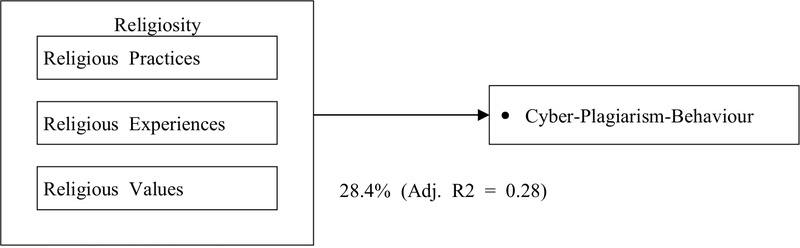
Schematic summary of religiosity (practices, experience and values) on cyber-plagiarism behaviour of female LIS postgraduate students in universities in South-west Nigeria
4.4 Reports of the Interview
An in-depth interview (IDI) was conducted on class leaders that represent the female LIS postgraduate students in the six studied universities. The interview guide was structured in line with the study's objectives. Particular attention was paid to the influence of religiosity on cyber plagiarism behaviour of female LIS postgraduate students in universities in South-West Nigeria. The report of the in-depth interview conducted on the six participants was analysed thematically as shown in Table 5. The issues bothering on awareness, religious practices, values and experience were broken down into themes, sub-themes and code for ease of reference.
Thematic Analysis Results for influence of religiosity on cyber-plagiarism behaviour of female LIS postgraduate students (See analysis Interview extracts at the Table bottom)
4.5 Thematic Analysis
The qualitative analysis begins with awareness and ends at religious values as shown in the Table.
4.6 Awareness
All the six participants claimed they are aware of cyber-plagiarism. They had this to say
Q1: (Can you describe your understanding of what cyber-plagiarism entails?)
It was apparent that 100% of the participants quite understood what cyber-plagiarism entails and nearly all of them described cyber-plagiarism as copying someone’s work from the internet and 89 ascribing it to self or an act of copying digital content in a fraudulent manner. Specifically, the responses reproduced are as follows:
- • As we know that, this is an information era, like we now belong to an information community. I would say cyber-plagiarism means copying digital content without permission or proper reference of the original owner of the content. [IDI/UI/MLIS/2025]
- • I understand cyber plagiarism as the ability of using another person's cyber content, detailed content without prior consent or permission and showing it as your own [IDI/LCU/PhD/2025].
- • Cyber-plagiarism is when you copy an online content without crediting the source or acknowledging that you took the idea from someone or somewhere [IDI/BABCOCK/MLIS/2025].
- • From the word cyber-plagiarism, cyber has to do with internet and plagiarism has to do with copying somebody else's work and claiming it as one's own. So that means cyber-plagiarism means copying somebody else's work from the internet or claiming something found or done through the net as somebody's own without citation or proper referencing of the original owner of the work [IDI/FUOYE/PhD/2025].
- • Cyber-plagiarism is simply copy and paste of online materials without citing the original owners of the materials. It could be described as academic theft of ideas. [IDI/AUE/MLIS/2025]
- • Cyber-plagiarism involves an individual making use of another person's idea or literary works in any form without duly acknowledging or referencing them. So it could be something as vague as a person's article, a person's document, or just a random image that is sent online and then taken and used without properly citing what the source is or where you got the document from or those works that you are making use of. So I think that's the type of acts constituting cyber plagiarism [IDI/AUE/PhD/2025].
- • It is a type of academic dishonesty that consists of reusing someone else e- documents in whole or part claim as your own [IDI/UI/PhD/2025]
4.7 Religiosity and Cyber-Plagiarism Behaviour
Participants were asked to describe the role played by religious activities on cyber plagiarism behaviour. The result indicated that the participants collectively affirmed that religiosity plays a significant role on cyber-plagiarism behaviour and guided them against stealing or theft. Additionally, they considered religious values, experiences and practices through various religious teachings as the moral gauge for their behavioural conduct particularly in social and academic circles.
1) Religious Practices
Q2: (How does your participation in religious practices influence your academic activities?)
The result showed that 75% of the participants claimed that their religious practices influenced their academic activities and affirmed that their religion shaped the way they behave both socially and academically. Some of the responses are reproduced as thus:
- • My religious practices have influenced my view on behaviours such as plagiarism and cyber-plagiarism positively which goes a long way in discouraging me from taking credit for work that is not mine, viewing it as a breach of moral principles [IDI/UI/MLIS/2025]
- • Religious teachings guide my ethical decision making by helping me to stay truthful in everything I do particularly academically. The teaching influences my ethical decisions to a large extent [IDI/BABCOCK/MLIS/2025]
- • My religious teachings narrow down and reflect my faith as a Christian. It helps me in making ethical decisions such as avoiding anything that goes against my beliefs and teachings [IDI/AUE/PhD/2025
- • My religious practices which include my church involvement have instilled in me values such as honesty and integrity. And these values influence my online academic work because it goes a long way in guiding me to avoid cyber-plagiarism and properly credit sources [IDI/AUE/PhD/2025]
Q3: (In what ways do you think religious teachings guide your ethical decision-making in academics?)
The result indicated that a greater number of the participants affirmed that religious teachings had guided their ethical decision-making in academics by avoiding unholy and sharp practices such as stealing other people’s work, efforts or ideas and claiming ownership of such. Some responses are as thus:
- • Participation in religious activities as a Muslim has enhanced my academic discipline, my full academic work and has improved me all around. My values are supposed to help me to tackle challenges in a fair and honest manner. I have been more disciplined, and do well with time management amongst other things that has been, which has affected my academics positively [IDI/LCU/PhD/2025].
- • Religious values have profoundly impacted my approach as a female postgraduate student to academic challenges by imbibing in me resilience, discipline, and hope in the face of adversity. It helps me draw strength in fighting academic challenges with a sense of trust or belief that persistence and effort will eventually lead to success [IDI/UI/PhD/2025].
- • My religious teachings often emphasise or depict values such as honesty, responsibility and perseverance, which serves as a directional guide on towards my academic decision-making [IDI/UI/MLIS/2025]
- • Religious teachings, I wouldn't say guides my decision making ethically, but religious teachings as it preaches honesty in every form, so it guides me in being honest academically with everything I'm doing and being able to attribute accomplishments and glory to whosoever deserves it, especially when it comes to using people's works or people's articles [IDI/LCU/PhD/2025]
- • My religious beliefs emphasise on the importance and practice of honesty, dignity and integrity in all my academic endeavours hence helps me realize that acts of dishonesty such as plagiarism or cyber-plagiarism are not right. [IDI/LCU/PhD/2025)
- • My religious beliefs have influenced my view on plagiarism or cyber-plagiarism positively in the sense that it identifies them as fraudulent acts which undermines academic integrity, truthfulness and honesty [IDI/FUOYE/PhD/2025]
Q4: (Can you describe how your religious beliefs have influenced your views on behaviours like plagiarism or cyber-plagiarism?)
The result showed that the religious beliefs of all the participants influence how they view behaviours such as plagiarism or cyber-plagiarism. Some of the results regarding the opinions of the participants are presented as follows:
- • My religious beliefs have streamlined my view on behaviours such as plagiarism or cyber-plagiarism to be categorised as dishonest behaviours or behaviours that undermines academic integrity. However, my religion beliefs teach me to love my colleagues and not be the judge on any matters rather, gives room to advice my colleagues against engaging in dishonest behaviours [IDI/BABCOCK/MLIS/2025].
- • My religious beliefs have influenced my view on behaviours such as plagiarism and cyber-plagiarism positively. It sensitises me on the danger of taking credit of works that are not mine [IDI/UI/PhD/2025]
- • Acts such as plagiarism or cyber-plagiarism behaviour are known to be acts of academic dishonesty which goes against all what my religious beliefs reflects. This influences how I view such behaviour as something that must not indulged [ IDI/AUE/PhD/2025]
- • I believe my research values have impact on my academic activities. There is a general saying that what is worth doing at all, worth doing it well. I tried to be truthful, promote integrity in whatever I do [IDI/LCU/PhD/2025].
2) Religious Experiences
Q5: (In what ways have your personal religious experiences motivated you to uphold academic integrity?)
The result showed that a greater proportion of the participants stated that their personal religious experiences have positively motivated them to uphold academic integrity and avoid any form of sharp practices in academic such as cyber-plagiarism. Some of the participants’ responses are presented as follows:
- • My personal religious experience has so far so good, motivated me in my academic endeavours. In the sense that one thing my religion preaches is honesty, integrity, as I said earlier on. And over time I have discovered that there is a thin line between trying to keep up with what the society is and trying to also stick to ethics and personal beliefs. [IDI/FUOYE/PhD/2025].
- • My experience has influenced me in positive ways, especially when it comes to assignments, term and seminar papers and research writing [IDI/AUE/MLIS/2025]
- • My personal religious experiences have motivated me to always uphold academic integrity in the sense that it taught me the importance of honesty, sincerity and most importantly integrity and how they should reflect in academic endeavours [IDI/FUOYE/PhD/2025]
- • Personal religious experiences have always motivated me to uphold academic integrity positively. It makes me to be honest with my assignments, coursework, projects, tests. It helps me to reflect on my faith, honesty and integrity as I have been taught and same reflects in my academics [IDI/BABCOCK/MLIS/2025]
- • Personal religious experience has motivated me positively with great impact on my academic endeavours. My religious experiences help me in promoting honesty and integrity in my academic practices always. There are times it comes to my mind to want to take up someone else’s works as mine, or times just want to do a shabby job, but the values I hold on to constantly remind me that whatever is worth doing is worth doing well, so I tend to remember putting the necessary efforts that is needed to perfect my academic work [IDI/LCU/PhD/2025]
- • Religious experiences have motivated me to nurture values like honesty, responsibility, and respect for others' work, all of which can strongly motivate me to uphold academic integrity. Similarly, being fair and treating others as one would like to be treated can discourage copying or misusing others' intellectual property [IDI/UI/PhD/2025]
3) Religious Values
Q6: (Do you think your religious values have impact on your approach to academic challenge?
If yes, can you share some of the experiences?) The result showed that all the participants (100%) believed that religious values had valuable impact on their approaches to academic challenges when they arise. Some of the experiences shared by the participants are hereunder reproduced:
- • Yes it does. No matter what I do, I try not to get into trouble or misrepresent myself in bad light. I believe that religious values were developed from what religious beliefs are. So, anything that will make someone call me out or say negative things about me, I tried not to get involved in such [IDI/BABCOCK/MLIS/2025]
- • Fundamentally, religious values have profoundly impacted my approach as a female postgraduate student. In terms of academic challenges, the religious values have imbibed in me the resilience, discipline, and hope in the face of adversity. It also helps me to draw strength in fighting academic challenges with a sense of trust or belief that persistence and effort will eventually lead to success [IDI/UI/MLIS/2025].
- • Certainly, I know this because while writing my dissertation during my master’s programme, sourcing for relevant and recent literature was a serious hassle but my religious values influenced how and where I sources for my literature [IDI/AUE/PhD/2025]
5. Discussion of the Findings
This study investigated the cyber-plagiarism behaviour and religiosity of female Library and Information Science (LIS) postgraduate students in universities in South-West Nigeria. The findings revealed a moderate level of cyber-plagiarism behaviour, characterized by a notably high level of self-regulation among students. Self-regulation covers their ability to plan, monitor, and control actions. It emerged as a crucial factor in deterring cyber-plagiarism. Many respondents indicated that their academic conduct was influenced by strong internal mechanisms, including ethical awareness and effective time management. This aligns with Elshafei and Jahangir (2020), who found Turkish university students with better self-regulation and ethical awareness and concluded that they less likely to engage in academic dishonesty. Additionally, Bandura’s (1991) theory of moral self-regulation supports the idea that individuals internalize standards of conduct to inhibit unethical decisions such as plagiarism. The perception of cyber-plagiarism among the students was moderate, suggesting a nuanced understanding of its seriousness. While most respondents recognized cyber-plagiarism as a form of copyright violation and ethical misconduct, some did not view it as outright cheating. This mixed perception stemmed from the normalization of digital copying in educational contexts, where the lines between research and reproduction became blurred. This observation is consistent with Park’s (2017) research, which highlights the variability in student perceptions of academic misconduct. Sefcik et al. (2019) further emphasized that students' understanding of plagiarism often lags behind in institutional expectations, particularly in the digital age. Regarding religiosity, the study conceptualised it through three dimensions: religious practices, values, and experiences. The overall findings indicate a high level of religiosity among the students, suggesting that their religious orientation significantly influences their academic behaviour, particularly in the areas of integrity and ethical decision-making. In terms of religious practices, students showed moderate engagement, with routine activities like daily prayers contributing to their academic discipline. These practices reinforced their ability to resist unethical conduct, aligning with Adamczyk et al. (2017), who noted that frequent religious involvement correlates with reduced unethical behaviour.
Religious values were particularly influential, with many students affirming that their beliefs discouraged cheating, even under academic pressure. This reflects the findings of Dein (2018), who observed that intrinsic religiosity is linked to ethical consistency. Furthermore, religious experiences played a significant role, as students reported that personal encounters with spirituality fostered a sense of accountability, discouraging cyber-plagiarism. This aligns with Arli et al. (2021), who found that strong religious experiences lead individuals to evaluate ethical decisions through a spiritual lens. Collectively, the three components of religiosity practices, values, and experiences indicated a high level of religiosity among the respondents. This suggests that religiosity serves as a protective factor, providing cognitive and emotional mechanisms that deter academic dishonesty. Cognitively, it supports a belief system that values honesty and respect for intellectual property, while emotionally, it instils a sense of spiritual accountability. These findings underscore the importance of integrating moral and spiritual dimensions into student development programmes.
The hypothesis examined the relationship between religiosity and cyber-plagiarism behaviour. The analysis revealed a significant positive relationship, indicating that higher levels of religiosity correlate with a reduced likelihood of engaging in cyber-plagiarism. This finding led to the rejection of the null hypothesis (H01), emphasising the role of religiosity in shaping ethical decision-making among female LIS postgraduate students. It suggests that religious values can guide students away from unethical behaviours, highlighting the potential for religious teachings to positively influence academic integrity in educational settings.
5.1 Recommendations
Arising from the findings of the study, the following recommendations are made for future implication:
- 1. Given the significant influence of religiosity on cyber-plagiarism behaviour, it is recommended that universities incorporate religious and ethical education programmes into the curriculum and promote strict enforcement of the same.
- 2. As the study focused on LIS postgraduate students, it is recommended that universities offering LIS programmes should ensure that ethical conduct, including plagiarism prevention, is integrated into the curriculum with utmost prioritisation placed on it for students to understand its importance and prevent engagement in same at all cost in their academic work.
- 3. To complement educational efforts, universities should develop and enforce clear anti-plagiarism policies that outline the consequences of academic dishonesty and train students to avoid involvement in such act in the bid to preserve academic integrity at all cost.
5.2 Implications of the study
Social implication
The findings of this study suggest that universities should not only focus on academic skills development but also consider the moral and psychological factors that influence students’ academic conduct. The significant role of religiosity in reducing cyber plagiarism highlights the need for universities to incorporate holistic approaches in their academic integrity strategies.
Practical Implication
The study indicates that students with higher religiosity are more likely to exhibit academic honesty. Educational institutions should consider incorporating ethics education, which reinforces moral values related to academic integrity, into the curriculum. This could be done through dedicated courses on ethics or by integrating ethical discussions within existing courses, particularly for postgraduate students.
6. Conclusion
The study demonstrates that religiosity is a critical factor deterring female LIS postgraduate students from getting involved in cyber-plagiarism act. The study found that cyber-plagiarism poses serious academic and ethical risks, as it undermines intellectual honesty, erodes critical thinking, and may lead to disciplinary actions that can damage academic record and future career opportunities. Cyber-plagiarism act does not only devalues the essence of scholarly work but also weakens the credibility of academic institutions. The study further points out a connection between religiosity and appropriate cyber-plagiarism behaviour among female LIS postgraduate students in the studied universities in South-West Nigeria. The findings highlight that higher levels of religiosity, characterised by strong ethical beliefs and practices can serve as protective factors against academic dishonesty, particularly cyber-plagiarism. This research underscores the importance of integrating spiritual and moral education into academic curricula to foster a culture of integrity among students. By reinforcing ethical standards and encouraging self-regulation, educational institutions can empower students to navigate the challenges posed by digital resources. The study contributes to a deeper understanding of how personal values, shaped by religiosity, can positively influence ethical decision-making in academic settings, thereby promoting a more honest and accountable academic space.
Statements and Declarations
Author Contributions: Conceptualisation, Saheed Abiola Hamzat; methodology, Saheed Abiola Hamzat, Aishat Wuraola Popoola, Jacob Oloruntoba Kutu; data collection, Saheed Abiola Hamzat, Aishat Wuraola Popoola; analysis, Saheed Abiola Hamzat, Aishat Wuraola Popoola, Jacob Oloruntoba Kutu.
Funding: The research received no external funding. All expenses involved in research structurization and data collection were borne by the authors
Data Availability Statement: The data presented in this study are available on reasonable request from the corresponding author.
Institutional Review Board Statement: The study was conducted in accordance with the relevant ethical guidelines and approved by Adeleke University Research and Ethical Committee with numberAUEREC/2025/11/22/LIS01
Informed Consent: An informed consent was obtained from all the study participants.
Conflict of Interest: The authors declare no competing or conflict interest. The output of the study is the true state of affairs among the studied participants.
References
-
Abbasi, P., Yoosefi-Lebni, J., Jalali, A., Ziapour, A., & Nouri, P. (2020). Causes of plagiarism: A grounded theory study. Nursing Ethics, 28(2), 282-296.
[https://doi.org/10.1177/0969733020945753]

-
Adamczyk, A., Freilich, J.D., & Chunrye Kim, C. (2017). Religion and Crime: A Systematic Review and Assessment of Next Steps. Sociology of Religion, 78(2), 192–232.
[https://doi.org/10.1093/socrel/srx012]
-
Ajzen, I. (1991). The Theory of Planned Behaviour. Organizational Behavior and Human Decision Processes, 50, 179-211.
[https://doi.org/10.1016/0749-5978(91)90020-T]
-
Arli, D., Septianto, F., & Chowdhury, R.M.M.I. (2021). Religious But Not Ethical: The Effects of Extrinsic Religiosity, Ethnocentrism and Self-righteousness on Consumers’ Ethical Judgments. Journal of Business Ethics, 171, 295–316.
[https://doi.org/10.1007/s10551-019-04414-2]
-
Ateeq, A., Alzoraiki, M., Milhem, M., & Ateeq, RA. (2024). Artificial intelligence in education: implications for academic integrity and shift towards holistic assessment. Frontiers in Education. 9.1470979.
[https://doi.org/10.3389/feduc.2024.1470979]
-
Awang. M.C., Lateh, N.H.M., Mahmud, M., & Nasir, N.S.M. (2021). Exploring Young ESL Learners’ Narrative Writing Performance based on their religion: Implications for Teachers and Learners. (2021). International Journal of Language Education and Applied Linguistics, 11(1), 37-47.
[https://doi.org/10.15282/ijleal.v11.6481]
-
Bandura, A. (2023). Social cognitive theory: An agentic perspective on human nature. Hoboken, NJ: John Wiley & Sons.
[https://doi.org/10.1002/9781394259069]
-
Bergan, A., & McConatha, J. T. (2000). Religiosity and life satisfaction. Journal of Psychology and Theology, 28(4), 365-374.
[https://doi.org/10.1300/j016v24n03_02]
-
Cleary, M. (2017). Top 10 reasons students plagiarize & what teachers can do about it (with apologies to David Letterman). Phi Delta Kappan, 99(4), 66-71.
[https://doi.org/10.1177/0031721717745548]
-
Dein, S. (2018). Against the Stream: religion and mental health – the case for the inclusion of religion and spirituality into psychiatric care. BJ Psychological Bulletin, 42(3), 127-129.
[https://doi.org/10.1192/bjb.2017.13]
-
Dewi, S.S., Madjid, Fauzan, A. (2020). The role of religiosity in work-life balance. Budapest International Research and Critics Institute Journal (BIRC-Journal). 66(3), 13-24.
[https://doi.org/10.33258/birci.v3i3.1192]
- Ebardo, R. (2018). Predictors of cyber-plagiarism: The case of Jose Rizal University. In Proceedings of the 26th International Conference on Computers in Education. Philippines: Asia-Pacific Society for Computers in Education, 778-783.
-
Elshafei, H.A., & Jahangir, T.M. (2020). Factors affecting plagiarism among students at Jazan University. Bulletin of the National Research Centre, 44-70.
[https://doi.org/10.1186/s42269-020-00313-z]
-
Herdian, H., & Mildaeni, I.N. (2022). Academic dishonesty based on religiosity among Muslim students in Indonesia. Culture, Education and Society, 13(1), 9-18.
[https://doi.org/10.17981/cultedusoc.13.1.2022.01]
-
Herdian, N. N., Cahyadi, W., & Perdana, A. T. (2021). Cheating Incidents in E-Assessment of Indonesian Higher Education Institutions. Journal of Physics: Conference Series, 1859(1), 8-16.
[https://doi.org/10.21125/edulearn.2021.1764]
-
Ibrahin, A.S., Khalifa, O.O., & Ahmed, D.E.M. (2020). Plagiarism detection of images. IEEE Student Conference on Research and Development (SCOReD). 183-188.
[https://doi.org/10.1109/SCOReD50371.2020.9250940]
-
Islam, M.N., Koka, N. A.,Wahab, M.O.A. & Khan, M.R. (2022) Plagiarism: All About How to Avoid, British Journal of English Linguistics, 10(1), 1-11.
[https://doi.org/10.37745/bjel.2013/vol10no1pp.1-11]
- Khan, I. U., Khalid, A., Hasnain, S. A., Ullah, S., Ali, N., & Zealand, N. (2019). The ımpact of religiosity and spirituality on academic dishonesty of students in Pakistan. European Online Journal of Natural and Social Sciences, 8(3), 381–398. https://european-science.com/eojnss/article/view/5525
- Khalid, S., & Al-Tamini, R. (2021). Understanding the types and consequences of plagiarism: Perspectives from the Gulf. Middle Eastern Journal of Educational Research, 11(1), 44–60.
- King, C., & Williamson, J. (2021). Understanding Religiosity: A Conceptual Framework. Journal of Religion and Spirituality, 45(1), 50-67.
-
Kusdiana, E., Djalali, M. A., & Farid, M. (2018). Self-confidence, religiosity, and cheating behaviour. Indonesian Journal of Counseling, 3(2), 37–41.
[https://doi.org/10.21067/jki.v3i2.2214]
- Luis-Solano, A. (2020). Cyber-plagiarism: Understanding a new form of academic misconduct in the digital age. Journal of Academic Ethics, 18(2), 123-139.
- McKenzie, J., & Rinaldi, A. (2021). Cyber-plagiarism in the digital age: An ethical perspective. Ethics and Information Technology, 23(2), 159-172.
-
Mireku, D.O., Dzamesi, P.D., & Bervell, B. (2021). Plagiarism in higher education (PLAGiHE) within sub-saharan Africa: A systematic review of a decade (2012-2022) literature. Research Ethics, 20(2), 156-186.
[https://doi.org/10.1177/17470161231189646]
-
Nelson, M. F., James, M. S. L., Miles, A., Morrell, D. L., & Sledge, S. (2017). Academic Integrity of Millennials: The Impact of Religion and Spirituality. Ethics and Behaviour, 27(5), 385-400.
[https://doi.org/10.1080/10508422.2016.1158653]
- Nguyen, H., & Kato, Y. (2022). Academic pressure and the rise of cyber-plagiarism: A qualitative study. Journal of College Student Development, 63(5), 547-562.
-
Oktaviyani, D., Sunawan, S., & Khairkhah, K. (2022). The Prediction of Religiosity on Students’ Academic Dishonesty. Journal Pendidikan Agama Islam, 19(1), 81–92.
[https://doi.org/10.14421/jpai.2022.191-07]
-
Onu, D. U., Onyedibe, M. C. C., Ugwu, L. E., & Nche, G. C. (2019). Relationship between religious commitment and academic dishonesty: is self-efficacy a factor? Ethics and Behaviour, 31(1), 13-20.
[https://doi.org/10.1080/10508422.2019.1695618]
- Oyewole, O., Rasheed, A.A., & Ogunsina, S.T. (2018). Awareness, perception and attitude towards plagiarism by distance learners in University of Ibadan, Nigeria. International Journal Academic Library Information Science, 6(4), 101-113.
-
Pantu, E. A., Karmiyati, D., & Winarsunu, T. (2020). The influence of peer pressure and anxiety in facing exams on academic dishonesty among students. Journal of Applied Psychology, 8(1), 54–65.
[https://doi.org/10.22219/jipt.v8i1.9127]
-
Park, C. (2017). “Other (People’s) words: plagiarism by university students-literature and lessons”, Assessment and Evaluation in Higher Education, 28(5), 471-488.
[https://doi.org/10.1080/02602930301677]
-
Park, C. L., & Paloutzian, R. F. (2021). The psychology of religion and spirituality: How big the tent? Psychology of Religion and Spirituality, 13(1), 3–13.
[https://doi.org/10.1037/rel0000218]
- Sambo, A.S., Lawal, A.M., & Shehu, H. (2021). Awareness and perception of plagiarism among postgraduate LIS students in south-east university libraries. Communicate Journal of LIS Ambrose Alli University, Ekpoma, 23(1), ISSN 115-26664
-
Sedikides, C. (2022). Religiosity: An Orientation and Lifestyle. Personality and Social Psychology Review, 26(3), 295-310
[https://doi.org/10.1177/1088868309352323P]
-
Sefcik, L., Stripe, M., & Yorke, J. (2019). Mapping the landscape of academic integrity education programs: what approaches are effective? Assessment & Evaluation Higher Education 45(1), 30-43.
[https://doi.org/10.1080/02602938.2019.1604942]
-
Selemani, A., Chawinga, W.D. & Dube, G. (2018). Why do postgraduate students commit plagiarism? An empirical study. International Journal for Educational Integrity, 14(7), 1-15.
[https://doi.org/10.1007/s40979-018-0029-6]
-
Smith, L., & Johnson, R. (2024). Digital anonymity and ethical detachment: The psychology of cyber-plagiarism. Cyber psychology, Behaviour, and Social Networking, 27(3), 223-230
[https://doi.org/10.13140/RG.2.2.22664.29447]
-
Vučković, D., Peković, S., Blečić, M., & Đoković, R. (2020). Attitudes towards cheating behaviour during assessing students᾽ performance: Student and teacher perspectives. International Journal for Educational Integrity, 16(1), 1–28.
[https://doi.org/10.1007/s40979-020-00065-3]
-
Vitell, S. J. (2020). Religiosity and Spirituality: Differences and Similarities. Journal of Business Ethics, 162(2), 299-310.
[https://doi.org/10.1007/s10551-010-0382-8]
-
Yaden, D. B., Giorgi, S., Kern, M. L., Adler, A., Ungar, L. H., Seligman, M. E. P., & Eichstaedt, J. C. (2021). Beyond beliefs: multidimensional aspects of religion and spirituality in language. Psychology of Religion and Spirituality. 15(2), 272–280.
[https://doi.org/10.1037/rel0000408]
Appendix
Appendix
Level of Religiosity (Religious Practices) of the Respondents
Level of Religiosity (Religious Value) of the Respondents
Level of Religiosity (Religious Experiences) of the Respondents
Saheed Abiola HAMZAT PhD is an alumnus of the prestigious University of Ibadan, Ibadan Nigeria. He teaches digital library, research methodologies, collection management and reference management, at both undergraduate and postgraduate levels at Adeleke University, Ede. He is a 2021 co-winner, Tertiary Education Trust Fund (TETFund)-National Research Fund (NRF) research grant, on ethical use of eLearning platforms among Nigerian LIS undergraduates. He has supervised more than ten doctoral theses/dissertations to date. His research publications cover remote teaching and learning in universities, digital library use, ethical sharing and information resources use, information literacy, research competence, entrepreneurial skills, Online Discussion Forum (ODF), recidivism and information management, big data analytics, Faculty Learning Communities among others. He has served as resource person at several professional and academic workshops and seminars. He belongs to the Nigerian Library Association, National Association of Library and Information Science Educators and Author's Licensing and Collecting Society, UK.
Aisha Wuraola POPOOLA is a certified lawyer, legal researcher and law librarian with deep commitment to information ethics, and the evolving technological impact on scholarly work. She bridges the multidisciplinary perspective of legal framework and information access, governance and accountability in academic matters through her research prowess. Her research interest span women involvement in emerging library and information technology usage, personality traits and ethical research use. She serves as law librarian in one of the leading private universities in Nigeria
Jacob Oloruntoba KUTU attended the University of Ibadan Library School for BLIS and MLIS and the Kwazul Nathan University, in South Africa for doctoral training respectively. He is a Principal Librarian/Senior Lecturer with more than 14years experience in information resources management and teaching. He currently serves as the Faculty Librarian in Agriculture and Renewable Natural Resources, University of Ibadan, Nigeria. He has published extensively in the area of collection management, library management and information literacy.