Online publication date 11 Mar 2026
Online Discourse and Network Structures of Yuseong-gu Public Libraries: Big-Data Text Mining and Topic Modeling for Evidence-Based Policy Design
Abstract
This study investigates how digital discourse surrounding Yuseong-gu public libraries is structured and how it informs evidence-based policy architecture. Online text data were collected from major Korean portals (Naver and Daum) between July 2022 and June 2025 using “Yuseong-gu public libraries” as the core search query. The corpus was analyzed using text mining, keyword network analysis, and latent Dirichlet allocation (LDA) topic modeling. Word frequency and TF–IDF results indicate that place-anchored identifiers (e.g., Yuseong-gu, Daejeon) and culture-related vocabulary constitute the discourse backbone, while managerial and operational terms such as integration, support, and homepage signal demand for coordinated governance and enhanced digital accessibility. N-gram analysis further emphasizes the demand for an integrated information and participation portal, most clearly reflected in the recurrent sequence “Yuseong-gu–integrated–library–homepage.” Network analysis reveals a high-density structure with a short average path length, confirming strong thematic interconnectedness; the node “library” functions as the primary hub and is directly linked to “culture,” indicating the library’s discursive positioning as a cultural platform. The findings support strategic policy directions, including a hub–satellite spatial system embedded across neighborhood life zones, cross-sectional programming integrating education, culture, and community participation, a mobile-first integrated digital portal, and institutionalized partnerships with schools and local cultural institutions.
Keywords:
Yuseong-gu, Public Libraries, Social Big Data, Text Mining, Topic Modeling, Network Analysis, Neighborhood Libraries, Integrated Platform1. Introduction
Situated within contemporary debates that aim to rearticulate the publicness, accessibility, and right to learn embodied by local public libraries, this study begins with a central premise: everyday language produced and accumulated across the web and media can be transformed into a meaningful source of policy knowledge. Public libraries increasingly position themselves as local hubs for information, culture, and civic participation, operating in alignment with internationally shared principles that emphasize evidence-informed decision-making and community capacity building. Yet in a digital platform environment, citizens’ lived experiences are difficult to capture through post hoc user satisfaction surveys or a limited number of interviews alone. Instead, they must be reconstructed from large-scale, unstructured textual flows—which can be modeled as semantic networks, affective patterns and relational configurations among actors. This calls for an analytical framework that moves beyond single indicators or event-centered assessments and instead integrates the interpretation of discourse structures (what is being said) with network structures (who is connected to whom).
To this end, the present research conducts an integrated quantitative–qualitative text-mining analysis of big-data materials collected from major Korean online platforms, including Naver and Daum, using “Yuseong-gu public libraries” as the focal search term. The dataset spans from July 1, 2022 through June 30, 2025. Using TEXTOM, the study operationalizes a multi-method design: it measures the salience and relative importance of key terms through word frequency and TF–IDF metrics; derives patterns of semantic co-occurrence and sequential linkage through N-gram analysis and keyword network modeling; and identifies latent thematic structures through latent Dirichlet allocation (LDA) topic modeling to delineate topics of policy relevance. The overall research design, as well as the scope of the data, channels, and procedural steps, are documented in detail in the project documentation and methodological records.
The objectives of this study can be summarized as follows. First, it identifies the structural characteristics of online discourse surrounding Yuseong-gu public libraries and specifies the core keywords that organize that discourse. Second, it synthesizes insights from multiple text-analytic techniques to provide an integrated account of the thematic architecture and relational dynamics that shape the Yuseong-gu public-library discourse. Third, it proposes strategic directions for public library operations, space, and services—explicitly grounded in empirical evidence.
Academically, this study aims to clarify the interface between the structuring of large-scale online discourse and policy design, thereby offering a methodological contribution that complements library research traditionally centered on satisfaction-based evaluation or case-study approaches. From a policy perspective, it seeks to provide a scientifically grounded basis for mid- to long-term master planning by leveraging topic and network indicators, in direct response to field-level demands for data-driven policy formulation and stronger integration between planning processes and evaluative metrics.
2. Literature Review
Research on data-driven decision-making and service innovation in public libraries has developed along two main trajectories in both domestic and international scholarship. The first focuses on analyzing internally generated data—such as system logs, collection and circulation records, and website access traces—to model user behavior and to inform service and platform design. The second examines externally produced big data from news and social media to interpret the discourses and relational structures surrounding libraries, thereby supporting public communication and policy design. The “discourse–network integrated analysis” underpinning the policy architecture proposed in this study represents an attempt to connect these two streams and to operationalize governance and implementation frameworks for a local public library system (Yuseong-gu) at the municipal scale.
1) Big-data platforms, log analytics, and service modeling
In Korea, discussions on platformization of and service –enablement us library big data began to gain traction in the mid-2010s. Pyo et al. (2015) proposed a big-data service model centered on public libraries, articulating a staged structure of collection–analysis–service delivery. Building on this line of inquiry, On and Park (2020) empirically examined the applicability of a public library big-data platform through a case study of the Daejeon Hanbat Library. Yoon (2022) further advanced user-oriented platform design by proposing an integrated approach that links information on cultural programs and community services, thereby specifying design challenges at the interface between internal data and user-facing touchpoints. Earlier conceptual groundwork was also laid by Lee (2013), who systematized the concept of big data and articulated its potential integration into library information service system.
On the empirical side, domestic studies have analyzed internal indicators across multiple dimensions—including collection and circulation data (Lee & Lee, 2021), usage logs (Kim, Baek, & Oh, 2018), website usage patterns (Lee & Jang, 2019), and children’s and youth services (Baek et al., 2018). Collectively, these works have identified behavioral patterns such as user segmentation, seasonality, topic- and age-specific demand profiles, and linkages between programs and circulation. At the policy and planning level, Kim and Noh (2018) tracked trends in Korea’s Comprehensive Library Advancement Plan through big-data analysis, underscoring the importance of indicator design that aligns national planning with field-level implementation. This domestic research agenda has evolved alongside institutional and infrastructural supports, including the National Library of Korea’s “Library Information Naru” (2026) and public data utilization casebooks (2020), contributing to the foundations of data governance for public libraries.
2) Discourse analysis using news and social big data
A growing body of work has also examined social perceptions of libraries and the dynamics of public discourse. Han (2019) analyzed news big data from 1990 to 2018 to identify longitudinal patterns in library-related reporting. More recently, Song (2025) traced post-2000 cases concerning intellectual freedom through newspaper big data, reconstructing debates on freedom of expression and censorship through empirical analysis. This line of research demonstrates, in measurable terms, how libraries function as mediators and coordinators of public issues, and how media and public discourse shape the processes through which library policies and services are formulated.
3) Social media use and participation mechanisms in public libraries
International scholarship provides robust empirical evidence that social media can facilitate user engagement, marketing, and community building for public libraries. Aharony (2012), drawing on a content analysis of Facebook use in U.S. public and academic libraries, noted a prevailing tendency toward one-way communication centered on announcements and notices. Joo, Choi, and Baek (2018) analyzsed 4,637 Facebook posts from public libraries and demonstrated the correlational structure between post types and engagement metrics (likes, comments, and shares), empirically indicating that content strategy is a key determinant of participation. Mathiasson and Jochumsen (2019) introduced an additional research pathway by leveraging Facebook event data to study public library programs, while Stvilia and Gibradze (2014) identified topical and utility-related factors associated with library tweets. Chua and Goh (2010) comparatively assessed libraries’ adoption of Web 2.0 tools on library websites and showed that interactive and participatory functionalities are linked to perceived service quality. Together, these studies contribute to clarifying the policy relevance of social media data by demonstrating how discourse-level content (topics and agendas) interacts with network-level dynamics (interaction and diffusion).
4) E-government, public communication, and policy linkage to libraries
The policy implications of social media in the public sector are closely intertwined with the library context. Bertot, Jaeger, and Hansen (2012) argued that governmental social media use introduces new policy challenges concerning accessibility, privacy, preservation, and governance, and proposed corresponding policy responses and governance frameworks. Extending this perspective, Jaeger et al. (2012) theorized the co-evolution of e-government and public libraries, conceptualizing libraries’ roles in networks, education, and partnerships within public service delivery. This strand of work underscores the need for social data strategies in libraries to be integrated with broader policy architecture—including performance indicators, accountability mechanisms, and participatory governance design—rather than being treated as standalone communication tools.
5) Methods and infrastructure: text mining, network analysis, and scalable processing technologies
Methodologically, both international and domestic studies have combined topic and sentiment analysis, content analysis, engagement metric modeling, and network analysis (e.g., retweets, comments, and co-tagging) to infer discourse, affect, and relational structures. For application at regional and institutional levels, however, scalable infrastructure capable of reliably processing high-volume streams and historical datasets is essential. Jeong et al. (2022) examined RDMA-based distributed processing, enabling high-throughput data transmission and low-latency computation across multiple nodes, and thereby proposed a technical architecture well suited to integrated analytical frameworks combining social media data with library usage log data.
6) Research gaps and the positioning of this study
In Korea, substantial progress has been made in analyzing internal data (collection, circulation, and logs) and in proposing big-data platforms and service models. However, studies that integrate social discourse and network structures to generate policy proposals at the local level remain comparatively limited. Internationally, research has accumulated on social media-based engagement and content strategies, diffusion structures, and program-related analyses, yet relatively few studies explicitly translate these insights into policy design frameworks that connect local governments and public libraries—such as indicator systems, decision-making flows, and partnership models. Against this backdrop, the present study uses Yuseong-gu as an empirical case to integrate big-data text mining (discourse) with network analysis, and to propose empirically grounded strategies for public library operations, space, and services. In doing so, it seeks to contribute to both academic scholarship and policy practice by advancing an integrated discourse-network analytical framework for local public library governance.
3. Research Methods and Procedure
1) Analytical Methods and Workflow
To improve methodological parsimony and interpretability, the analysis was organized into a three-module pipeline. First, lexical salience was quantified using word frequency and TF–IDF to identify backbone vocabulary and discriminative terms. Second, relational and sequential structure was examined by deriving N-gram co-occurrence chains and constructing a keyword network to assess connectivity and centrality patterns. Third, latent thematic structure was inferred via LDA topic modeling, and topic outputs were interpreted in conjunction with network evidence to support policy translation. Community detection was used as a robustness check to verify whether major discourse blocks persist across different partitioning logics.
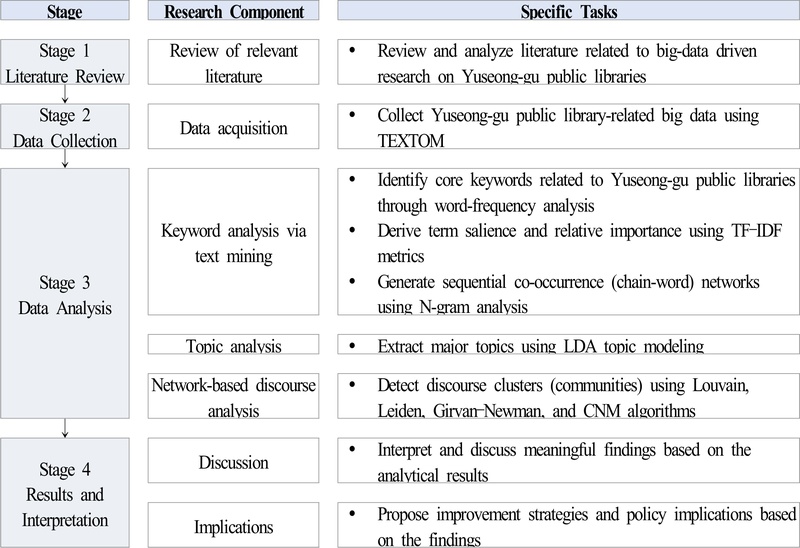
Data Analysis Procedure
2) Data and Analytical Techniques
To develop a fine-grained understanding of recent trends regarding Yuseong-gu public libraries, this study collected big data and applied a suite of text-mining techniques. Data collection was restricted to Korea’s major portal platforms, Naver and Daum. Naver and Daum were selected because they are the two most widely used portal ecosystems in Korea and provide heterogeneous public-facing channels (e.g., news, blogs, and online communities) through which both institutional narratives and citizens’ everyday language are continuously produced and archived. In addition, these platforms allow consistent and replicable data acquisition within a single collection environment (TEXTOM), thereby reducing platform-induced measurement heterogeneity that can arise when combining sources with different access policies, indexing rules, or API constraints. While this restriction improves comparability and reproducibility, it may under-represent discourse circulating in closed or highly platform-specific environments; this limitation is therefore acknowledged in the limitations section. The core search keyword was set to “Yuseong-gu public libraries,” and the collection period was defined as July 1, 2022 to June 30, 2025 to comprehensively capture online discourse generated during the three-year window. The three-year observation window was chosen to balance recency and analytic stability. A shorter window risks insufficient volume and unstable topic estimation, whereas a substantially longer window increases the likelihood of concept drift and policy-context discontinuities. The selected period is long enough to capture multiple annual cycles and recurring program/usage signals, while remaining sufficiently recent to support policy-relevant interpretation for mid- to long-term planning. After compiling the corpus, the study sequentially applied word frequency analysis, TF–IDF, N-gram analysis, named entity recognition, network analysis, and LDA topic modeling to provide a comprehensive account of salient issues and structural patterns and thematic dynamics associated with Yuseong-gu public libraries.

Analytical Dataset Information
3) Analytical Architecture and Issue Identification
The analytical architecture was designed as a chained pipeline: “collection → preprocessing → feature extraction → module-based analyses → integrated interpretation → issue identification.” Using TEXTOM, data related to “Yuseong-gu public libraries” were collected from Naver and Daum for the period July 1, 2022 through June 30, 2025, yielding a total corpus size of 720.43 KB. To minimize analytical noise and reduce error, duplicate entries and promotional/advertising posts were removed. The corpus was then preprocessed by applying a stopword dictionary and conducting morpheme-level normalization to construct an analytically valid dataset.
Subsequently, word frequency and TF–IDF metrics were computed to estimate the salience of key terms. A keyword network was visualized based on N-gram co-occurrence patterns to identify discourse hubs and connectivity patterns. Finally, LDA topic modeling was implemented to infer latent thematic structures, and its outputs were cross-validated against the preceding results to assess the coherence between topic structures and relational patterns.
Key issues were derived from the principal results of the analyses. Specifically, the study integrated: (i) high-ranking TF–IDF terms, (ii) N-gram association strength, (iii) network centrality measures (e.g., degree and betweenness), and (iv) LDA topic probabilities. The resulting issue set was consolidated into policy-relevant categories—services, programs, space/facilities, operations/governance, and communication—thereby confirming a coherent bundle of core issues that explain prevailing trends related to Yuseong-gu public libraries.
The research questions guiding this study are as follows:
RQ1. How is online discourse concerning Yuseong-gu public libraries structurally constituted, and how are its core keywords organized?
RQ2. What evidence-based operational and policy strategies can be driven from the results of the data analysis?
4. Results
This section highlights three core findings. First, place-anchored and culture-related terms constitute the discourse backbone, indicating that Yuseong-gu public libraries are primarily discussed as locally embedded cultural infrastructure. Second, sequential co-occurrence and network structure converge on a hub-centered configuration in which “library” functions as the dominant node, with strong linkages to “culture” and place markers, underscoring a platform-like role rather than a single-purpose facility. Third, topic modeling consolidates these signals into policy-relevant thematic bundles that jointly support spatial reconfiguration, integrated digital access, and user-group–tailored services.
4.1 Keyword Analysis of Yuseong-gu Public Libraries Based on Text Mining
Within the study corpus, the terms “library” (396 occurrences; 4.037%), “Daejeon” (274; 2.793%), and “Yuseong-gu” (264; 2.691%) appeared with overwhelmingly high frequency. This pattern confirms that the core semantic axis directly specifying the analytic object and scope occupies the central position of the online discourse. At the same time, the distribution of terms such as “culture” (74), “region” (60), “center” (53), and “Daejeon Metropolitan City” (53) suggests that the library is widely perceived not merely as an information facility but as a component of local cultural infrastructure that is tightly interwoven with broader community networks. In addition, the presence of “book” (48), “reading” (34), and “education” (34) indicates that libraries continue to be strongly associated with their foundational functions—information provision and educational support.
At the level of space and facilities, terms including “facility” (36), “operation” (30), “scheduled” (27), “homepage” (26), and “visit” (26) were salient. This implies substantial public attention to administrative and service-related attributes such as the quality of the user environment, accessibility, and operational timelines. Moreover, the prominence of “apartment” (31) and “road/street” (31) reflects user expectations regarding neighborhood-level accessibility, spatial proximity, and the integration of library services into everyday residential environments.
In terms of user groups and service demand, “children” (26), “kids” (21), “students” (24), and “study” (21) accounted for a comparatively large share, indicating strong demand concentrated among school-age users—from early childhood through adolescence. Furthermore, the appearance of “daily life” (23), “event” (23), “recommendation” (21), and “information” (20) points to an evolving role for libraries that extends beyond reading and lending toward facilitating access to practical, everyday information and serving as platforms for community-level cultural exchange.
Three policy implications emerge from these findings. First, signals such as “culture,” “center,” “event,” and “integration” support the need to reposition libraries from conventional reading and lending sites toward community-embedded, multifunctional cultural hubs. Second, given the thematic clustering around “children,” “kids,” “study,” and “information,” there is a clear rationale for strengthening life-course and user-tailored services—expanding family-oriented programming and reinforcing educational support functions that can contribute to reducing learning disparities. Third, the frequency of “homepage,” “location,” and “visit” indicates that both digital accessibility and physical convenience must be improved in tandem; accordingly, upgrades to online access pathways should be pursued alongside systematic enhancements to on-site circulation routes and user guidance and signage systems.
Top 50 Keywords Related to Yuseong-gu Public Libraries (Word-Frequency Analysis)
4.2 Identifying Core Keywords for Yuseong-gu Public Libraries Through TF–IDF Analysis
The TF–IDF results indicate that certain terms function as highly discriminative signals. Although their overall frequencies are relatively modest, elevated IDF values indicate strong contextual specificity and a greater capacity to delineate distinct thematic domains. Representative examples include “center” (TF–IDF 112,796; IDF 2.128), “hwa” (111,234; 2.396), “studio apartment/one-room” (95,522; 4.143), and “homepage” (63,998; 4.396). In contrast, terms such as “region” (123,822; 2.307), “culture” (134,373; 1.946), and “Yuseong” (118,051; 1.064) operate as foundational vocabulary that anchors the corpus, foregrounding spatiality, localness, and linkages with municipal governance within the broader library discourse.
Taken together, this lexical landscape suggests that the library is increasingly perceived not merely as a reading facility, but as a multifunctional cultural platform and a locally embedded support node for residents. This interpretation is reinforced by the semantic cluster around “center,” “support,” “service,” “operation,” “integration,” “program,” and “information.” In particular, “integration” (IDF 2.854), “operation” (2.311), and “support” (2.485) function as managerial and governance indicators directly associated with organizational and policy implementation efficiency. Their prominence points to priority agenda items for governance design, including service integration, operational standardization, and the enhancement of support systems.
From a user-demand perspective, terms such as “child/kid” (IDF 2.856), “daily life” (2.689), “study” (2.594), “class” (2.656), and “school” (2.659) signal strong needs concentrated among early childhood through adolescent cohorts and underscore the imperative to strengthen the library’s role as an educational support platform. Meanwhile, “science” (2.439), “café” (2.269), and “visit” (2.534) reflect growing expectations for a community-embedded spatial configuration in which experiential learning, leisure, and cultural activity converge.
Overall, the top TF–IDF keywords capture not just frequency but also strategic relevance; accordingly, terms with higher IDF values should be treated as policy-relevant priorities in future service planning, spatial programming, and educational content development. Consistent with the signals implied by “center,” “integration,” “program,” “daily life,” and “homepage,” the findings support a strategic shift toward multifunctional, hybridized community spaces alongside a strengthened digitally enabled operating model. In addition, to respond to the demand profile articulated by “child/kid,” “school,” “study,” and “class,” the library should expand learning-support and career exploration programs for children, adolescents, and families, while institutionalizing partnership models with local education offices and schools. Finally, as implied by terms such as “pastel-hwa,” “daily life,” “café,” “science,” and “visit,” reinforcing locally tailored, everyday-life-oriented content offers a viable pathway for evolving the library into an integrated community hub where culture, leisure, and learning coexist.
Top 50 Keywords for Yuseong-gu Public Libraries Identified via TF–IDF Analysis
4.3 Keyword Influence Relationships Identified Through N-gram Analysis
The bigram analysis shows that Daejeon–Yuseong-gu (93), Yuseong-gu–Library (59), and Daejeon Metropolitan City–Yuseong-gu (44) occur most frequently, indicating that Yuseong-gu’s local identity is repeatedly articulated in conjunction with the institutional context of a public service system. Collocations such as Library–Homepage, Yuseong–Reading, and Library–Center suggest sustained attention to service accessibility, programmatic linkage, and functional expansion. In addition, combinations including Project–Linkage, Library–Operations, and Library–Program imply that social expectations extend beyond facility use to the strategic and policy-relevant organization of library operations. Taken together, these bigram patterns indicate that Yuseong-gu public libraries are predominantly recognized as place-based public institutions for which the perceived quality of operational delivery—particularly in relation to programs and digital access points (e.g., the homepage)—constitutes a central evaluative dimension.
At the trigram level, Yuseong-gu–Integrated–Library (19) and Daejeon–Yuseong-gu–Library (18) rank highest, underscoring the salience of an integrated operational framework and municipality-to-local institutional connectivity within the discourse. Sequences such as Integrated–Library–Homepage (16) and other webpage-anchored chains point to the growing centrality of online information services, while terms indicating institutional linkage (e.g., references to promotion-related bodies) suggest that the library discourse is not confined to usage narratives but extends into the policy and administrative domain. Moreover, chains such as Purchase–Reading–Materials and Project–Linkage–Roundtable foreground the library’s role as an implementation arena in which resources are allocated and stakeholder engagement is coordinated. This pattern supports the interpretation that the library is increasingly expected to operate not only as a reading-and-lending facility but also as a policy-relevant institutional platform embedded within local governance arrangements.
The tetragram results provide further confirmation of this interpretive trajectory. The most frequent sequence, Yuseong-gu–Integrated–Library–Homepage (15), directly signals demand for an integrated information service anchored in a centralized digital portal infrastructure. The recurrent emergence of highly specific place-name chains, including Daejeon Metropolitan City–Yuseong-gu–Wonsinhung–Nam-ro, indicates that users reference the library through concrete locational anchors, thereby highlighting the need for node-based and sub-area-tailored service design. In parallel, execution-oriented chains such as Reading–Materials–Purchase–Books and Project–Linkage–Roundtable–Held suggest an operational logic that emphasizes implementation, coordination, and feedback rather than symbolic planning. Overall, the N-gram structure converges on three implications: strengthening the library’s role as a digital information hub through an integrated platform centered on the homepage; establishing an implementation-driven operating model aligned with policy initiatives (as reflected in repeated linkages among projects, programs, and operations); and elaborating a community-embedded hub strategy that specifies differentiated functions at the sub-district level, in line with locally marked signals such as Wonsinhung and other sub-area references.
Top 20 N-gram Chains (Bigram/Trigram/Tetragram)
4.4 Results of Topic Modeling: Key Topics in the Yuseong-gu Public Library Discourse
In this study, a six-topic solution was determined to be optimal. Specifically, the model with six topics achieved the highest coherence score, indicating the strongest semantic cohesion among terms and, consequently, the clearest topic boundaries. This level of structural clarity is particularly advantageous for policy interpretation and field-level application, as it supports more straightforward translation of analytic outputs into actionable policy and operational initiatives.
Importantly, adopting a six-topic structure is also practically effective for designing user-centered operational strategies and developing differentiated policy responses for distinct stakeholder groups (e.g., children, older adults, and citizen creators/entrepreneurs). By minimizing thematic overlap across topics, the six-topic configuration provides a more transparent and analytically robust set of implementation pathways and reduces ambiguity in prioritization and responsibility assignment.
Moreover, the selection of the number of topics was not based on intuition or experience alone. Rather, it was grounded in quantitative evidence produced through text-mining diagnostics (e.g., perplexity and coherence), thereby strengthening the scientific rigor and explainability of the decision-making process. In this respect, the approach offers a reusable, data-driven strategic modeling template that can be replicated in mid- to long-term development planning for local public libraries.
The six-topic framework also enables a multi-layered analytical perspective that moves beyond fragmented interpretation of single issues. It simultaneously captures intersecting policy domains—such as spatial integration, reading culture, and age-friendly services—thereby facilitating an integrated understanding of complex governance and service challenges. This, in turn, supports a reframing of the library not merely as an access point for information resources, but as a multifunctional cultural complex and s hub for everyday-life policy implementation embedded within the local community.
Finally, because the topic structure is supported by measurable coherence and boundary sharpness, it provides a principled basis for strategic consolidation and prioritization. Low-impact or redundant domains can be integrated and strengthened, while topics with higher urgency and broader spillover effects can be positioned as strategic priorities. For example, themes clustered around “local culture + reading activities” warrant early action given their potential to reinforce local identity and expand civic participation.
These findings are not limited to Yuseong-gu. The analytical model is scalable to other municipal-level local governments (municipalities) as a framework for developing community-embedded cultural policies, and it also has strong potential to inform a broader policy research framework for public libraries nationwide through the systematic adoption of digital text mining. Ultimately, the six-topic solution reflects the multi-dimensional policy demands facing Yuseong-gu public libraries and provides sufficient explanatory power and practical utility to serve as foundational evidence for a mid- to long-term library master plan—enabling cross-cutting strategies that intersect target-group policies (children, older adults, citizen creators) with function-oriented agendas (spatial integration and digital-operational innovation).
Semantic Topic Naming and Policy Directions Based on Keywords Across Six Topics
Topic-Number Optimization Results (Perplexity and Coherence)
LDA topic modeling is an algorithm that probabilistically clusters words with similar meanings across large document collections to infer latent themes. In this study, it was employed to identify salient issues emerging from Yuseong-gu public library–related data and to interpret underlying trend patterns. In the visualization, the size of each topic circle represents the topic’s prevalence (i.e., its proportional weight) within the corpus; accordingly, larger circles can be interpreted as more structurally central thematic domains.
The analysis indicates that the keyword clusters yield ten strategic policy directions necessary for planning and implementation. These directions suggest that future-oriented operational models extend well beyond physical space expansion to include digitally enabled information services, science-oriented specialization, family-friendly governance models, and strengthened community linkages. In particular, the findings confirm that integrated multifunctional space development, neighborhood-scale (everyday-life) embedded strategies, and participation-driven operating models can serve as core pillars of Yuseong-gu’s future library policy.
To translate these topic groups into actionable policy, maintaining balanced provision across everyday living areas (life zones) is essential. A decentralized system that distributes library functions across key localities—such as Wonsinhung, Jeonmin, and Gujeuk—would support spatially balanced service development. In areas with dense apartment housing and clusters of educational and cultural facilities, establishing new neighborhood-based public libraries or pursuing targeted facility remodeling would be a viable policy approach. At the same time, an institutionalized cooperation framework between Daejeon Metropolitan City and Yuseong-gu is necessary to align district-level implementation with a metropolitan-scale library infrastructure planning framework. Such alignment would enable a coherent, operationally implementable policy portfolio that reflects both localized spatial conditions and differentiated user demand.
LDA Topic Modeling Results (Top Terms and Term Probabilities by Topic)
Summary of LDA Topic Modeling Results (10-Topic Solution)
4.5 Relationship Analysis of Yuseong-gu Library Activities
The results are clearly organized into four thematic clusters. First, the space- and physical-infrastructure cluster—comprising library–operations–facilities–support–center–space—exhibits strong connectivity based on similarity coefficients, pointing to policy and management issues directly linked to expanding space-based services and strengthening the library’s physical service foundation. Second, the place-based cluster consolidated around Daejeon–Yuseong-gu–region–Yuseong underscores the need for library policy that is tightly aligned with the administrative-territorial context and local governance structure. Third, the function-oriented cluster converging on education–reading–culture–books reflects strong social expectations regarding the library’s educational and cultural roles; notably, reading and education demonstrate an exceptionally strong association (similarity = 0.2041). Fourth, the everyday-life embedded cluster linking apartment–road/street–function–center reveals the library’s practical significance within residents’ daily routines and the library’s positional embeddedness within neighborhood-scale living environments.
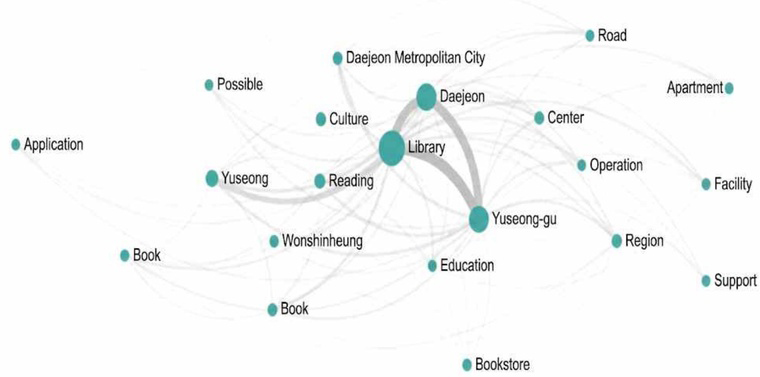
From a network perspective, the term “library” functions as the primary hub node, forming similarity links of 0.07 or higher with nearly all keywords. In addition, terms such as Yuseong-gu, Daejeon, operations, and education form multiple connections with core keywords, indicating that they can be treated as key structural variables in policy design and strategic planning. This suggests that the discourse hub is structurally anchored around the library itself, while place markers (Yuseong-gu, Daejeon) and the operational–educational axis provide the principal structural supports that stabilize and organize that hub within the broader semantic network.
Analysis of High-Similarity Keyword Pairs
Policy implications can be derived along several lines. First, because the current discourse remains strongly anchored to a conventional image centered on operations, facilities, and books, there is a need to diversify library functions by expanding digital content, hybridized spaces, and creative programming. Second, since the geographic configuration of Daejeon–Yuseong-gu–Yuseong operates as the baseline frame through which policy narratives are articulated, policy design should foreground place-based publicness and spatial accessibility as core principles. Third, given the exceptionally strong coupling between reading and education, it is strategically sound to prioritize education-collaboration content targeting school-age children and families. Fourth, the findings support a shift toward an everyday-life embedded spatial model: by leveraging the neighborhood network implied by apartment–road/street–center, the library can develop community-oriented spaces that foster a cyclical user experience in which daily life, learning, and culture mutually reinforce one another.
Co-occurrence Matrix (1-mode; Similarity Coefficients)
4.6 Network Analysis Results
The network exhibits high density and a short average path length, indicating that information diffusion and thematic interrelatedness are strongly integrated across the discourse space. At the same time, because a subset of keywords functions as central hubs, future policy keyword selection and content curation processes are likely to be most effective if they adopt a hub-centered approach—designing derivative and diffusion strategies that radiate from these high-salience core terms. Meanwhile, overall betweenness centralization is extremely low, suggesting that the network does not depend on a single gatekeeper node and instead supports a distributed, multi-path structure. This configuration is advantageous for planning programs and cross-cutting services that flexibly combine distinct themes, as it enables multiple thematic entry points and recombination without bottleneck effects.
Network Properties and Values
Across the full-network results, “library” recorded the highest values in both word frequency and centrality, confirming its role as the primary organizing node of the discourse. In parallel, geographic and administrative terms—such as “Daejeon,” “Yuseong-gu,” and “Wonsinhung”—also show relatively high centrality, indicating that library-related discourse and cultural policy considerations are closely tied to place-specific, locally differentiated strategies. This finding supports the need to pursue living-area–based (neighborhood-scale) library policies in tandem with customized services at the sub-district (eup-myeon-dong) level.
Moreover, the frequent co-occurrence of “culture,” “center,” and “books” with “library” highlights the growing prominence of the library as a multifunctional cultural complex and a space for creative activity. This pattern suggests that policy should more strongly prioritize content-oriented spatial innovation strategies, including cultural-arts education, digital creation spaces, and makerspaces. By contrast, keywords such as “operations,” “support,” and “application/registration” appear less often in absolute frequency, yet they provide critical leverage points along connectivity pathways for improving administrative and operational service quality. Accordingly, these terms warrant prioritized attention at the detailed design stage of the policy operational model, where implementation feasibility and service delivery mechanisms are specified.
Taken together, the results support a coherent strategic direction: establishing a library-centered, multi-issue policy agenda (positioning the library as a policy platform); designing regionally tailored libraries embedded in everyday living areas (operationalized through sub-district (eup-myeon-dong)level differentiation); expanding policy models that integrate space and content (via linkages among culture, books, and centers); and strengthening implementation capacity through systematic refinement of operational and support systems.
Overall Network Analysis Results
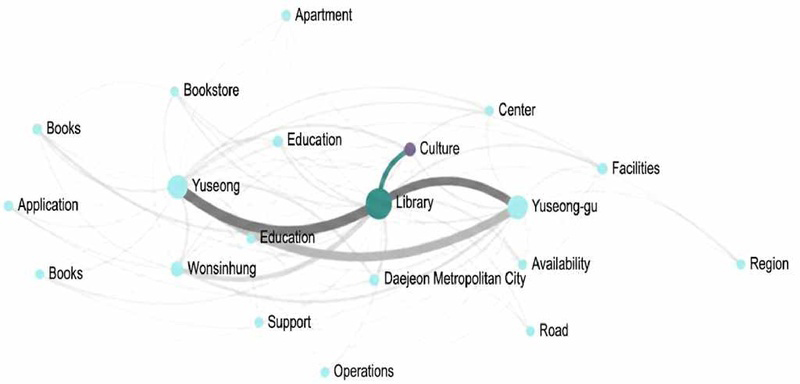
In the shortest-path analysis, “library” and “culture” were found to be directly connected (one step). In the visualization, the edge linking the two nodes is rendered as a thick, dark gray line, suggesting a relatively high cosine similarity and/or co-occurrence frequency. Because this relationship is established without any intermediary (bridging) node, the shortest distance is interpreted as 1 (Fig. X).
This finding indicates that the library is positioned not merely as an information-provision facility but as a cultural platform within the local discourse structure. Accordingly, it may be beneficial to integrate the design of local cultural promotion initiatives with exhibition, performance, and experiential programs, while institutionalizing collaborative governance with relevant municipal departments (e.g., the Culture and Arts Division and the Lifelong Education Division). Such coordination would enable the library to function as a cultural-content coordination hub. In the short term, expanding programming through book concerts and reading-culture festivals is appropriate; in the mid to long term, a more strategic direction is to develop the library into a sustainable node within the local cultural ecosystem by connecting and mobilizing diverse cultural actors across the community.
4.7 Clustering Analysis Results
The community structure was analyzed within the keyword network. To achieve an analysis that is both internally consistent and sufficiently discriminative, four community-detection algorithms were applied in combination: Louvain, Leiden, Girvan–Newman, and Clauset–Newman–Moore (CNM). Each algorithm contributes a distinct analytical advantage: Louvain identifies discourse blocks via modularity optimization; Leiden strengthens cluster reliability by improving intra-community connectivity; Girvan–Newman, by sequentially removing high-betweenness edges, helps reveal peripheral or weakly integrated terms; and CNM serves as a complementary validation tool, particularly useful for assessing whether the network simultaneously contains a library-centered structure and an everyday-life infrastructure-related structural axis.
Shortest Path between “Library” and “Culture”
The Louvain algorithm begins by assigning each node to its own cluster and then iteratively moves nodes into neighboring candidate clusters to maximize modularity. Modularity increases when within-cluster link density is high and between-cluster connectivity is relatively sparse; consequently, the algorithm is oriented toward identifying a partition that most cohesively explains the network’s community structure.
The Louvain results indicate three substantive communities. Cluster 1 (green) is centered on library–culture–Daejeon Metropolitan City–Yuseong-gu, foregrounding the library’s cultural function and its role as a place-based public hub. This configuration simultaneously highlights the structural linkage among locality, publicness, and cultural resource distribution. Cluster 2 (purple) is organized around the node set support–apartment–application/registration, capturing policy demand and accessibility dynamics associated with residential living environments and institutional support mechanisms. This cluster underscores the need for a public library operational model that is structurally integrated with neighborhood-level infrastructure. Cluster 3 (blue) consolidates center–facilities–operations–road/street, concentrating on issues related to spatial infrastructure and operational governance systems. It implies a policy agenda focused on operational optimization and stronger integration with multifunctional public facilities.
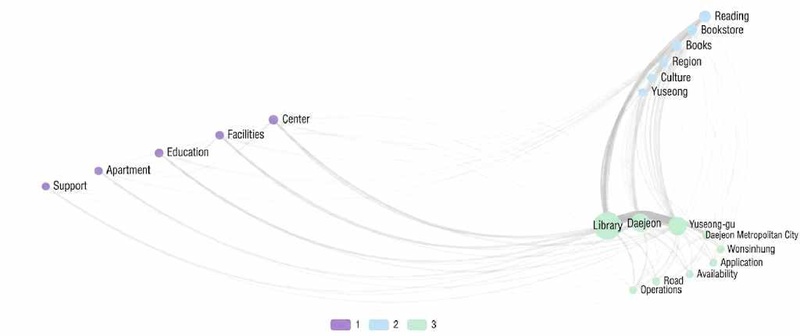
Louvain Clustering Results
The Leiden algorithm improves upon Louvain by first refining nodes into smaller, better-connected communities and then gradually merging them, yielding a more stable and internally coherent community structure. In this analysis, two dominant clusters emerged.
The first cluster converges on library, reading, Yuseong, Yuseong-gu, culture, functions, books, and operations, indicating that attention is concentrated on core library services—reading activities, cultural programming, and operating functions. From a policy standpoint, this suggests the need to strengthen and upgrade the library’s functional capacity and strengthen reading-culture and content services. The second cluster groups Daejeon, Yuseong-gu, region, center, apartment, facilities, support, road/street, and education, emphasizing locational conditions, accessibility, and place-based linkage. Accordingly, it is reasonable to pursue living-area–centered redistribution (or reconfiguration) of library services, and reinforce institutional linkages with multifunctional cultural spaces.
The Girvan–Newman algorithm identifies community structure by sequentially removing edges with high betweenness, thereby hierarchically partitioning the network. When applied here, the results reveal a clear split between a core service axis and a peripheral cultural linkage structure.
The first community clusters library, Daejeon, Yuseong, reading, application/registration, facilities, and programs, confirming a central service axis in which the library’s functions, operations, and usage modalities are tightly integrated. This suggests that strengthening functional delivery and improving facility operations are essential for enhancing user experience and program execution capacity. By contrast, the second community isolates “bookstore” as a peripheral node, indicating weak structural connectivity between the library and external cultural touchpoints. This finding implies the need to establish institutional collaboration channels with independent bookstores and the local publishing ecosystem, and to mitigate fragmentation in the cultural network through joint planning (e.g., author talks, book talks) and coordinated distribution and promotion.
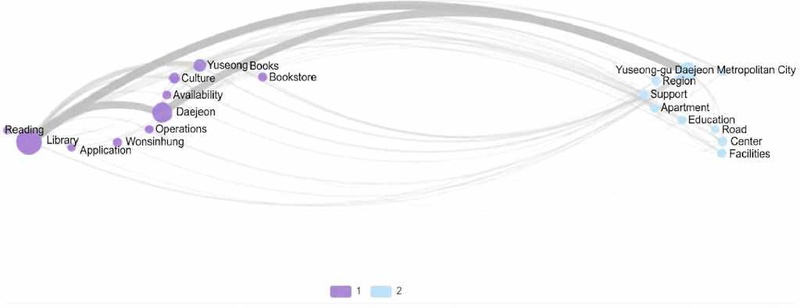
Leiden Clustering Results
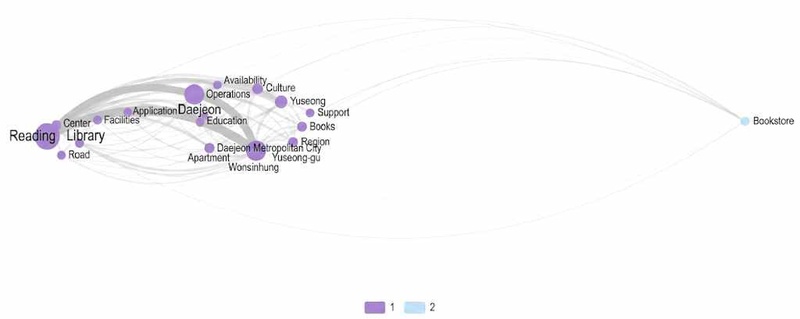
Girvan–Newman Clustering Results
The Girvan–Newman algorithm identifies community structure by sequentially removing edges with high betweenness, thereby hierarchically partitioning the network. When applied here, the results reveal a clear split between a core service axis and a peripheral cultural linkage structure.
The first community clusters library, Daejeon, Yuseong, reading, application/registration, facilities, and programs, confirming a central service axis in which the library’s functions, operations, and usage modalities are tightly integrated. This suggests that strengthening functional delivery and improving facility operations are essential for enhancing user experience and program execution capacity. By contrast, the second community isolates “bookstore” as a peripheral node, indicating weak structural connectivity between the library and external cultural touchpoints. This finding implies the need to establish institutional collaboration channels with independent bookstores and the local publishing ecosystem, and to mitigate fragmentation in the cultural network through joint planning (e.g., author talks, book talks) and coordinated distribution and promotion.
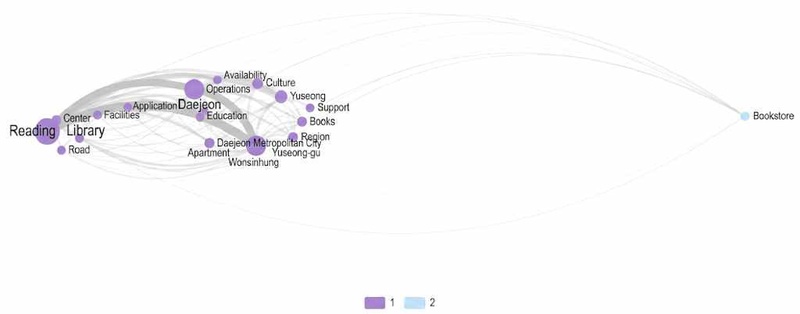
Girvan–Newman Clustering Results
The CNM algorithm is a modularity-based community-detection method that identifies the most cohesive partition by comparing intra-community link density against the overall graph connectivity pattern. In CNM, modularity increases when nodes within the same community are densely connected while connections between communities remain relatively sparse (Clauset, Newman, & Moore, 2004). Notably, the CNM results replicate the major structural pattern observed in the Leiden analysis, providing evidence of structural convergence and methodological robustness.
Specifically, the first cluster—including library, Yuseong-gu, culture, reading, functions, Daejeon Metropolitan City, Wonsinhung, and application/registration—forms a library-centered network in which operational and user-centered terms are tightly interwoven. This indicates that refined user-oriented service design—such as improving operational efficiency, program architecture, and application/use pathways—should be treated as a priority policy and operational priority. The second cluster—comprising facilities, road/street, education, center, region, and apartment—forms an infrastructure and living-area axis, where physical space and neighborhood concepts cohere into a single structural configuration. This pattern supports an expansion strategy premised on organic linkage with lifestyle infrastructure: improving sub-area accessibility, integrating with multifunctional cultural complexes, and strengthening connections with education and welfare infrastructure systems.
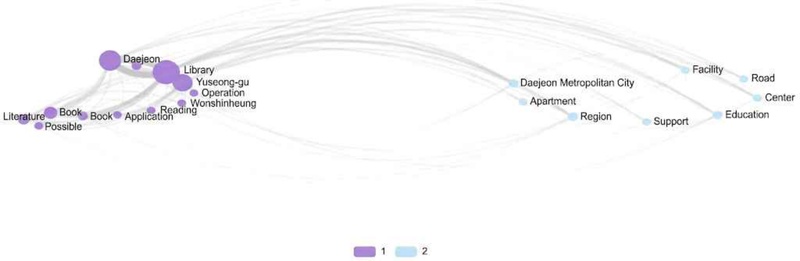
Clauset-Newman-Moore analysis results
5. Discussion
This section integrates the findings from text mining, network analysis, and topic modeling to discuss strategic directions for public library policy in Yuseong-gu.
First, with respect to whether the network structure of Yuseong-gu public libraries supports the role of a place-based public service hub, the network exhibits high density and a short average path length, indicating tightly coupled information diffusion and thematic connectivity. “Library” is identified as the central hub, ranking highest in both frequency and betweenness-centrality measures. The direct one-step linkage between “library” and “culture,” together with the strong cohesion of the “Daejeon–Yuseong-gu–region” axis, suggests that the library should be redefined not as a stand-alone facility but as a platform for an integrated culture-education complex at the local level. The fact that multiple community-detection methods—Louvain, Leiden, CNM, and Girvan–Newman—repeatedly reproduce the “library–culture–Yuseong-gu (Daejeon)” axis and the “facilities–center–operations” axis further strengthens the plausibility of a hub strategy that combines (i) a hub–satellite (branch) configuration at the neighborhood-unit level (e.g., Wonsinhung, Jeonmin, Gujeuk) with (ii) governance and program modules responsive to local agendas. Consistent with this interpretation, the 2040 Daejeon Urban Master Plan (Daejeon Metropolitan City, 2025) identifies persistent gaps in accessibility to public library services in some neighborhoods, particularly in newly developed and peripheral areas. It also points to substantial variation in library utilization across sites and a tendency for demand to concentrate in certain facilities. Against this backdrop, this study argues that policy should pursue both balanced neighborhood-based coverage and strengthened functions of integrated hub libraries, with concrete operational implications supported by the topic map and the keyword/network evidence.
Second, regarding spatial and service reconfiguration for a transition toward a multifunctional cultural platform, the LDA topics and the N-gram/keyword results jointly indicate two intertwined axes: a convergence axis of “education–culture–information–resident activities” and a management axis of “integration–operations–support–center.” The strong multi-word chain “Yuseong-gu–integrated–library–homepage” provides particularly clear evidence for the necessity of building a digitally anchored portal that integrates information access and civic participation. At the spatial level, the “facilities–center–road/street” cluster reflects concerns regarding neighborhood accessibility and supports redesigning library space into hybrid configurations that combine functions such as makerspaces, digital creation studios, family learning lounges, and small-scale performance/exhibition areas. At the service level, the strong coupling between “reading” and “education,” together with demand signals such as “children,” “school,” and “classes,” indicates the need for cross-bundled programming that interlinks (i) education collaboration programs aligned with schools and district education offices for school-age children and families, (ii) support for citizen creators (e.g., local content production and community-history archiving), and (iii) age-friendly services (e.g., digital capacity building and health-information support). In addition, operational keywords such as “operations,” “support,” and “application/registration” carry actionable implications for the service delivery system. These findings suggest that the service journey from application to use and feedback should be standardized, while the advantages of a distributed network structure should be leveraged to flexibly assemble thematically integrated programs without bottlenecks.
Third, in designing a data-driven policy planning and evaluation system, the six-topic structure—selected on the basis of topic coherence—reduces thematic redundancy and enhances interpretability, providing a quantitative foundation for strategic prioritization. A KPI dashboard that embeds text-mining indicators across the full cycle of planning, implementation, and evaluation is therefore recommended, with three primary analytic pillars: discourse (topic probabilities and keyword centrality), sentiment (positive/negative polarity and finer-grained affect composition), and relations (network centrality and modularity). Building on these pillars, high-impact themes such as “local culture + reading activities” can be designated as lead pilot projects and monitored quarterly by linking changes in topic shares to participation rates, satisfaction, and revisit rates. Resource allocation can then be operationalized through a decision matrix combining cohesion, diffusion potential, and intervention difficulty—prioritizing high-impact/low-cost areas for initial investment while integrating or scaling down redundant or low-efficiency areas. Finally, if the same methodology is formalized into a routine protocol—collection, preprocessing, modeling, validation, and policy translation—applicable across administrative neighborhoods and other municipalities, it can ensure scalability and long-term policy and operational sustainability.
Overall, the convergent evidence from discourse analysis, network structure, and topic modeling indicates that Yuseong-gu public libraries are well positioned to evolve into a regionally anchored multifunctional cultural platform. In terms of space and infrastructure, multifunctional cultural and learning resources should be concentrated in high-centrality hub nodes, while a hub–branch distributed spatial strategy should ensure balanced accessibility across local living areas. In terms of operations and services, libraries should transition toward a service portfolio in which education, culture, information, and community engagement are integrated, and user-centered, empathy-based experiential design that fosters positive affect should be strengthened. In terms of content and programs, life-stage- and interest-specific curation should be advanced, while multi-institutional partnerships—among the local government, schools, and community organizations—should be institutionalized to build a locally driven cultural collaboration network. Finally, by establishing a data-driven decision system that uses quantitative indicators such as cosine similarity, topic modeling outputs, and network centrality as core evidence for policy prioritization and performance evaluation, Yuseong-gu libraries can function as a sustainable public cultural infrastructure that strengthens local identity and community capacity.
6. Conclusion and Recommendations
This study integrated big-data evidence collected between July 2022 and June 2025 through text mining, network analysis, and LDA topic modeling, with the aim of translating the discourse structure, user affect, and relational patterns surrounding Yuseong-gu public library services into an actionable policy architecture. The results identify “library” as the dominant hub in both frequency and betweenness centrality, while its one-step cohesion with “culture,” “Yuseong-gu,” and “Daejeon” positions the library as a platform for locally grounded cultural and educational policy. In addition, the six-topic structure, selected to maximize interpretability while minimizing redundancy, enabled the derivation of layered strategies spanning space, services, and governance. Taken together, the findings indicate that Yuseong-gu public libraries possess strong structural potential to evolve into a regionally anchored multifunctional cultural platform.
Based on these results, the following policy recommendations are proposed. First, reconfigure space and infrastructure by designing a distributed hub–satellite (branch) system, concentrating hybrid functions—such as makerspaces, digital creation studios, and family learning lounges—within high-centrality hub library nodes, while deploying smaller, modular, accessibility-oriented facilities within neighborhood units (e.g., Wonsinhung, Jeonmin, and Gujeuk) to ensure balanced spatial coverage. Second, transform the service portfolio toward an integrated model that combines education, culture, information, and community engagement, and develop cross-bundled programming that links school-age and family-oriented initiatives with school and education-office partnerships, while simultaneously expanding support for citizen creators and age-friendly services for older adults. Third, build a digital hub by developing an integrated portal that consolidates search, reservation, participation, reviews, and data disclosure, consistent with the strong “integration–homepage–operations” chain; this should be paired with mobile-first user experience design and a standardized application–use–feedback service journey. Fourth, institutionalize local collaborative governance by establishing a standing consultative body involving the local government, schools, independent bookstores, and cultural institutions, and formalizing mechanisms for joint programming (e.g., book talks and local-history archiving) and resource sharing. Fifth, adopt affect-based experience design by scaling experiential programs that amplify positive affect, while assigning the “inconvenience” factors that generate negative sentiment—such as circulation, noise, seating, and wayfinding—as short-term operational improvement priorities to produce visible, rapid changes. Sixth, embed data-driven decision-making by building a dashboard that integrates the six-topic structure, keyword centrality, and sentiment indicators as core KPIs for quarterly monitoring, and prioritizing investment in high-impact/low-cost intervention areas. Seventh, operationalize a communication strategy by leveraging the diffusion capacity of Tistory blogs through ambassador and experiential reviewer programs, systematizing media exposure with press-kit packages supported by quantitative indicators and infographics, and penetrating weaker café- and neighborhood-platform channels via highly localized informational content (e.g., program calendars and neighborhood-linked service offerings).
An implementation roadmap is proposed in three phases. In the short term (0–6 months), the focus should be on micro-level UX improvements, a minimum viable product (MVP) of the integrated portal, and dual-track diffusion via bloggers and traditional media channels. In the mid-term (6–18 months), priorities include designing and piloting hub–satellite spatial reallocation, branding flagship education–culture integrated programs (e.g., a “local culture + reading” pilot), and institutionalizing the consultative governance body. In the long term (18+ months), the aim should be to establish a performance-based budgeting model anchored in outcome indicators and to scale successful models to adjacent neighborhoods and other municipalities. Performance evaluation should be structured across five dimensions: discourse (topic shares and centrality), affect (positive/negative polarity and fine-grained emotion profiles), relations (network centrality and modularity), use (participation, revisits, and dwell time), and accessibility (mobile use and coverage of vulnerable user groups).
Several limitations should be acknowledged. The data sources were limited to publicly available textual data from Naver and Daum, which limits the capture of discourse contexts circulating within closed platforms (e.g., messaging apps and some SNS environments). Automated morphological processing may also introduce misclassification errors that are difficult to quantify with precision. In addition, the analytical pipeline depends on TEXTOM’s algorithmic procedures and dictionary settings, which may constrain interpretive flexibility. The restricted three-year window may further introduce distortions related to seasonal variation and policy-cycle effects. Future work should therefore broaden generalizability by incorporating multiple platforms and heterogeneous data sources, and should strengthen inference by integrating fused data collection with user journey (log) analytics and by adopting causal frameworks that link topics, affect, and behavior through experimental or quasi-experimental designs. Moreover, because this study prioritizes structural discourse analysis using conventional text-mining techniques, subsequent research should explore the use of large language models (LLMs) to enable context-sensitive representation learning and more precise investigation of latent semantic relations and inferential meaning structures.
Despite these limitations, this study provides a concrete pathway for redesigning the public library as a policy platform, grounded in quantitative evidence on local discourse, affect, and relational structure. If Yuseong-gu implements the proposed spatial, service, governance, and data systems in a staged manner, its public libraries can move beyond their conventional role as reading facilities to become everyday cultural hubs where learning, creation, and civic solidarity converge—ultimately contributing to measurable public outcomes such as stronger local identity and enhanced community capacity.
Statements and Declarations
Author Contributions: Conceptualisation, Y.N. and J.K.; methodology, Y.N., J.K., and I.J.; software, J.K. and J.S.; validation, Y.N. and J.K.; formal analysis, J.K. and Y.S.; investigation, Y.N., J.K., and Y.S.; resources, Y.N. and I.J.; data curation, J.K. and Y.S.; writing—original draft preparation, Y.N. and J.K.; writing—review and editing, Y.N., I.J., and J.S.; visualisation, J.K. and J.S.; supervision, Y.N.; project administration, Y.N. and I.J.; funding acquisition, Y.N. All authors have read and agreed to the published version of the manuscript.
Institutional Review Board Statement: Not applicable.
Informed Consent Statement: Not applicable.
Funding: Not applicable.
Data Availability Statement: The data presented in this study are available from the corresponding author upon reasonable request.
Conflicts of Interest: The authors declare no conflict of interest.
References
-
Abadie, A., Diamond, A., & Hainmueller, J. (2010). Synthetic control methods for comparative case studies: Estimating the effect of California’s tobacco control program. Journal of the American Statistical Association, 105(490), 493–505.
[https://doi.org/10.1198/jasa.2009.ap08746]

-
Ansell, C., & Gash, A. (2008). Collaborative governance in theory and practice. Journal of Public Administration Research and Theory, 18(4), 543–571.
[https://doi.org/10.1093/jopart/mum032]
-
Bennett, A., & Checkel, J. T. (2015). Process tracing: From metaphor to analytic tool. Cambridge, UK: Cambridge University Press.
[https://doi.org/10.1017/CBO9781139858472]
-
Bitner, M. J. (1992). Servicescapes: The impact of physical surroundings on customers and employees. Journal of Marketing, 56(2), 57–71.
[https://doi.org/10.1177/002224299205600205]
-
Borgatti, S. P., & Everett, M. G. (1997). Network analysis of 2-mode data. Social Networks, 19(3), 243–269.
[https://doi.org/10.1016/S0378-8733(96)00301-2]
-
Burt, R. S. (1992). Structural holes: The social structure of competition. Cambridge, MA: Harvard University Press.
[https://doi.org/10.4159/9780674029095]
-
Coleman, J. S. (1988). Social capital in the creation of human capital. American Journal of Sociology, 94, S95–S120.
[https://doi.org/10.1086/228943]
-
Emerson, K., Nabatchi, T., & Balogh, S. (2012). An integrative framework for collaborative governance. Journal of Public Administration Research and Theory, 22(1), 1–29.
[https://doi.org/10.1093/jopart/mur011]
-
Freeman, L. C. (1979). Centrality in social networks: Conceptual clarification. Social Networks, 1(3), 215–239.
[https://doi.org/10.1016/0378-8733(79)90002-9]
-
Granovetter, M. S. (1973). The strength of weak ties. American Journal of Sociology, 78(6), 1360–1380.
[https://doi.org/10.1086/225469]
- Krippendorff, K. (2013). Content analysis: An introduction to its methodology (3rd ed.). Thousand Oaks, CA: SAGE.
-
Lee, S., Kim, H., Baeck, S., & Yoon, S. (2022). A Study on the Research Trends of Big Data at Public Libraries: with a Focus on the Journal “Public Library Quarterly”. International Journal of Knowledge Content Development & Technology, 12(Special Issue), 69–83.
[https://doi.org/10.5865/IJKCT.2022.12.S.069]
-
Lincoln, Y. S., & Guba, E. G. (1985). Naturalistic inquiry. Newbury Park, CA: SAGE.
[https://doi.org/10.1016/0147-1767(85)90062-8]
- Miles, M. B., Huberman, A. M., & Saldaña, J. (2014). Qualitative data analysis: A methods sourcebook (3rd ed.). Thousand Oaks, CA: SAGE.
-
Noh, Y., & Kim, D. (2022). A Study on Social Perceptions of Public Libraries Utilizing the sentiment analysis. International Journal of Knowledge Content Development & Technology, 12(4), 41–65.
[https://doi.org/10.5865/IJKCT.2022.12.4.041]
- Noh, Y., & Lee, J. (2024). A cultural space connecting books and people: Records of independent bookstores—Gangwon & Chungcheong [in Korean]. Chungju, Korea: Institute for Knowledge Contents.
-
Noh, Y., & Lee, J. (2024). Independent bookstores as cultural infrastructure in regions at risk of population decline. Korean Comparative Government Review, 28(4), 243–261.
[https://doi.org/10.18397/kcgr.2024.28.4.243]
-
Noh, Y., & Lee, J. (2024). Revitalizing bookstores as disappearing local cultural resources. Korea and the World, 6(4), 131–166.
[https://doi.org/10.22743/kwr.2024.6.4.131]
-
Noh, Y., & Lee, J. (2025). Bookstores’ roles in regional regeneration and creative-class formation in depopulating areas. Korea and International Society, 9(1), 681–701.
[https://doi.org/10.22718/kga.2025.9.1.024]
-
Noh, Y., Roh, J.-w., & Kim, H.-w. (2025). The Multidimensional Evolution of Literacy and Its Social Role: An Empirical Study Through Network Analysis. International Journal of Knowledge Content Development & Technology, 15(2), 97–121.
[https://doi.org/10.5865/IJKCT.2025.15.2.097]
- Oldenburg, R. (1999). The great good place (2nd ed.). New York, NY: Marlowe & Company.
-
Opsahl, T., Agneessens, F., & Skvoretz, J. (2010). Node centrality in weighted networks: Generalizing degree and shortest paths. Social Networks, 32(3), 245–251.
[https://doi.org/10.1016/j.socnet.2010.03.006]
- Pine, B. J., II, & Gilmore, J. H. (1999). The experience economy. Boston, MA: Harvard Business School Press.
-
Provan, K. G., & Kenis, P. (2008). Modes of network governance: Structure, management, and effectiveness. Journal of Public Administration Research and Theory, 18(2), 229–252.
[https://doi.org/10.1093/jopart/mum015]
-
Provan, K. G., & Milward, H. B. (1995). A preliminary theory of interorganizational network effectiveness: A comparative study of four community mental health systems. Administrative Science Quarterly, 40(1), 1–33.
[https://doi.org/10.2307/2393698]
-
Provan, K. G., & Milward, H. B. (2001). Do networks really work? A framework for evaluating public-sector organizational networks. Public Administration Review, 61(4), 414–423.
[https://doi.org/10.1111/0033-3352.00045]
-
Putnam, R. D. (2000). Bowling alone: The collapse and revival of American community. New York, NY: Simon & Schuster.
[https://doi.org/10.1145/358916.361990]
-
Ragin, C. C. (2008). Redesigning social inquiry: Fuzzy sets and beyond. Chicago, IL: University of Chicago Press.
[https://doi.org/10.7208/chicago/9780226702797.001.0001]
- Relph, E. (1976). Place and placelessness. London, UK: Pion.
-
Schneider, C. Q., & Wagemann, C. (2012). Set-theoretic methods for the social sciences: A guide to qualitative comparative analysis. Cambridge, UK: Cambridge University Press.
[https://doi.org/10.1017/CBO9781139004244]
- Tuan, Y.-F. (1977). Space and place: The perspective of experience. Minneapolis, MN: University of Minnesota Press.
Younghee Noh has an MA and PhD In Library and Information Science from Yonsei University, Seoul. She has published more than 50 books, including 3 books awarded as Outstanding Academic Books by Ministry of Culture, Sports and Tourism (Government) and more than 120 papers, including one selected as a Featured Article by the Informed Librarian Online in February 2012. She was listed in the Marquis Who’s Who in the World in 2012-2016 and Who’s Who in Science and Engineering in 2016-2017. She received research excellence awards from both Konkuk University (2009) and Konkuk University Alumni (2013) as well as recognition by “the award for Teaching Excellence” from Konkuk University in 2014. She received research excellence awards form ‘Korean Y. Noh and Y. Shin International Journal of Knowledge Content Development & Technology Vol.9, No.3, 75-101 (September 2019) 101 Library and Information Science Society’ in 2014. One of the books she published in 2014, was selected as ‘Outstanding Academic Books’ by Ministry of Culture, Sports and Tourism in 2015. She received the Awards for Professional Excellence as Asia Library Leaders from Satija Research Foundation in Library and Information Science (India) in 2014. She has been a Chief Editor of World Research Journal of Library and Information Science in Mar 2013 ~ Feb 2016. Since 2004, she has been a Professor in the Department of Library and Information Science at Konkuk University, where she teaches courses in Metadata, Digital Libraries, Processing of Internet Information Resources, and Digital Contents.
Inho Chang was granted a degree of Library and Information Science from Sungkyunkwan University, Seoul, South Korea. He has published more than 55 papers. Since 2014, he is an Associate Professor in the Department of Library and Information Science at Daejin University, where he teaches courses in Metadata, Information Retrieval, Ontology Engineering, and Digital Curation. His main research fields are Metadata, Ontology Engineering, Semantic Web etc.
Jihei Kang is an associate professor at the Department of Library and Information Science at Dongduk Women’s University, South Korea. She is interested in understanding how information specialists perceive innovations and advancements in technology. Dr. Kang received her master's degree in Library and Information Science from the University of Buffalo, SUNY, and her doctorate from Florida State University. She serves as a member of the Korean Bibliography Numbering Committee of the National Library of Korea, an advisory member of the National Library for the Disabled, and a member of the Research Ethics Advisory Group of the National Research Foundation of Korea.
Ji-Yoon Ro received her PhD in Library and Information Science from Konkuk University. She is an associate professor in the Department of Library and Information Science at Gwangju University, South Korea. Her research interests include the sharing economy, knowledge sharing, blockchain applications in libraries, cooperative networks, social informatics, and libraries and urban regeneration.
Youngji Shin received her PhD in Library and Information Science from Konkuk University. She is an associate professor in the Department of Library and Information Science at Dong-Eui University, South Korea. Her research interests include digital transformation, digital competencies, and data science.