Evaluating and Restructuring Library Specialization Strategies: A Case Study of Pyeongchang County
Abstract
This study diagnoses the outcomes and limitations of thematic specialization in Pyeongchang County’s public and small libraries and proposes a sustainable re-specialization model. Through literature review, current status analysis, and survey research, the implementation of the 1st Mid- to Long-term Development Plan (2020-2025) was evaluated, and a demand survey (n=169) comparing users’ and non-users’ perceptions along with a librarian survey (n=7) were conducted. Findings reveal that both users (66.3%) and non-users (62.5%) prioritize user demand and community needs analysis, with no statistically significant differences between groups ( χ2=2.15, p=0.91). While the 1st plan achieved results in remodeling and infrastructure, program sustainability was constrained by insufficient specialized personnel, governance structures, and financial continuity. Pyeongchang’s thematic specialization tracks (digital, senior, youth, culture & arts, everyday-life, multicultural) align with regional contexts (average 3.5-3.7 points), but sustained success requires integrated mechanisms: specialized librarian systems, cohort-type program architecture, cross-sector network governance, and diversified funding portfolios. Library-specific implementation models and a phased roadmap (2026-2030) are proposed to transform specialization strategies into sustainable structures.
Keywords:
Specialized Libraries, Regional Contexts, Program Sustainability, User Demand, Implementation Model1. Introduction
The 4th Comprehensive Library Development Plan (2024-2028), deliberated and finalized by the Presidential Committee on Library Policy on May 29, 2024, establishes a national-level library policy with the vision of “Libraries for All, Libraries with Communities.” Specifically, it designates “providing specialized services to enhance regional vitality” as a core task, emphasizing the need to discover future-oriented specialized themes based on community demands and to foster and support specialized libraries with local content for regional brand formation (Presidential Committee on Library Policy, 2024). This national policy direction serves as crucial guidance for local governments in establishing library development plans, and Pyeongchang County libraries are also required to develop mid- to long-term development plans aligned with these policies.
Subject-based library specialization has been justified as a differentiation strategy tailored to regional demands. Examining factors to consider when selecting and designing specialized themes through previous research, Jang, Kim, and Kim (2016) emphasized the need for integrated design of specialized themes with spatial configuration and usage behavior compatibility. Chung (2023) proposed through a meta-analysis of domestic library and information science research that specialization should be approached as an integrated design methodology encompassing space-content-programs-personnel-governance rather than as a single element. Kim and Kim (2024) presented construction and operation models based on regional environmental analysis, specifying application strategies for specialization that reflect regional contexts.
Pyeongchang County is a basic local government in Gangwon Special Self-Governing Province, characterized as a mountainous and rural area experiencing population aging. With residential areas dispersed across eight eup and myeon (townships), the region exhibits significant seasonal fluctuations in tourism demand following the 2018 Winter Olympics and maintains an industrial structure centered on agriculture and tourism. These regional characteristics raise the necessity for public library operations to secure accessibility at the residential area level, develop collections reflecting regional identity, design programs encompassing diverse generations and themes, and establish external network linkages to complement limited personnel. In particular, library specialization in rural areas should not be approached simply as the deployment of subject-specific collections, but rather as an integrated operational system that analyzes actual community needs and usage patterns and connects them with spatial configuration, program operations, and personnel deployment.
Accordingly, this study aims to diagnose the achievements and limitations of subject-based specialization in Pyeongchang County’s public and small libraries, structurally identify constraining factors in organization, finance, and networks, and propose sustainable re-specialization and operational models. The research methodology included literature review, current status analysis, and survey research targeting users, non-users, and librarians of Pyeongchang County’s public and small libraries. Through this approach, the study seeks to present an evidence-based policy framework for sustainable specialization design of libraries in rural local governments.
2. Literature Review
Research on library specialization has established itself as a major trend in public library operational strategies. In particular, as the necessity of subject-specialized libraries reflecting regional characteristics and user demographics has been emphasized, various case analyses and studies on development directions have been conducted.
The majority of studies propose operational strategies for specialized libraries considering regional contexts and user needs. Noh, Kwak, and Shin (2018) compared domestic and international specialized library cases to explore the typology and development directions of library specialization, while Noh, Jung, and Noh (2020) presented specialization strategies reflecting user group demands and regional conditions through the Gimpo City case. Noh, Jang, Kang, et al. (2021) specifically proposed operational strategies for specialized libraries linked to regional cultural revitalization through the Dong-gu, Incheon Metropolitan City case. Park (2023) analyzed the functional characteristics of subject-specialized libraries focusing on the Kim Geun-tae Memorial Library, emphasizing the necessity of specialization operations reflecting regional identity and commemorative value. Kim and Kim (2024) presented specialization operation directions based on regional environments, centering on a specific county library construction case, and emphasized the potential for linking regional ecological and cultural resources with library services. These studies demonstrate that region-based differentiation strategies and reflection of regional identity are core elements of specialized library success.
Meanwhile, research on spatial configuration and administrator perceptions of library specialization has also been conducted. Jang, Kim, and Kim (2016) analyzed the spatial configuration and characteristics of specialized libraries, revealing that spatial arrangement according to specialization themes and differentiation of user experience are directly connected to operational performance. Noh and Oh (2018) revealed diverse perceptual differences regarding the necessity and limitations of specialization in a survey of public library directors, emphasizing the need for policy support and establishment of institutional foundations. This suggests that specialization requires not only physical spatial design but also awareness of operating entities and institutional support.
Synthesizing previous research, successful operation of specialized libraries requires theme selection reflecting regionality and user demographics, integrated design of collections, spaces, and programs, and systematic establishment of operational foundations such as budget, personnel, and networks. This means that library specialization is not simple specialization of collections or programs but a strategic approach requiring comprehensive coordination of regional identity, user characteristics, and space-service-network. Therefore, Pyeongchang County libraries’ specialization strategy must also build differentiated models reflecting regional demographic structure and sociocultural resources based on these principles.
3. Methodology
This study conducted literature review, current status analysis, and survey research to establish specialization strategies for public libraries in Pyeongchang County. This approach stems from the recognition that library specialization must comprehensively reflect regional contexts, user needs, and institutional environments, beyond mere collection or program planning dimensions. The detailed research procedures and methods are as follows.
First, through literature review, previous research on operational strategies and development directions of specialized libraries domestically and internationally was examined. This enabled the organization of theoretical foundations and key issues of the specialization concept and the derivation of an analytical framework for the Pyeongchang County case study. Major references analyzed included research on the typology and development directions of library specialization (Noh, Kwak, & Shin, 2018), region-based specialization strategy research (Kim & Kim, 2024), and specialized library case studies from Gimpo City and Incheon Metropolitan City (Noh et al., 2020; 2021).
Second, current status analysis was conducted targeting seven libraries in Pyeongchang County (Daehwa Library, Bongpyeong Library, Jinbu Library, Daegwallyeong Library, HAPPY700 Yongpyeong Library, Kkumyeoul Library, and Bangrimgyechon Library). Implementation status of the 1st Pyeongchang County Library Mid- to Long-term Development Plan (2020-2025) was analyzed through examination of annual investment plans and library-specific specialization initiatives. Operational data, internal documents, and statistical materials from each library were collected and analyzed to identify the implementation status of specialization-related infrastructure expansion, program diversification, and community-led participation program development for each library. Additionally, an online survey was conducted with seven librarians working in Pyeongchang County libraries from March 31 to April 2, 2025, to evaluate the implementation excellence and importance of specialization strategy tasks.
Third, a survey was conducted targeting Pyeongchang County residents to identify library usage status, satisfaction levels, and requirements for library specialization. The survey was conducted online for approximately one month from February 26 to March 25, 2025. A total of 169 questionnaires were collected, with respondents divided into registered library members (users) and non-users and sampled considering distributions of gender, age, residence, and occupation. Survey items consisted of considerations for specialization implementation and appropriateness of specialization themes. Each item was measured using a 5-point Likert scale, and analysis employed descriptive statistics and inter-group difference tests (chi-square test, t-test). Through these research methods, collected data were comprehensively analyzed to derive specialization directions and implementation strategies for each library in Pyeongchang County.
4. Results
4.1 Evaluation of the 1st Pyeongchang County Library Mid- to Long-term Development Plan (2020-2025)
To evaluate the performance of the 1st Pyeongchang County Library Mid- to Long-term Development Plan (2020-2025), the annual investment plans and library-specific specialization initiatives were analyzed.
1) Annual Investment Plan
The analysis of the specialization-related budget plan for 2021-2025 is presented in <Table 1>. A total budget target of 2.18 billion won was established, with 130 million won allocated for specialized collection expansion and 2.05 billion won for remodeling.

Phased Specialization Investment Budget (Unit: million won)
2) Library-Specific Specialization Initiatives and Improvement Tasks
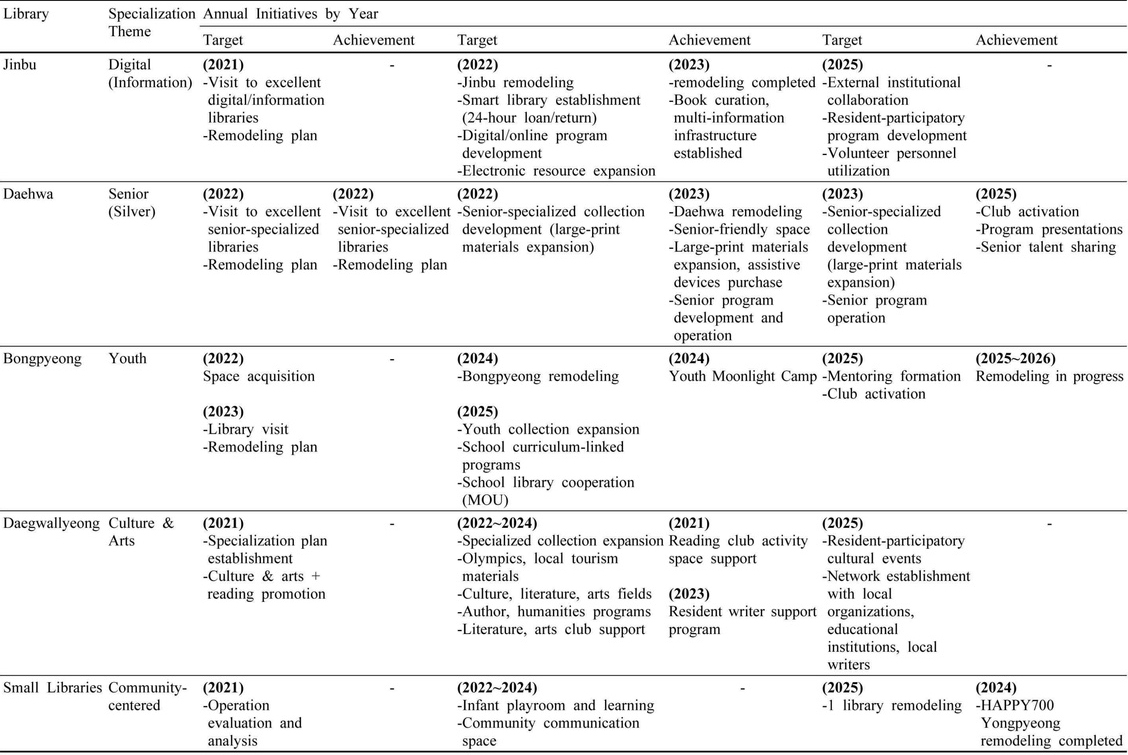
The analysis of annual initiatives by library specialization theme is presented in <Table 2>. Jinbu Library specialized in digital and information services, Daehwa Library in senior services, Bongpyeong Library in youth services, Daegwallyeong Library in culture and arts, and small libraries in community-centered services.
Library-Specific Specialization Initiatives
The analysis revealed that remodeling and basic infrastructure construction generally proceeded as planned. Jinbu Library, Daehwa Library, Bongpyeong Library, and small libraries (HAPPY700 Yongpyeong) have completed or are in the process of completing remodeling, with spaces designed according to their specialization themes.
Each library developed and operated programs aligned with their specialization themes; however, challenges regarding sustainable operation were identified. Resident-led program development, club activation, and external institutional collaboration were set as goals but did not materialize into actual achievements. The utilization of volunteer personnel at Jinbu Library, club activation and program presentations at Daehwa Library, resident-participatory cultural events and regional network establishment at Daegwallyeong Library, and mentoring formation at Bongpyeong Library were proposed as 2025 targets but had not been implemented at the time of this survey.
Accordingly, future improvement tasks for each library are as follows. Jinbu Library completed smart library infrastructure construction but needs to promptly implement external institutional collaboration and resident-participatory programs. Establishing a sustainable operation system, particularly through volunteer personnel utilization, is urgent. Daehwa Library completed senior-friendly space development but needs to establish a senior talent-sharing system through club activation and program presentations. Implementing practical programs to encourage active senior participation is required. Bongpyeong Library established an MOU with school libraries but needs to promptly promote mentoring formation and club activation. Implementing youth-led programs is necessary. Daegwallyeong Library achieved some results through the resident writer support program but needs to fully implement resident-participatory cultural events and establish networks with local organizations, educational institutions, and local writers. Systematic strengthening of regional cooperation is required. Small libraries completed the HAPPY700 Yongpyeong Library remodeling but need to complete the remodeling of the remaining library and maximize the use of infant playrooms and community communication spaces. A strategy to disseminate successful cases to other small libraries is needed.
The implementation excellence and importance of library specialization-related items among the tasks of the 1st Pyeongchang County Library Mid- to Long-term Development Plan (2020-2025) were evaluated (Table 1). The evaluation was conducted through an online survey of seven librarians working in Pyeongchang County libraries from March 31 to April 2, 2025.
1) General Statistics of Respondents
The distribution of seven librarians working in Pyeongchang County libraries by library was Daehwa Library 3 persons (43%), Jinbu Library 2 persons (29%), and Daegwallyeong Library and Bongpyeong Library 1 person each (14%) (Table 2). Respondents’ work experience ranged from 1 to 25 years, with those having 20 years of experience being the most common at 3 persons (42.8%) (Table 3).
Evaluation Framework for Specialization Strategy Tasks
2) Evaluation of Specialization Strategy Implementation
The implementation excellence and importance of detailed items in library-specific specialization strategies were evaluated on a 5-point scale (Table 4). The ‘expansion of theme-specific infrastructure (space, collections, librarian personnel)’ item showed an average of 2.5 points, indicating somewhat insufficient implementation, while item importance was evaluated at an average of 3.7 points, representing a moderate level. The ‘diversification of specialized programs’ item showed an average of 2.7 points, indicating somewhat insufficient implementation, while item importance was evaluated at an average of 3.6 points, representing a moderate level. The ‘development of community-led voluntary participation programs’ item showed an average of 2.3 points, indicating somewhat insufficient implementation, while item importance was evaluated at an average of 3.3 points, representing a moderate level.
Distribution of Respondents by Library
Distribution of Respondents’ Work Experience
Overall, implementation excellence for all items (2.3-2.7 points) was evaluated lower than importance (3.3-3.7 points). This indicates that while the importance of library specialization strategies is recognized, actual implementation performance has not met expectations. In particular, the low evaluation of implementation excellence in infrastructure expansion and community participation program development suggests the possible influence of structural constraints such as budget, personnel, and operational systems.
Evaluation of Library-Specific Specialization Strategy Implementation
4.2 Survey Results on Library Specialization Demand
This survey was conducted to identify Pyeongchang County residents’ demands for library specialization. Survey participants were divided into registered library members (users) and non-users during the same period. The survey was conducted online for approximately one month from February 26 to March 25, 2025. Survey items consisted of considerations for specialization implementation and appropriateness of specialization themes. Each item was measured using a 5-point Likert scale, and analysis employed descriptive statistics and inter-group difference tests (chi-square test, t-test).
1) Considerations for Library Specialization Implementation
Analysis of key considerations for library specialization implementation revealed that both users and non-users identified ‘user demand and community needs analysis’ as the most important factor (users 66.3%, non-users 62.5%). This demonstrates that both groups commonly recognize that the starting point of specialization should be demand-based planning rather than facility supply. Next, ‘geographical and regional environmental factors’ (users 46.2%, non-users 45.3%) and ‘specialized program and service development’ (users 36.7%, non-users 39.1%) formed top responses. This indicates strong demand for simultaneous improvement of physical accessibility and spatial functionality. Inter-group distribution difference testing revealed a chi-square statistic of χ2=2.15, p=0.91, confirming that perceptual differences between the two groups were not statistically significant.
Key Considerations for Library Specialization Implementation
2) Appropriateness of Specialization Themes
Average response value differences between users and non-users across specialization themes were not statistically significant (p>0.05). Both groups evaluated the regional appropriateness of each theme similarly, with means generally converging in the positive range of 3.5~3.7. This indicates that specialization themes established by Pyeongchang County align with regional identity and social needs, with minimal perceptual gaps based on usage status.
Appropriateness of Specialization Themes
3) Implications of Survey Results
Survey results revealed similar perceptions among both users and non-users, with demand-based planning and spatial functionality improvement emerging as common challenges. This suggests that the success of library specialization in extensive rural regions like Pyeongchang County depends on ‘what and how services are provided.’
First, the identification of ‘user demand and community needs analysis’ as the top priority demonstrates the necessity of transitioning from facility-centered supply to user-centered planning. Regarding policy, establishing demand-based strategies should become a core task, requiring institutionalization of continuous demand survey systems and participatory opinion-gathering procedures including both users and non-users.
Second, high demands for ‘geographical and environmental factors’ and ‘functionality and efficiency’ show that content enhancement alone cannot drive usage, and simultaneous improvement of accessibility and spatial configuration is essential. Design priorities for space and services should be realigned in the order of accessibility correction, availability expansion, functionality enhancement, and inclusivity strengthening. Particularly in extensive rural regions like Pyeongchang County, accessibility correction strategies such as residential area-based distributed hubs, mobile loan and return services, flexible operating hours, and online-offline hybrid provision are necessary.
Third, results showing no inter-group perceptual differences in specialization theme appropriateness demonstrate that current specialization directions are appropriate. However, detailed adjustments according to residential area, age, and digital competency are needed at the implementation stage, and performance management indicators should be redesigned from satisfaction-centered to behavior-based indicators such as reach rate, dwell time, revisit rate, and program satisfaction to establish a virtuous cycle structure of demand-based planning.
4.3 Comprehensive Implications for the Operation of Pyeongchang County Specialized Libraries
The following implications were derived by synthesizing the performance analysis of the 1st Pyeongchang County Library Mid- to Long-term Development Plan (2020-2025) and the results of the library specialization demand survey.
First, demand-based planning is necessary. The demand survey revealed that both users and non-users recognized ‘user demand and community needs analysis’ as the top priority for specialization promotion (users 66.3%, non-users 62.5%). The difference in perception between the two groups was not statistically significant ( χ2=2.15, p=0.91), indicating that demand-based specialization strategies have universal validity. The status analysis also confirmed that the implementation of resident-led program composition, club activation, and external institutional collaboration was insufficient. This suggests the need to shift from supplier-centered facility development and program planning to demand-customized planning that reflects the actual needs of local residents.
Second, accessibility improvement and spatial functionality enhancement are required. In the demand survey, ‘geographical and regional environmental factors’ (users 46.2%, non-users 45.3%) and ‘development of specialized programs and services’ (users 36.7%, non-users 39.1%) showed high response rates. This demonstrates that usage promotion cannot be achieved through qualitative content improvement alone, and that simultaneous improvement of physical accessibility and spatial functionality is essential. The status analysis confirmed that remodeling of Jinbu Library, Daehwa Library, Bongpyeong Library, and small libraries (HAPPY700 Yongpyeong) has been completed or is in progress. Moving forward, along with securing core spaces that align with specialization themes (maker spaces, senior lounges, youth media rooms, exhibition and performance spaces, etc.), accessibility improvement strategies reflecting the characteristics of extensive rural areas (distributed hubs based on living zones, mobile lending and return services, flexible operating hours, online-offline hybrid provision) are necessary.
Third, establishing a sustainable program operation system is necessary. The status analysis revealed that while each library developed and operated programs aligned with specialization themes, there were limitations in ensuring sustainability. Programs need to transition from one-time events to sustainable operation systems. By organizing regular cultural events, education, and experiences into cohort-type curricula (introductory-basic-advanced), establishing hybrid delivery systems combining face-to-face and digital methods, and managing outcomes (completion rates, re-participation rates, outputs), the accumulation and deepening of learning can be ensured.
Fourth, securing specialized personnel and capacity building is essential. The librarian survey results showed that the implementation excellence of specialization strategies (2.3-2.7 points) was rated lower than their importance (3.3-3.7 points). In particular, the implementation excellence of thematic infrastructure expansion and community-led participatory program development was rated low, suggesting the influence of structural constraints such as budget, personnel, and operational systems. It is necessary to establish specialized librarian systems by theme (senior, cultural arts, digital, youth, etc.) and operate regular instructor pools through partnerships with local universities and institutions. The internalization of librarians’ curation, learning design, and community organizing capabilities through regular training is likely to determine the success or failure of specialization strategies.
Fifth, strengthening regional networks and collaboration systems is required. The status analysis confirmed insufficient linkage with external institutions and local communities. It is necessary to regularize joint planning, joint budgets, and joint outcomes through consortium-type governance with senior welfare centers and health centers (senior), schools and career institutions (youth), cultural foundations and artist groups (cultural arts), universities and IT companies (digital), and multicultural support centers (multicultural).
Sixth, while maintaining the appropriateness of specialization themes, detailed adjustments are necessary. In the demand survey, the difference in average response values between users and non-users regarding the regional appropriateness of specialization themes was not statistically significant (p>0.05). Both groups evaluated the regional appropriateness of each theme similarly (average 3.5-3.7 points), indicating that the specialization themes established by Pyeongchang County align with regional identity and social needs. While the current specialization direction is appropriate, detailed adjustments according to living zones, age, and digital capacity are needed at the implementation stage. It is necessary to establish a virtuous cycle structure of demand-based planning by redesigning performance management indicators from satisfaction-centered to behavior-based indicators such as reach rate, dwell time, revisit rate, and program satisfaction.
Additionally, establishing multilayered collection policies is necessary. Specialized collection policies need to be established as multi-format systems including e-books, audiobooks, databases, local archives, and multilingual materials.
Synthesizing the above analysis results, Pyeongchang County libraries’ specialization strategies achieved results in remodeling and basic infrastructure development during the 1st Mid- to Long-term Development Plan period, but improvements are needed in program sustainability, specialized personnel recruitment, external collaboration system establishment, and performance management systematization. The demand survey results showed that demand-based planning, accessibility improvement, and spatial functionality enhancement are common tasks, and the regional appropriateness of specialization themes was positively evaluated by both users and non-users. For Pyeongchang County libraries’ specialization strategies to transform into practical resident utility in the future, it is necessary to establish an integrated operation system where theme-appropriate collections, purpose-based spaces, regular programs, specialized personnel, networks, and finances are combined into a single governance structure. Additionally, it is desirable to systematically verify and expand policy effectiveness through the behavioralization of performance indicators and the introduction of performance-linked budgets.
5. Re-specialization Strategies for Pyeongchang County Libraries
5.1 Re-specialization and Library-specific Implementation Models for Pyeongchang County Libraries
Daehwa Library is a public library located in Daehwa-myeon, Pyeongchang County, and will be transformed into a senior-specialized library reflecting the region’s demographic structure and social changes. The specialization goal is to establish the library as a complex cultural space for the senior generation within the local community through customized information provision for middle-aged and elderly people, lifelong learning support, and health and cultural welfare program operation, considering Pyeongchang County’s entry into a super-aged society. In particular, it needs to be operated with the goal of developing the library beyond a simple reading space into a senior-friendly learning and cultural community hub through strengthening information accessibility for the elderly, providing health and welfare services, and activating social exchange.
The rationale for specialization selection is as follows. Geographically, Daehwa-myeon is a region with a high proportion of elderly population in Pyeongchang County, and with traditional markets, health centers, and senior welfare facilities located near the library, information provision and cultural activity support through linkage with spaces frequently visited by the elderly is facilitated. In terms of facilities, senior-customized reading and education spaces can be created using existing facilities, and accessibility enhancement is possible through the introduction of large-print book zones, reading support auxiliary devices and rest spaces, IT education rooms and smart device experience spaces for seniors with low digital information accessibility, and barrier-free facilities. In terms of cultural resources, senior-customized programs utilizing traditional culture and rural resources in the region are possible, and culture, arts, and health-related programs can be jointly operated in collaboration with senior welfare centers, health centers, and lifelong learning centers. Socioeconomically, Pyeongchang County is entering a super-aged society, and with the population aged 65 and over accounting for more than 35% of the total population, demand for information and cultural services for the elderly is rapidly increasing, making public education essential to solve digital exclusion problems.
The specialization operation plan consists of six axes: programs, services, collections, spaces, personnel, and networks. Programs that can be operated include Silver Book Café (for those aged 60 and over, reading groups and author invitation lectures), Senior IT Education (for middle-aged and elderly people, smartphone usage and online information search), Health and Healing Reading (for the silver generation, introduction of health books and meditation reading), Traditional Culture Experience (for local seniors, hanji crafts and traditional food making), and Intergenerational Exchange Programs (for seniors and youth, reading and play activities with grandchildren). Services that can be provided include senior-customized reading services with large-print books, audiobooks, and braille books, smart device lending, internet and kiosk usage education to strengthen digital information accessibility, and health and medical information curation services and consultation programs in cooperation with local health centers and welfare institutions to provide health and welfare information. Collections that can be expanded include health and wellness books (elderly health, dementia prevention, nutrition management), electronic and audiobooks (voice books for the visually impaired elderly), memoirs and autobiographies (books supporting autobiography writing), and local history and traditional culture (Pyeongchang regional history, folk culture) materials. It is proposed to create spaces including a Senior Book Café (reading, discussion, and exchange space), Digital Learning Zone (dedicated space for IT education and information search), Health and Healing Reading Space (space for meditation and yoga program operation), and Barrier-free Facilities (wheelchair circulation secured, height-adjustable desk arrangement). It is necessary to assign personnel including specialized librarians for senior reading guidance and information provision, digital utilization education instructors, and health and psychological counseling experts linked with local health centers and welfare centers. Networks can be established with Pyeongchang County Senior Welfare Center (joint operation of culture and education programs for seniors), local health centers (cooperation in providing health and welfare information), Pyeongchang County Office of Education (linked operation of lifelong learning programs), and local volunteer organizations (senior reading mentoring and club support).
Bongpyeong Library is a public library located in Bongpyeong-myeon, Pyeongchang County, and operates as a youth-specialized library supporting the intellectual growth and creativity enhancement of youth. The specialization goal is to create a complex cultural space that comprehensively supports youth reading, learning, career exploration, and cultural activities, reflecting the distribution of the youth population in the region, the lack of learning and cultural infrastructure, and the need for self-directed learning and creative activity spaces. It needs to be operated with the goal of creating a proactive learning culture through youth-customized reading support, mentoring programs, and creative experiential activities, expanding information accessibility for youth in the region, and developing into a youth education, culture, and creation hub.
The rationale for specialization selection is as follows. Geographically, Bongpyeong-myeon is a region with a high proportion of youth residents, lacking public cultural facilities that can support learning and career exploration, and with schools and educational facilities distributed nearby, establishing a cooperative model between libraries and schools is facilitated. In terms of facilities, youth-customized learning, creation, and cultural spaces can be created using existing spaces, and the creation of discussion rooms, media production spaces, and multimedia zones that promote creative thinking, as well as study zones and group study rooms that are self-directed learning spaces, is possible. In terms of cultural resources, reading, career exploration, and learning support programs can be jointly operated in cooperation with schools and youth support institutions in the region, and strengthening humanities and literature education for youth utilizing literary resources in the region is possible. Socioeconomically, cultural and educational exclusion problems are occurring due to the lack of dedicated spaces and programs for youth in Pyeongchang County, and creative and convergent education is needed in preparation for the Fourth Industrial Revolution and the digital transformation era.
The specialization operation plan consists of six axes: programs, services, collections, spaces, personnel, and networks. Programs that can be operated include Youth Reading Club (for middle and high school students, reading discussions and book review writing), Career and Mentoring Programs (for high school students, job exploration, career counseling, and expert invitation lectures), and Youth Creative Activity Support (for youth, literary creation, webtoon production, and film production). Services that can be supported include youth-customized reading support with career exploration and learning materials, reading club operation, essay and book review contests, and career exploration and mentoring through expert invitation lectures, job experience programs, and career exploration linked with local companies and institutions. Collections that can be expanded include career and job exploration books, youth humanities and social books, and literature creation and art-related materials. It is proposed to create spaces including Youth Reading and Discussion Space and Career Exploration and Creative Activity Zone. It is necessary to assign personnel including youth education and reading experts and psychological counseling and career mentoring experts. Networks can be established with Pyeongchang County Office of Education (youth reading and learning support), local companies and institutions (career mentoring and job experience), and cultural arts organizations (youth creative activity support).
Jinbu Library is a public library located in Jinbu-myeon, Pyeongchang County, and operates as a digital and information-specialized library that strengthens digital information accessibility and utilization capacity. The specialization goal is to provide local residents with opportunities to utilize the latest information technology in preparation for the Fourth Industrial Revolution and digital transformation, and to resolve the information gap through digital literacy education. It needs to be operated with the goal of developing into a future-oriented digital learning and information center that improves digital-based learning and information utilization capabilities and supports local residents in performing creative activities using digital technology.
The rationale for specialization selection is as follows. Geographically, Jinbu-myeon is a region with relatively low digital and information accessibility, requiring resolution of the digital gap, and with schools and educational institutions located nearby, capacity building through digital education and information utilization education is facilitated. In terms of facilities, dedicated spaces for digital creation and information utilization can be created using existing spaces, and support for experiencing the latest technologies such as smart devices, VR, AR, and 3D printing is possible. In terms of cultural resources, digital and information utilization programs can be operated in cooperation with educational institutions and public institutions in the region, and digital-based regional information provision, remote work, and startup support spaces can be utilized in cooperation with local companies and public institutions. Socioeconomically, Pyeongchang County is a region with a digital information gap, making digital education essential for the information-excluded class, and provision of startup and work support services utilizing digital technology is needed to revitalize the local economy.
The specialization operation plan consists of six axes: programs, services, collections, spaces, personnel, and networks. Programs that can be operated include Digital Literacy Education (for local residents, smart device usage, online information search, and fake news detection), Coding and Programming Education (for youth and adults, basic coding, web development, AI, and data analysis introduction), Media Content Production Workshop (for youth and the general public, video editing, podcast production, and VR/AR content production), 3D Printing and Maker Education (for youth and adults, 3D modeling and printing utilization education), and Smart Work and Startup Support (for prospective entrepreneurs and remote workers, digital marketing, e-commerce, and remote work utilization). Services that can be provided include digital information search and database provision with public data utilization education and online library and e-book lending services, digital content production support with video, music, and podcast editing equipment rental and AI and big data analysis experience, and IT and remote work support with coworking space and network support and e-commerce and digital marketing-related materials. Collections that can be expanded include digital literacy and information utilization books, coding and programming-related books, media content production-related books, and digital business and startup books. It is proposed to create spaces including Digital Learning Zone, Media Content Production Zone, VR/AR Experience Zone, and Remote Work and Startup Support Space. It is necessary to assign personnel including digital information specialist librarians, media content experts, coding and programming instructors, and digital startup and remote work experts. Networks can be established with Pyeongchang County Office of Education (digital education), local IT companies and startup support centers (digital startup and remote work support), media content production institutions (video production and media literacy education), smart agriculture and tourism-related organizations (regional economy revitalization utilizing digital technology), universities and research institutions (latest digital technology research and education), and public data and public institution networks (public data utilization education).
Daegwallyeong Library is a public library located in Daegwallyeong-myeon, Pyeongchang County, and operates as a cultural arts-specialized library that supports cultural and artistic activities and utilizes the region’s cultural assets. The specialization goal is to provide cultural and artistic experiences to local residents and visitors and support creative activities by utilizing the arts, tourism, Olympic heritage, and natural environment possessed by the Daegwallyeong region. It needs to be operated with the goal of developing into an arts and culture hub that creates an environment where various cultural and artistic contents such as literature, performing arts, media arts, and visual arts can be accessed, promoting regional cultural development and creative activities.
The rationale for specialization selection is as follows. Geographically, Daegwallyeong-myeon is a region rich in cultural and tourism resources, with Daegwallyeong International Music Festival, Pyeongchang Daegwallyeong Music Festival, Olympic heritage, and media art exhibition spaces nearby, facilitating library operation linked with various cultural and artistic contents, and as a region visited by many domestic and foreign tourists, it can perform the role of cultural promotion and tourism content provision. In terms of facilities, art exhibition, performance, media content experience, and creative activity support spaces can be created using existing library spaces, and linkage of artistic activities and library services is possible through the creation of multipurpose cultural spaces. In terms of cultural resources, music and performance-related content reflecting international cultural and artistic events such as Daegwallyeong International Music Festival and Pyeongchang Daegwallyeong Music Festival is possible, and the preservation of sports culture and art-related records and arrangement of exhibition spaces linked with Pyeongchang Olympic cultural heritage is possible. Socioeconomically, the library needs to perform the role of a cultural arts experience and creative complex space due to the lack of spaces where regional cultural and artistic activities can be enjoyed, and cultural arts-based regional economic revitalization is possible.
The specialization operation plan consists of six axes: programs, services, collections, spaces, personnel, and networks. Programs that can be operated include Cultural Arts Book Talk (for the general public, artist invitation lectures and reading discussions on arts and literature), Media Art Experience (for youth and adults, VR/AR-based digital art experience), Art Creation Workshop (for local residents and youth, creative activities such as painting, photography, sculpture, and performing arts), and Music and Performing Arts Experience (for the general public and tourists, classical music appreciation, performances, and musical experiences). Services that can be provided include professional materials and digital content in the arts field with the construction of electronic materials and multimedia content related to music, performing arts, media art, and design and the preservation of local cultural arts and Olympic-related records and construction of digital archives, performance, exhibition, and creative activity support with the operation of exhibition spaces for artist and resident creations and cooperation with local artists and organizations for performance and creative activity support, and cultural tourism linkage with the provision of local cultural arts information to tourists and cultural experience programs and art reading programs linked with local festivals and cultural events. Collections that can be expanded include performing arts and music-related books, media art and design materials, literature and art creation books, and local cultural heritage and art record materials. It is proposed to create spaces including Media Art Experience Zone, Performance and Exhibition Space, Art Creation Studio, and Cultural Tourism Information Provision Space. It is necessary to assign personnel including art and culture specialist librarians, cultural arts instructors and artists, and digital content experts. Networks can be established with Daegwallyeong International Music Festival Organizing Committee (music performance and appreciation programs), local artists and organizations (art creation support and exhibition planning), Media Art Gallery (digital art experience), and Pyeongchang Olympic Cultural Foundation (Olympic cultural heritage records and arts content construction).
HAPPY700 Yongpyeong Library is a small library located in Yongpyeong-myeon, Pyeongchang County, and operates as a multicultural-specialized library for multicultural families and foreign residents. The specialization goal is to respect cultural diversity and provide various language and cultural contents in response to the increase in multicultural families and the influx of foreign workers and tourists in the region. It needs to be operated with the goal of developing into a multicultural community hub by strengthening language, education, and living support for multicultural families and promoting cultural exchange between local residents and multicultural families.
The rationale for specialization selection is as follows. Geographically, Yongpyeong-myeon has the regional characteristic of increasing foreign workers and multicultural families due to the high proportion of tourism and service industry workers, and with Yongpyeong Resort and surrounding tourist attractions located, the need for multilingual services and cultural content provision for foreign tourists is increasing. In terms of facilities, although it is a small library, customized material provision and learning support space creation for multicultural families and foreign workers is possible, and the creation of multilingual library corners, education spaces for multicultural families, language education and cultural exchange spaces, and expansion of multicultural information accessibility through the use of online and electronic books is possible. In terms of cultural resources, cultural exchange programs in cooperation with international tourist sites and multicultural-related organizations in Pyeongchang County are possible, and bilingual and native language education programs in cooperation with multicultural family support centers and immigrant support institutions are possible. Socioeconomically, the need for Korean settlement support and child education support for multicultural families is increasing with the increase in the proportion of multicultural families in Pyeongchang County, and resolution of information access and language barriers for foreign workers engaged in tourism and agriculture is needed.
The specialization operation plan consists of six axes: programs, services, collections, spaces, personnel, and networks. Programs that can be operated include Bilingual Book Club (for multicultural families and local residents, simultaneous reading and discussion in Korean and native languages), Multicultural Understanding Classroom (for local residents and students, multicultural culture experience and language education), Life Korean Education for Foreigners (for foreign workers and multicultural family parents, life Korean and basic literacy education), Multicultural Food and Traditional Play Experience (for multicultural families and local residents, multicultural cooking and traditional play experience), and Global Cultural Festival (for multicultural families, local residents, and tourists, multinational performances and traditional costume experience). Services that can be provided include multilingual material provision and online content support with the provision of multilingual books in Korean, English, Chinese, Vietnamese, etc. and multicultural family living information materials, Korean and bilingual education support with Korean education operation for foreign workers and multicultural family parents and native language and bilingual education support for multicultural family children, and multicultural information and social support with counseling program operation for immigrants and multicultural families and cultural exchange programs in cooperation with multicultural-related institutions in the region. Collections that can be expanded include multilingual books and electronic materials, multicultural education materials, life Korean learning materials, and children’s bilingual books. It is proposed to create spaces including Multilingual Reading Zone, Multicultural Family Learning Support Space, Cultural Exchange and Experience Space, and Online and Digital Learning Space. It is necessary to assign personnel including multicultural support specialist librarians, Korean and bilingual instructors, and multicultural understanding education experts. Networks can be established with Pyeongchang County Multicultural Family Support Center (multicultural family counseling and bilingual education), local foreign worker support organizations (foreign worker living support and Korean education), multinational embassies and cultural centers (cultural and traditional event planning for each country), and tourism-related institutions and companies (multilingual material provision and cultural experience for foreign tourists).
Kkumyeoul Library and Banglim Gyechon Library are small libraries in Pyeongchang County and operate as life-oriented libraries closely related to residents’ daily lives. The specialization goal is to strengthen the role of small libraries to provide practical information and cultural and educational programs to local residents and to create community-centered libraries. It needs to be operated with the goal of developing the library beyond a simple reading space into a life-friendly space where residents can gather to communicate and easily access knowledge and information in their daily lives.
The rationale for specialization selection is as follows. Geographically, it is necessary to operate small libraries with high accessibility as hubs for information provision and cultural activities in daily life in rural areas away from the city center, and the library is highly likely to be utilized as an educational and community space due to the lack of cultural and educational facilities in the region. In terms of facilities, small libraries have the advantage of being able to operate as small-scale facilities that local residents can easily access, unlike large public libraries, and practical facilities such as children’s playrooms, multipurpose learning spaces, and community activity spaces can be created using existing spaces. In terms of cultural resources, customized materials and programs need to be operated so that small libraries in the region can perform roles closely related to residents’ daily lives, and reading clubs, study groups, and life lectures can be supported to activate resident-led communities. Socioeconomically, the introduction of life-oriented services is needed to solve the lack of cultural and educational infrastructure for local residents, and rural residents, the elderly, children, and housewives should be able to easily access information and educational opportunities in their daily lives.
The specialization operation plan consists of six axes: programs, services, collections, spaces, personnel, and networks. Programs that can be operated include Reading Groups in Daily Life (for local residents, reading discussions, book recommendations, and book talk), Life Information Lectures (for general residents, practical lecture operation such as health, cooking, finance, and agriculture), Children’s Creative Play Program (for infants and elementary school students, play activities based on reading and creativity development programs), and Resident Participatory Library Operation Program (for local residents, volunteer work, reading to others, and local recording project operation). Services that can be provided include life, health, and education-related information with life law, health management, childcare, child education, return-to-farming, and return-to-rural information material provision and practical materials frequently sought by local residents, and small-scale reading and study group support with autonomous reading and learning club support utilizing the characteristics of small libraries and activation of voluntary cultural, artistic, and hobby gatherings of local residents. Collections that can be expanded include life and practical information books, children’s and youth books, return-to-farming and return-to-rural materials, and elderly-customized books. It is proposed to create spaces including Community Space, Children’s Reading and Play Space, and Small Library Archive. It is necessary to assign personnel including life information and practical book specialist librarians and the introduction of a resident participatory operation model (program operation centered on volunteers). Networks can be established with Pyeongchang County Agricultural Technology Center (return-to-farming, return-to-rural, and agriculture-related information), local health centers (health and wellness-related information provision and counseling), Pyeongchang County Office of Education and village schools (children’s and youth reading and learning support), and local resident self-governing councils and clubs (resident voluntary participatory reading and cultural program planning).
5.2 Pyeongchang County Library Specialization Strategy Plan
The comprehensive goal of Pyeongchang County library specialization is to transform libraries into regionally customized knowledge, culture, and community hubs to maximize publicness and utilization. To this end, the roles of public libraries and small libraries are clearly divided. Public libraries (Daegwallyeong, Bongpyeong, Jinbu, Daehwa) are responsible for research, education, and cultural hub functions, while small libraries (Kkumyeoul, HAPPY700 Yongpyeong, Banglim Gyechon) perform life-oriented support functions.
The phased roadmap needs to be promoted step by step over five years from 2026 to 2030, the period of the 2nd Mid- to Long-term Development Plan. 2026 is the basic construction phase, where specialization plan establishment, 10% collection expansion, pilot program operation, and basic space design can be conducted. 2027 is the expansion phase, where program regularization, 15% additional collection expansion, e-book and AR/VR introduction, and space reorganization initiation can be promoted. 2028 is the deepening phase, where specialized service introduction, 20% additional collection expansion, university and research cooperation strengthening, and specialized space completion can be targeted. 2029 is the diffusion phase, where resident participatory program expansion and evaluation-improvement circulation systems can be established. 2030 is the completion phase, where model branding, establishment of sustainable operation measures, and settlement of external networks can be completed.
6. Conclusion and Recommendations
6.1 Conclusion
This study empirically explored subject-based specialization strategies for Pyeongchang County’s public and small libraries. Through literature review, it was confirmed that the performance of specialized libraries is determined by theme appropriateness, integrated design of space-collections-programs, specialized personnel and external networks, and financial sustainability. Analysis of the 1st Mid- to Long-term Development Plan (2020-2025) revealed achievements in remodeling and basic infrastructure, but identified constraints in program sustainability due to insufficient specialized personnel, governance structures, and financial continuity. The demand survey showed that both users (66.3%) and non-users (62.5%) prioritized ‘user demand and community needs analysis,’ with no statistically significant perceptual differences between groups ( χ2=2.15, p=0.91). Both groups positively evaluated the regional appropriateness of current specialization themes (average 3.5-3.7 points). Based on these findings, library-specific implementation models were proposed: Daehwa Library as a senior-friendly space, Bongpyeong Library as a youth education hub, Jinbu Library as a digital learning hub, Daegwallyeong Library as a cultural arts platform, HAPPY700 Yongpyeong Library as a multicultural community hub, and small libraries as life-oriented service hubs. The proposed specialized librarian system, cohort-type program architecture, and inter-library network strategy constitute core mechanisms for sustainable structures.
6.2 Recommendations
This study reformulated specialized libraries as policy platforms integrating services, personnel, networks, and finances, and presented empirical evidence applicable to rural contexts. The minimal perceptual differences between users and non-users demonstrate the generalizability of demand-based planning.
However, this study has limitations. First, the online survey may underrepresent elderly people and non-users with low digital accessibility. Second, results may have constraints in generalization beyond Pyeongchang County’s specific context. Third, longitudinal research is needed to verify actual policy effects by tracking usage rates and community impact before and after implementation.
Future research should employ quasi-experimental designs and quantify social return on investment (SROI). When Pyeongchang County libraries deepen thematic specializations based on resident demand and expand regional learning ecosystems through inter-library collaboration, they will function as social infrastructure producing tangible public value in daily life.
Acknowledgments
This paper was conducted as part of the research for establishing the 2nd Pyeongchang County Library Mid- to Long-term Development Plan (2026-2030) in 2025.
References
-
Chung, Y. (2023). Overlap analysis of research areas in four library and information science journals. Journal of the Korean Society for Information Management, 40(4), 259-277.
[https://doi.org/10.3743/KOSIM.2023.40.4.259]

-
Jang, S., Kim, Y., & Kim, E. (2016). A study on the space organization and features of specialized library. Journal of the Korea Institute of the Spatial Design, 11(4), 77-87.
[https://doi.org/10.35257/KOSID.2016.11.4.077]
-
Kim, B., & Kim, H. (2024). A study on the operation direction of the specialized library based on the local environment: Focusing on the construction of County A library. Journal of the Korean Society for Information Management, 41(1), 59-83.
[https://doi.org/10.3743/KOSIM.2024.41.1.059]
-
Noh, Y., & Oh, E. (2018). A Study on the Library Director’s Perception on Public Library Specialization Service. Journal of Korean Library and Information Science Society, 49(2), 151-178.
[https://doi.org/10.16981/kliss.49.2.201806.151]
-
Noh, Y., Jang, I., Kang, J., & Kim, D. (2021). Study on Deduction of Operation Strategies for Specialized Library in Dong-gu, Incheon. Journal of the Korean Society for Information Management, 38(2), 39-63.
[https://doi.org/10.3743/KOSIM.2021.38.2.039]
-
Noh, Y., Jung, D., & Ro, J. (2020). A Study on the Development Direction of Specialized Library in Gimpo City Reflecting User Class and Regional Characteristics. Journal of Korean Library and Information Science Society, 51(1), 43-70.
[https://doi.org/10.16981/kliss.51.1.202003.43]
-
Noh, Y., Kwak, W., & Shin, Y. (2018). A Study on the Development Direction of Library Specialization Based on Case Analysis. Journal of the Korean Biblia Society for Library and Information Science, 29(3), 245-270.
[https://doi.org/10.14699/kbiblia.2018.29.3.245]
-
Park, T. (2023). A Study of the Functional Characteristics of Subject Specialized Libraries - Focusing on the case of Kim Geun-Tae memorial library-archives. Journal of D-Culture Archives, 6(2), 113-131.
[https://doi.org/10.22772/dcaj.2023.6.2.113]
- Presidential Committee on Library Policy. (2024). The 4th comprehensive library development plan (2024-2028). Seoul: Presidential Committee on Library Policy. https://www.clip.go.kr/base/board/read?boardManagementNo=8&boardNo=1754&page=1&menuLevel=2&menuNo=11
Ji-Yoon Ro has MA in Library & Information Science from Chung-Ang University, Seoul. She is Researcher of the Institute of Knowledge Content Development & Technology. She has published one book, and seven articles, and has participated in five projects relevant to the library. Also, she is now PhD Student in Department of Library & Information Science at the Konkuk University in Korea. Her works focus specifically on Sharing Economy, Social Economy, Knowledge Sharing, Blockchain and Library, Cooperative Networks, Social Informatics, and Urban Regeneration and Library. Ji-Yoon Ro is the corresponding author and can be contacted at: rojyliv@gmail.com
Younghee Noh has an MA and PhD In Library and Information Science from Yonsei University, Seoul. She has published more than 50 books, including 3 books awarded as Outstanding Academic Books by Ministry of Culture, Sports and Tourism (Government) and more than 120 papers, including one selected as a Featured Article by the Informed Librarian Online in February 2012. She was listed in the Marquis Who’s Who in the World in 2012-2016 and Who’s Who in Science and Engineering in 2016-2017. She received research excellence awards from both Konkuk University (2009) and Konkuk University Alumni (2013) as well as recognition by “the award for Teaching Excellence” from Konkuk University in 2014. She received research excellence awards form ‘Korean Y. Noh and Y. Shin International Journal of Knowledge Content Development & Technology Vol.9, No.3, 75-101 (September 2019) 101 Library and Information Science Society’ in 2014. One of the books she published in 2014, was selected as ‘Outstanding Academic Books’ by Ministry of Culture, Sports and Tourism in 2015. She received the Awards for Professional Excellence as Asia Library Leaders from Satija Research Foundation in Library and Information Science (India) in 2014. She has been a Chief Editor of World Research Journal of Library and Information Science in Mar 2013 ~ Feb 2016. Since 2004, she has been a Professor in the Department of Library and Information Science at Konkuk University, where she teaches courses in Metadata, Digital Libraries, Processing of Internet Information Resources, and Digital Contents.
Inho Chang was granted a degree of Library and Information Science from Sungkyunkwan University, Seoul, South Korea. He has published more than 15 papers. Since 2014, he is an Associate Professor in the Department of Library and Information Science at Daejin University, where he teaches courses in Metadata, Information Retrieval, Ontology Engineering, and Digital Curation. He won an excellence award for Industry-Academic Collaboration at Daejin University in 2019. He is now member of presidential commission on policy at Planning in Korean Library Association (KLA), director of Studies Korean Library and Information Science Society (KLISS), director of planning at Korean Society for Library and Information Science (KSLIS), and editorial committee member for Korea Society Information Management (KOSIM). His main research fields are Metadata, Ontology Engineering, Semantic Web etc.