
Scientific Production of Journals in Heart Transplantation: A Bibliometric Study
Abstract
Heart transplantation is a surgical treatment that is performed on patients with end-stage heart failure for different causes. Since the increasing number of heart failures and dynamic growth in the research on heart transplantation, bibliometrics was performed to investigate the impact of the most productive journals in this domain. The bibliographical details of 49791 articles were extracted from the Scopus database from 1994 to 2023, which were scattered across 3914 journals. The Journal of Heart and Lung Transplantation secured the top rank, producing 3563 (7.16%) articles, and placed in second position, having 129600 (9.88%). However, the journal Circulation dominated by holding 142717 (10.88%) citations for 983 articles for 30 years. Likewise, the top 30 leading journals covered 43.91% of the total publications. Bradford’s Law examines the research on the ratio of one-third of the total publications into 1: n: n2 (3 zones) and the scattered as 13: 148: 3754, Bradford’s multiplier is ~ 18.37. Initially, the Bradford distribution does not fit with the current data until Leimkuhler’s mathematical model is applied. Finally, it is scrutinised with Leimkuhler’s model, Bradford’s multiplier ~ 2.8494 is validated, and the error percentage is -0.04229.
Keywords:
Heart Transplantation, Bibliometric Analysis, Bradford’s Law, Core Journals, Source Impact, Most Cited Sources1. Introduction
The World Health Organisation (WHO) statistics say that Heart (Cardiovascular) disease is one of the dominant causes of death in the world, resulting in 16% of the total deaths globally as of 2019. It is projected that the number of deaths will reach 23.6 million from heart disease. With the evolution in medicine and clinical practices, the growth and causes of various heart diseases have also been discovered steadily. In cases of failing other treatments to treat heart diseases or heart failure, Heart transplantation stands as the final surgery (Shang et al., 2025).
Heart Transplantation is a gold-standard clinical treatment for patients with heart failure at the end stage. A study defined approximately 65 million adults as having heart failure due to modern lifestyle and rapid population growth (Jou et al., 2024). In 1905, Alexis Carrel and Guthrie made the first attempt at the University of Chicago, and later, Dr Shumway attempted in 1950, both in dogs. The first human heart transplantation was performed by Dr Christiaan Nethling Barnard at Groote Schuur Hospital in Cape Town, South Africa, on December 3, 1967 (Chrysakis et al., 2024). In India, Dr Prafulla Sen in Mumbai added his achievement to the history of heart transplantation on February 17, 1968 (Vaidya, 2021).
Alan Pritchard, the British librarian, introduced the term ‘bibliometrics’ in 1969, and he defined bibliometrics as “the application of mathematical methods to books, journals, and other media of communication”. Bibliometrics denotes quantitative analysis and statistical methods to evaluate the various publication patterns within a discipline (Prichard A., 1969). In modern research trends, researchers can examine the quantitative overviews of the specific subject using Bibliometric tools. Several studies have been conducted to illustrate the trends in subjects, the contribution of countries and institutions, and to identify the dynamics of the journals, scientists, and researchers’ global contribution.
Scientific journals are vital in sharing the growth of scientific inventions, discoveries, observations, and predictions. Most productive articles are drawn from the peer-reviewed journals, which the expert committees recommend. Journals are covered in an attractive and subjective collection of scientific works that can be used to understand the growth of science and generate innovative ideas for future studies. When research work is published in prestigious journals, it can increase the visibility and credibility of the researchers. Many studies have proved that academic journals are the most effective and reliable publishing method (Kumar, 2020).
The current study investigates and identifies the core journals, most cited sources, the impact of the dominant sources, and the application of Bradford’s Law in the heart transplantation literature.
2. Objectives of the Study
The study was conducted based on the following objectives.
- a) To conduct a quantitative overview of the heart transplantation literature.
- b) To identify the core journals with more articles.
- c) Determining which journal has more citations by identifying the most cited sources in this field.
- d) To illustrate the Source Impact with h, g, and m index (s).
- e) To measure how articles on heart transplantation are scattered across the journal using Bradford’s Law of scattering.
3. Scope and Limitation of the Study
The study of heart transplantation is the most life-saving treatment in medicine. The present study is crucial in selecting core journals for clinical moves and research. The researcher used similar keywords to collect data on ‘heart transplantation’ or ‘cardiac transplantation’. The study is limited to 30 years, from 1994 to 2023, and the ‘Medicine’ area is restricted to publications.
4. Methodology
The Scopus database gathered bibliographical data on heart transplantation literature between 1994 and 2023. Scopus database is the largest abstract and citation database of scientific literature. The main reason for the selection of the Scopus database is its coverage. It covers 100% of the titles that are indexed in the MEDLINE and PubMed databases. It gives a comprehensive dataset that helps with quantitative analysis. Advanced search strategies used to extract accurate information, i.e., SUBJAREA (MEDI) TITLE-ABS-KEY ({heart-transplantation} OR {cardiac-transplantation} OR {heart transplantation} OR {cardiac transplantation} OR {heart-transplant} OR {cardiac-transplant} OR “heart-transplant*” OR “cardiac-transplant*” OR “heart transplant*” OR “cardiac transplant*”) PUBYEAR > 1993 AND PUBYEAR < 2024. The data was downloaded on 28th May 2024.
The study area ‘heart transplantation’ is purely associated with ‘Medicine’, hence the study is strictly limited to the Subject Area ‘Medicine’ in the Scopus database. 49791 documents were found and downloaded into .csv format. The downloaded data was used in R Studio for statistical analysis using bibliometric indicators. Later, the data was analysed using the ‘Bibliometrix tool’, Biblioshiny, and MS Excel.
5. Review of Literature
‘Bibliometric’ is a tool used to analyse the growth of science. Bibliometric analysis is a globally recognised method of information processing. It helps to analyse the collected data on journals, authors, countries, keywords, institutions, and cited references using bibliometric indicators. These indicators enable visualisation of the data and trend analysis. Providing predictive references for upcoming research directions (Tu et al., 2024). The study identified a total of 1696 research articles from 583 journals. The most dominant journals are ranked according to their productivity within a specific area of research. The Bibliometrix tool has been used to identify the core zone, which consists of 27 journals with 534 (33.3%) articles. The Impact factor of the top 10 journals spanned from 3.752 to 13.801. Among the top journals, Cancer Research scored 39 for h-index. The top 5 dominant journals have received over 10,912 citations for 196 articles (Xie et al., 2024). The study chose the PubMed database to conduct a bibliometric analysis on the computerised physician order entry system (CPOE) and extracted 2,946 articles from 623 journals. Apart from these, eight dominant journals have covered one-third of the articles published between 2003 to 2022 (Gosselin et al., 2023). A study attempts to apply Bradford’s Law of scattering and Leimkuhler model on Information Science literature to 213 journals extracted from the Scopus database between 2001 to 2020. The minor percentage error of 0.0092357 has been examined and defined as a study fit to Bradford’s Law with the dominant journals’ highest frequency (Borgohain et al., 2021). The study applied Bradford’s Law to identify the core journals in the ‘Surgical Robotics’ field. A total of 6897 articles were retrieved from the 772 journals from 2015 to 2020. As per the rules applied to this study, the journals are scattered in the ratio of 16:64:692, and the Bradford Multiplier (k) is 8.75, which is used to fit the Bradford Law of Scattering (Kumar, 2020). A further study investigates drone technology literature, which scattered 3433 articles in 1155 core journals published between 2008 and 2017. It reveals that the top ten journals covered 682 (19.86%) articles. The journals are distributed at a ratio of 32:195:928, as per Bradford’s Law, but drone technology is not satisfied. However, it has been tested and proven that the data fit the Leimkuhler model (Lakshminarasimhappa M C & Kemparaju T D, 2019). A global share of 48% is covered by the top 15 productive journals on quantum sensing. Physical Review ranked 1 with 30 papers, followed by Physical Review Letters, New Journal of Physics and Physical Review Applied, leading in global productivity (Gupta & Dhawan, 2022).
5.1 Pillar 1: Institutional Support Structures
A study attempted to analyse immune response in heart transplantation, which was collected from the Science Citation Index Expanded. A total of 1393 papers came up in 414 journals. Of these, 12 journals covered more than 20 papers, and 627 (45.01%) articles were published. ‘Transplantation’, ‘Journal of Immunology’, and ‘Proceedings of the National Academy of Science of the United States of America’ are the top three most cited journals (Zhang X. et al., 2022; Du, Yihang et al., 2022). reviewed the heart transplantation literature using bibliometric indicators. The study has selected the Web of Science as a data source and extracted 19998 articles from 1990 to 2021. It analyses the core authors, country and institutions’ collaboration and keywords using CiteSpace and VOSviewer software. The status journal ‘Current Problems in Cardiology’ has been selected for bibliometric study to highlight the total publications, citations, and dominance of journals, most prolific authors, institutions and country collaborations (Hassan et al., 2024).
6. Results and Data Analysis
6.1 Quantitative overview of the heart transplantation literature (1994-2023)
Table 1 shows the overview of the heart transplantation literature covering 1994 to 2023. A total of 49791 research papers were extracted from the Scopus database and are scattered in 3914 productive journals. The results reveal a 2.1% growth rate in the research area for 30 years. A total of 13,11,936 citations received for 48473 (out of 49791) articles, an average of 27.06 citations per article. It accumulates a total of 1020854 references. Keywords play an essential role in Zipf’s Law of bibliometrics. In this study, Keywords Plus (48559) dominates the keywords given by the authors (30094). A total of 114945 prolific authors has contributed to the area of research and identified 3458 single-authored and 5007 articles with collaboration. The present research area has a good sign of international collaboration, with 12.42% of global publications. In addition, journal articles led with 66.11% in total publications.

Quantitative overview of Heart transplantation literature
6.2 Journals with more articles
Scientific journals can be defined as a specific area of research that is a source of innovative thoughts. Table 2 lists the top 30 core journals with the most articles in the research area. The United States journal, the Journal of Heart and Lung Transplantation, ranked at the top of the list, producing 3563 articles, which hold 7.16% of total articles published on heart transplantation from 1994 to 2023. Followed by Transplantation Proceedings ranked 2nd with 3035 articles, and Transplantation has obtained the 3rd rank with 1980 articles. The journals, Annals of Thoracic Surgery, American Journal of Transplantation, and Journal of Thoracic and Cardiovascular Surgery have published more than 1000 papers in the stipulated period. They are ranked in the following positions in the column. The top 30 listed journals covered 21861 (43.91%) articles out of 49791.
The top 30 core journals with the most articles.
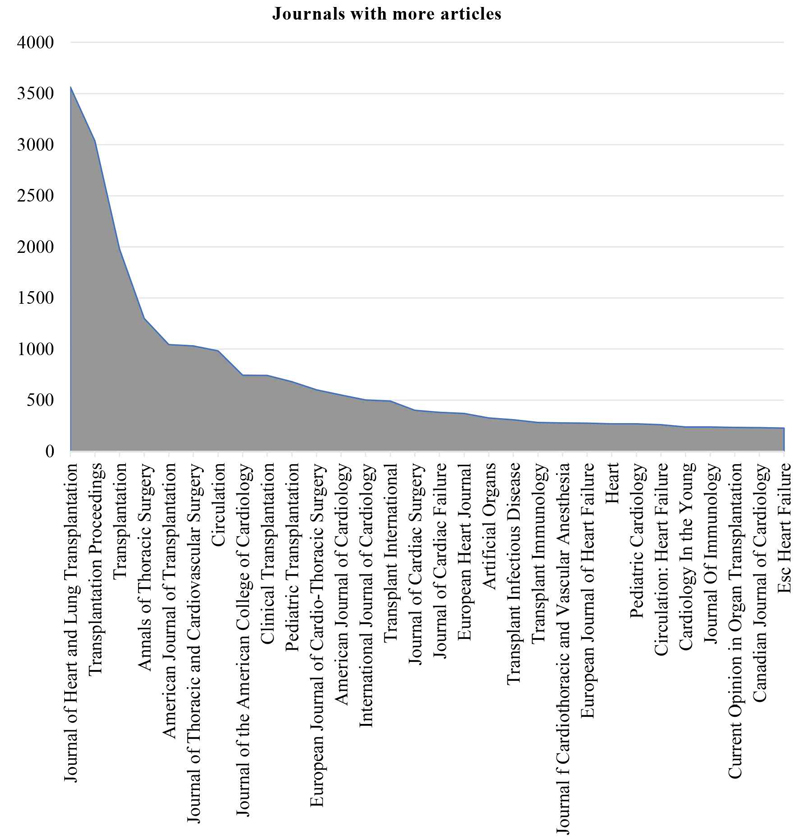
Graphical representation of Journals with more articles
6.3 Most Cited Sources
Citations are metrics that denote the frequency of articles cited by other articles and help to assess the popularity and rank the research within a specific field. The impact of a research journal or an article can be measured based on the quality index of citations received. Table 3. It shows the top 30 most productive sources with the highest citations. A total of 1311936 citations received for 3038 out of 3914 sources, and the listed top 30 sources are dominated, holding 65.67% of the total citations. An average of 431.84 citations was received for the productive journals of the heart transplantation literature. Among the list of sources, the dominant journal, Circulation, was ranked first with 142717 (10.88%) citations for 983 articles over 30 years and captured an average of 4757.23 citations per year. Followed by Journal of Heart and Lung Transplantation secured 2nd rank with 129600 (9.88%) citations for 3563 articles with an average of 4320 citations per year. Journal of the American College of Cardiology stands in 3rd position, holding 71243 (5.43%) of the overall citations. Transplantation, European Heart Journal, American Journal of Transplantation and New England Journal of Medicine seized the following positions, having a total of 217321 (16.58%) citations. Interestingly, the American Journal of Transplantation obtained 44411 citations (3.39%), an average of 1930.91 citations over 23 years.
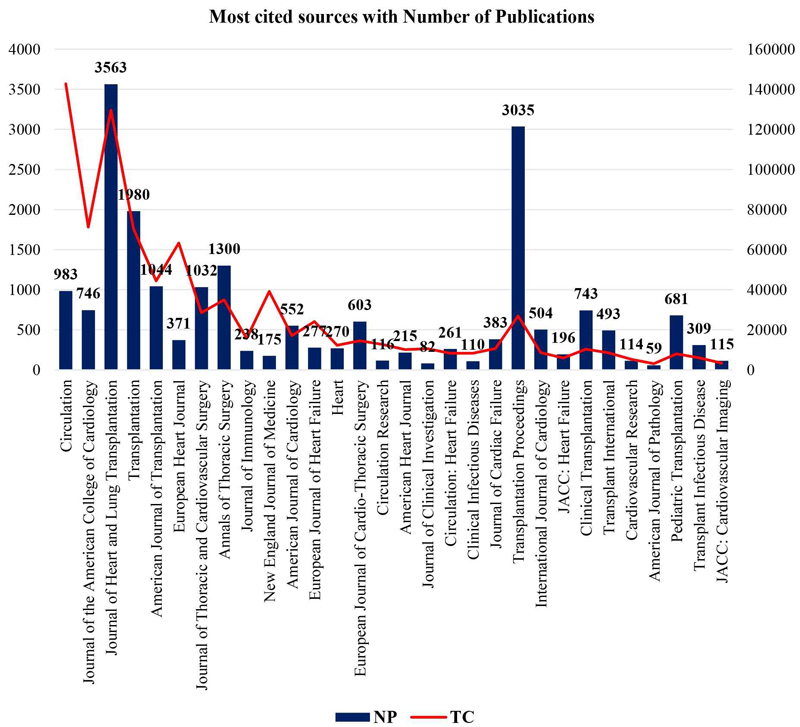
Most cited sources with the number of articles
Top 30 Most Cited Sources.
6.4 Source Impact (h-index, g-index, and m-index)
The impact of journals can be measured based on the number of journal citations over a specific period. There are several studies and tools to evaluate the effect of the most productive journals. The present study used h, g, and m-indices to examine the impact of the productive sources in heart transplantation. These indices are primarily author-level metrics and can be applied to measure the impact of journals, sources, and institutions. Jorge E. Hirsch recommended the H-index to measure the scientific productivity of a specific source based on the individual’s contribution to the area of research. The journal Circulation received 142717 citations for 983 articles, calculated a 181 h-index, a 351 g-index and a 5.66 m-index, and was listed first among the top 30 sources. The Journal of the American College of Cardiology obtains the second-highest metrics (h,g,m index) for 746 articles. Subsequently, the Journal of Heart and Lung Transplantation secured the 3rd position with 129600 citations, obtaining 132 h-index, 229 g-index, and 4.13 m-index. Followed by Transplantation (112, 160, & 3.50) and American Journal of Transplantation (101, 154, & 4.04) were calculated on received citations, respectively h, g, and m index. Interestingly, the European Heart Journal has a 251 g-index for 371 articles. The rest of the sources obtained less than a 100 h-index. The study observed that the top 30 journals proved the most impactful sources in heart transplantation.
Source impact (h, g, m index) - Top 30 sources.
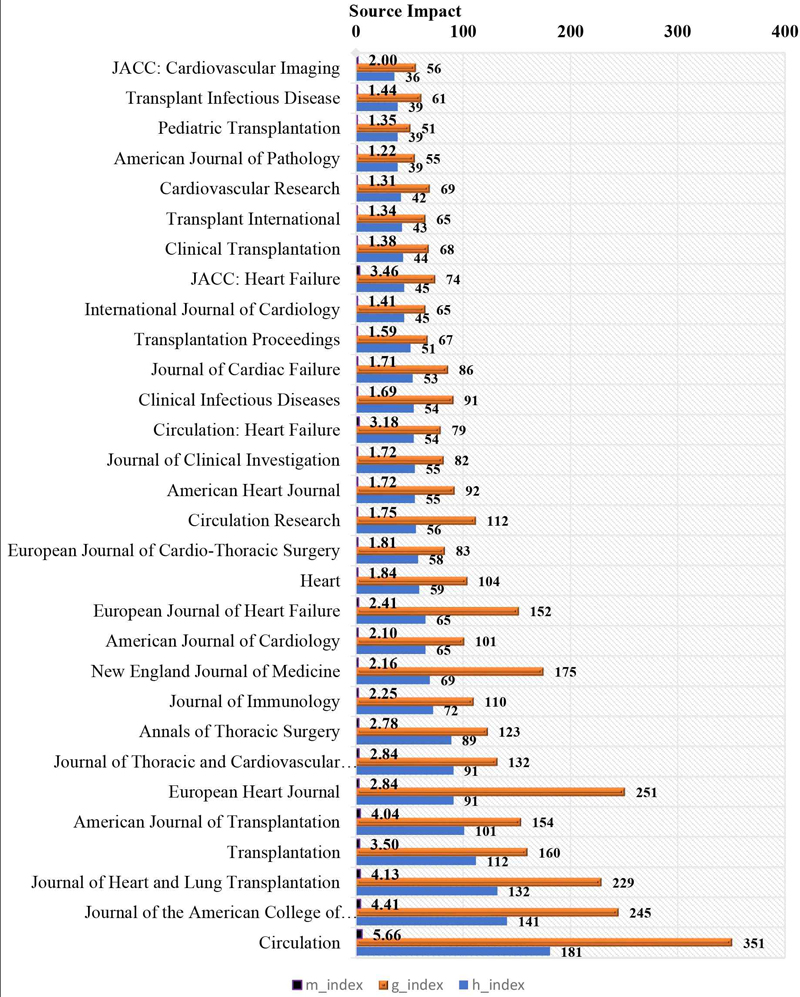
Source Impact (h, g, m index) of heart transplantation literature.
6.5 Bradford Distribution of Journals
Bradford’s law defines scientific journals measured and ranked according to their published articles in a specific area of research, which can be approximately categorised into three zones, each containing an equal number of articles in the total publications (Xie et al., 2024).
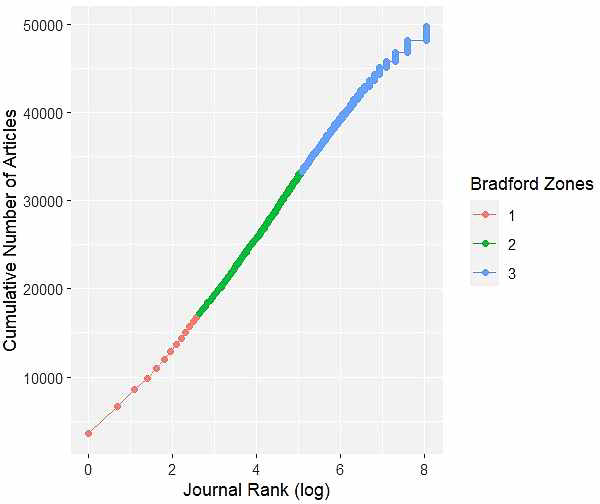
Bradford distribution of the journals
Table 5. Zone 1 covers 16766 (33.67%) of 49791 articles in 13 core journals, the most productive and the core zones. Zone 2 covers 16609 (33.36) articles in 148 journals, a prolific zone containing the same number but more journals than Zone 1. Zone 3 includes 16416 (32.97%) articles in 3754 journals, which is a low-productivity zone, and it has more journals than Zone 2, covering the same number of articles. These three zones cover one-third of the total published articles. The distribution of journals into Bradford’s zones is as follows: 1: n: n2, and the research output is scattered into 13:148:3754. Whereas the Bradford Multiplier mean is 18.37. Bradford’s Law on current data is divided into 13:13 (18.37):13 (18.37)2, and the percentage error calculated is 112.0833, which is technically wrong. Hence, the present data does not fit Bradford’s Law of Scattering.
Bradford distribution of journals
Hence, the Leimkuhler model (1967) is used to verify the current data with Bradford’s Law of Scattering.
3914 journals are divided into three zones (one-third of the total publications) in descending order of their productivity to test Bradford’s Law of Scattering. Bradford assumes the minimum zones, i.e. p = 3 (zones), hence the value of k=Bradford’s multiplier can be formulated using k (ey ym)1/p and Euler’s number (ey = 1.781), and ym is the number of articles in the most productive journals (3914).
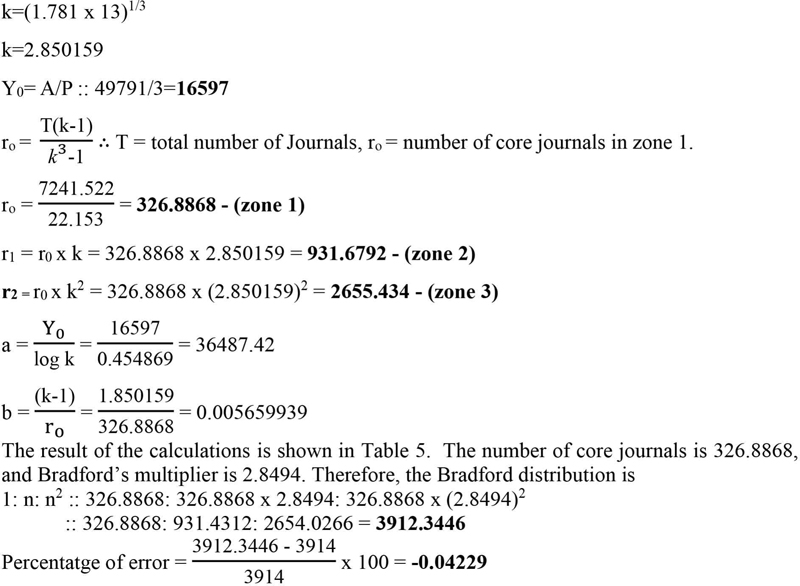
Bradford distribution of journals with the Leimkuhler model
The study presents a percentage of error in the distribution of -0.04229. Zone 1 or 38021 (76.36% of total publication) articles were scattered in 327 (8.35% of total journals), the most productive journals, considered the core zone. Zone 2 contains 7696 articles with 932 journals, which are regarded as fairly prolific journals, and zone 3 covers the remaining 4074 articles in 2655 journals, which are poorly productive.
7. Concluding Remarks
The scientific or productive journals measure the quality of the research area. Likewise, the core journals play a leading role in heart transplantation literature. The Journal of Heart and Lung Transplantation secured the top rank, producing 3563 (7.16% of total publications) articles and the journal, Circulation, was ranked first by holding 142717 (10.88%) citations with 181h, 351g, and 5.66 m-index frequencies for 983 articles over 30 years from 1994 to 2023. In addition, the top 30 most productive journals covered 43.91% of articles in 49791 and 65.67% of citations. The output of the Bradford distribution of journals is 1: n: n2, and the research scattered as 13:148:3754. However, it found that the current study does not fit Bradford’s Law since the percentage error is 112.0833. Alternatively, Leimkuhler’s mathematical formulation has been adopted to evaluate Bradford’s distribution. It scrutinised Bradford’s 1:n:n2 and found the error percentage is -0.04229. Hence, it declares that Bradford’s Law of Scattering is fit when it applies to the Leimkuhler model to validate the current data.
The present study helps researchers, doctors, and medical and clinical practitioners understand the research area’s growth and gain in-depth knowledge on heart transplantation and its branches. It is also used by academic librarians, teaching professionals, and LIS students to explore bibliometric studies in the future and make collection development decisions. Bradford’s Law of Scattering lists the most productive journals in a specific domain. This directly helps and guides in the selection of productive journals in the field of cardiology and heart transplantation.
References
-
Borgohain, D. J., Verma, M. K., Nazim, M., & Sarkar, M. (2021). Application of Bradford’s law of scattering and Leimkuhler model to information science literature. COLLNET Journal of Scientometrics and Information Management, 15(1), 197-212.
[https://doi.org/10.1080/09737766.2021.1943041]

-
Chrysakis, N., Magouliotis, D. E., Spiliopoulos, K., Athanasiou, T., Briasoulis, A., Triposkiadis, F., Skoularigis, J., & Xanthopoulos, A. (2024). Heart Transplantation. In Journal of Clinical Medicine, 13(2), 558.
[https://doi.org/10.3390/jcm13020558]
-
Du, Y., Duan, C., Yang, Y., Yuan, G., Zhou, Y., Zhu, X., Wei, N., & Hu, Y. (2022). Heart Transplantation: A Bibliometric Review From 1990-2021. In Current Problems in Cardiology, 47(8), 101176.
[https://doi.org/10.1016/j.cpcardiol.2022.101176]
-
Gosselin, L., Leguillon, R., Rollin, L., Lejeune, E., Darmoni, S. J., & Grosjean, J. (2023). Trends in computerised provider order entry: 20-year bibliometric overview. Frontiers in Digital Health, 5, 1217694.
[https://doi.org/10.3389/fdgth.2023.1217694]
-
Gupta, M. M., Dhawan, S. M., & Mamdapur, G. M (2022). Quantum Sensing Research: A Scientometric Assessment of Global Publications during 1991-2020. International Journal of Knowledge Content Development & Technology, 12(3), 31-49.
[https://doi.org/10.5865/IJKCT.2022.12.3.031]
-
Hassan, W., Zafar, M., & Eliene Duarte, A. (2024). The Research Progress of Current Problems in Cardiology. In Current Problems in Cardiology, 49(3), 102335.
[https://doi.org/10.1016/j.cpcardiol.2023.102335]
-
Jou, S., Mendez, S. R., Feinman, J., Mitrani, L. R., Fuster, V., Mangiola, M., Moazami, N., & Gidea, C. (2024). Heart transplantation: advances in expanding the donor pool and xenotransplantation. Nature Reviews Cardiology, 21(1), 25-36.
[https://doi.org/10.1038/S41569-023-00902-1]
-
Kumar, K. (2020). Applying Modified Bradford’s Law of Scattering to Identify Core Journals of Surgical Robotics. Second International Conference on Science & Technology Metrics, 2, 1-13.
[https://doi.org/10.6025/stm/2020/2/1-13]
- Lakshminarasimhappa M C., & Kemparaju T D. (2019). Impact of Bradford’s Law of Scattering on Drone Technology Publications CORE View metadata, citation, and similar papers at core.ac.UK provided by DigitalCommons@University of Nebraska. https://digitalcommons.unl.edu/libphilprac
-
Leimkuhler, F. F. (1967). The Bradford Distribution. Journal of Documentation, 23(3), 197-207.
[https://doi.org/10.1108/eb026430]
- Pritchard, A. (1969). Statistical Bibliography or Bibliometrics. Journal of Documentation, 24, 348-349.
-
Shang, X., Zhang, C., Wang, Y., Liu, M., Zhong, Y., & Dong, N. (2025). Heart transplantation: comparing the impact of modified heart preservation with conventional methods. Scientific Reports, 15(1), 2937.
[https://doi.org/10.1038/s41598-025-87091-8]
-
Tu, J. B., Liu, T., Li, J. F., Long, J., Wang, X., Liu, W. C., & Gao, X. H. (2024). Global research trends and hotspots in metabolomics of osteosarcoma: a decade-spanning bibliometric and visualized analysis. Frontiers in Immunology, 15, 1463078.
[https://doi.org/10.3389/fimmu.2024.1463078]
-
Vaidya, G. (2021). Heart transplantation in India. Indian Heart Journal, 73(4), 518-520.
[https://doi.org/10.1016/j.ihj.2021.06.013]
-
Xie, H., Wang, S., Niu, D., Yang, C., Bai, H., Lei, T., & Liu, H. (2024). A bibliometric analysis of the research landscape on vascular normalization in cancer. Heliyon, 10(7), e29199.
[https://doi.org/10.1016/j.heliyon.2024.e29199]
-
Zhang, X., Liu, W., & Du, Y. (2022). Immune response in heart transplantation: a bibliometric analysis. Journal of Thoracic Disease, 14(3), 635-645.
[https://doi.org/10.21037/jtd-22-200]
Mr. M C Lakshminarasimhappa is pursuing a PhD in the Department of Library and Information Science, Bangalore University, Bengaluru, India and working as an Assistant Librarian in the University College of Education, Bengaluru North University, Kolar. He was a Documentation Assistant, Documentation Consultant in the CLIx Project, collaborated by MIT London & Tata Institute of Social Science. He holds an MLISc degree from Bangalore University, Bengaluru (2010-12), PGDLAN from University of Hyderabad, Telangana (2015), and PGDLIM from Tata Institute of Social Sciences, Mumbai (2017). He also obtained KSET (2013) and UGCNET (2015, June 2019, December 2019). Lakshminarasimhappa has attended several workshops, seminars, conferences and presented papers. His areas of interest are Digital Libraries, Library Automation, User Studies, Scientometric and Bibliometric. He has published over 10 research papers in various disciplines.
Dr T D Kemparaju is an eminent LIS Professional, and he holds key administrative positions in the various universities of Karnataka State. He is an active member of the Karnataka State Higher Education Council, Karnataka. He served as a Professor and Chairman in the Department of Library and Information Science, Bangalore University, Bengaluru, for 12 years. He has over 3 decades of teaching and research experience in LIS. Prof. T D Kemparaju was the first Vice-Chancellor of Bengaluru North University, Kolar. He has held several administrative and statutory positions, such as Registrar, Bangalore University and Mangalore University; Director, Directorate of Correspondence & Distance Education, Bangalore University; Director, Planning, Monitoring Evaluation Board (PMEB), Bangalore University; Chairman of various Statutory bodies, and Board of Studies and Examinations. He has been recognised with several awards for his contribution, such as the IATLIS Motwale National Best Teacher Award in 2000; Dr Harishchandra-Sushila Chandra Best Librarian Award in 2006 by SALIS; Karnataka State Best Librarian Award by the Government of Karnataka; PSG Kumar Life Time Award in 2005 by ILA, etc.
Dr Ramesha is a Senior Professor in the Department of Library and Information Science, Bangalore University, Bangalore. He was elected as the President of the Indian Association of Teachers of Library and Information Science (IATLIS) for the years 2023 to 2026. He was awarded the ILA - A.G. Motiwale Award for Young LIS Professionals and the ILA - Dr C.D. Sharma Best Paper Award by the Indian Library Association (ILA). Dr Ramesh is one of the winners of the IFLA World Library and Information Science Congress participating grant under the first-time attendees of the IFLA conference from developing countries, and he was invited to participate and present a paper during the 81st IFLA World Library Congress held at Cape Town, South Africa. He is a member of the State Library Authority (SLA), the Dept of Public Libraries; a member of the State Level Book Selection Committee, Govt. Of Karnataka for the year 2023-2024; and members of the State Level Subject Expert Committee in Library and Information Science under NEP-2020. Chairman of various Statutory bodies, and Board of Studies and Examinations. He successfully guided 11 PhD candidates, and 6 candidates are pursuing their PhD. He has published more than 150 research papers both in National and International Journals and Conference Proceedings and participated in more than 60 National and International Conferences, Seminars, and workshops. He is a life member of many professional associations, including ILA, IASLIC, IATLIS, SALIS, MALA, TLA, KALA, etc.